
Picking the wrong development package can cost you months of rework and thousands in budget you did not plan to spend. Most business owners start by comparing prices, then realize the plan they chose was missing key features, had no room to scale, or required expensive add-ons from day one.
When you look at eCommerce website packages, the differences go well beyond cost. These are structured service plans that bundle design, development, and store setup into one defined scope. They make pricing predictable and reduce back-and-forth about what is or is not included. But not every package fits every business.
This guide breaks down how these packages work, what each tier covers, how pricing is structured, and what to check before signing with an eCommerce development agency. By the end, you will have a clear picture of which option matches your store’s size, product volume, and growth plans.
Quick Answer
eCommerce website packages are pre-scoped service plans that cover design, development, product setup, and store configuration at a fixed cost. They range from starter builds for new stores to enterprise packages for large catalogs, multi-region selling, and custom integrations. The right package depends on your product volume, feature needs, and plans for growth.
What Types of eCommerce Website Packages Are Available?
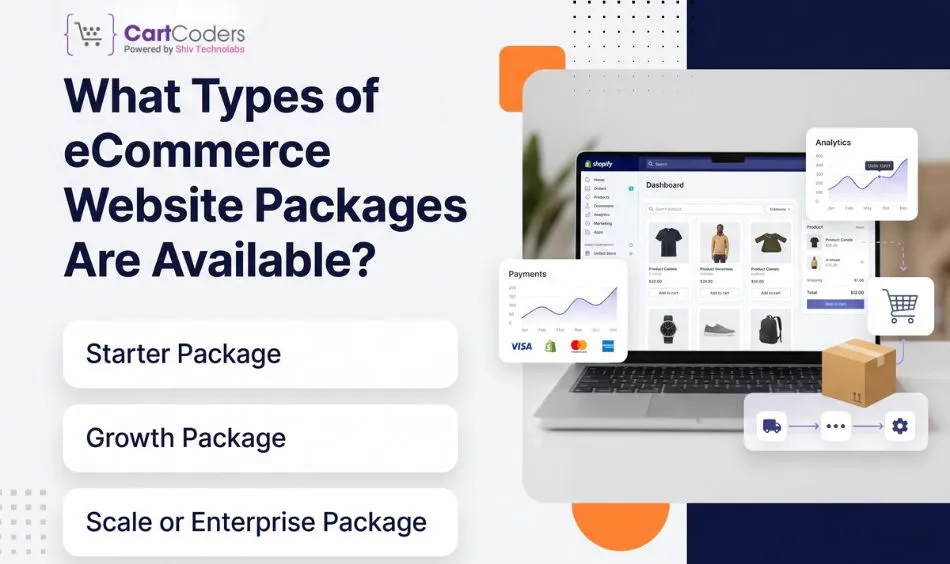
Most agencies and developers structure eCommerce website packages around three tiers: starter, growth, and enterprise. Each tier is built around a different stage of business and level of technical complexity. Understanding these types prevents you from choosing a package that limits your store later.
Starter Package
Starter packages are for businesses launching their first online store with a limited product range and straightforward operations. These packages move fast because they rely on existing themes and standard configurations, which keeps cost and timeline low.
- Who it fits: New eCommerce businesses, direct-to-consumer brands with under 50 products, and stores selling in a single market without complex shipping or tax requirements.
- What is typically included: Theme-based storefront setup, core page builds (home, collection, product, cart, checkout), payment gateway and shipping configuration, basic product upload, and navigation setup.
- What it usually does not include: Custom UI design, third-party app integrations, analytics setup, or post-launch support. These are often add-ons or part of higher tiers.
Starter eCommerce website development packages are the fastest path from zero to live. They work well when speed matters more than custom functionality.
Growth Package
Growth packages are for businesses that already sell online or have a clear plan to scale. These packages go beyond the basics and focus on conversion, automation, and integrations that keep a store running without manual effort.
- Who it fits: Brands with 50 to 500 products, businesses running paid ads or email marketing, and stores that need third-party apps for loyalty, reviews, or subscriptions.
- What is typically included: Custom theme sections, advanced product filters and navigation, conversion tracking and analytics, email platform and marketing tool integrations, and UX improvements based on buyer behavior.
- What it usually does not include: Custom-built functionality, B2B pricing rules, ERP connections, or multi-language setups. These push the project into enterprise territory.
This is the most chosen tier among growing eCommerce brands because it balances investment with measurable return.
Scale or Enterprise Package
Enterprise packages handle large, complex stores that need custom development, system integrations, and infrastructure built for scale. These are not off-the-shelf builds. They require discovery, planning, and phased delivery.
- Who it fits: Stores with over 500 products, B2B brands with customer-specific pricing, businesses selling across multiple countries, and any store that connects to an ERP, CRM, or third-party fulfillment system.
- What is typically included: Custom functionality and business logic, multi-currency and multi-language setup, ERP or CRM integration, performance architecture, and scalable product data structure.
- What it usually does not include: Post-launch managed services unless agreed separately. Enterprise packages focus on the build, not ongoing operation.
Enterprise eCommerce packages require a longer timeline and a larger budget, but they avoid the technical debt that comes from outgrowing a smaller package too quickly.
Also Read: Shopify Website Design Packages
What Should You Expect Inside an eCommerce Website Package?
Inclusions vary by agency and tier, but most eCommerce website packages cover a consistent core set of features. The difference between tiers is usually depth and customization, not whether a feature exists at all. Here is what you should expect in each area.
Storefront Design and User Experience
This covers how your store looks and how customers move through it. Starter packages apply an existing theme with brand colors and fonts. Growth and enterprise packages adjust layouts, build custom sections, and refine UX based on how your buyers shop.
- Mobile-first layout for all screen sizes
- Homepage, collection, and product page setup
- Navigation menus, search, and filters
- Brand identity application (colors, typography, logo placement)
Higher-tier packages go further by building sections that do not exist in a standard theme, such as interactive product builders, multi-step configurators, or advanced image galleries.
Checkout, Payments, and Order Flow
A working checkout is non-negotiable for any eCommerce store. Every package tier should include payment gateway connection, shipping rule setup, and order confirmation emails as a baseline.
- Payment gateway integration and testing
- Shipping zone and rate configuration
- Tax setup based on selling regions
- Cart, checkout flow, and abandoned cart trigger
Growth and enterprise packages add custom checkout logic, such as region-specific payment options, minimum order rules, or checkout fields tied to customer accounts.
Product Catalog and Inventory Management
How your products are structured affects everything from search rankings to customer experience. A good catalog setup makes managing products easier after launch.
- Product and variant structure
- Collection and category hierarchy
- Bulk or assisted product upload
- Inventory tracking and low-stock alerts
Enterprise packages handle complex catalogs with thousands of SKUs, custom metafields, and pricing rules that vary by customer segment or volume.
Analytics, Tracking, and Basic Technical SEO
You cannot improve what you cannot measure. Most eCommerce website development packages include basic tracking setup, but the depth varies by tier.
- Google Analytics 4 setup and event tracking
- Google Search Console and sitemap submission
- On-page SEO structure for product and collection pages
- Page speed baseline checks
Growth and enterprise packages add conversion event tracking, custom analytics dashboards, and structured data markup for rich search results.
How Much Do eCommerce Website Packages Cost?
eCommerce website package pricing depends on store complexity, design requirements, integrations, and the level of customization involved. The ranges below reflect current industry benchmarks and should be used as a starting point before requesting a detailed proposal from any agency.
One-time Project Packages
| Package Type | Best For | Pricing (USD) | Key Inclusions |
| Starter | New stores, small catalogs (up to 50 products) | $2,000 – $10,000 | Theme setup, core pages, payment & shipping config, basic product upload |
| Growth | Scaling brands, 50-500 products | $10,000 – $25,000 | Custom sections, advanced catalog, analytics, third-party app integrations |
| Scale / Enterprise | Large catalogs, B2B, multi-region | $25,000 – $55,000+ | Custom development, ERP/CRM integrations, multi-currency, performance optimization |
Monthly Ongoing Packages
Some businesses prefer monthly eCommerce development packages instead of a one-time build. These cover continuous improvements, ongoing support, and regular feature updates.
| Package Type | Monthly Pricing (USD) | Suitable For |
| Starter Monthly | $800 – $1,500 | Maintenance, minor updates, bug fixes |
| Advanced Monthly | $1,800+ | Continuous improvements, integrations, and ongoing optimization |
What Drives Price Differences Within the Same Tier?
Two stores choosing the same package tier can receive very different quotes. These factors explain the variation.
| Pricing Factor | Why It Affects Cost |
| Product volume and variants | Large catalogs need a structured data setup, bulk upload, and more QA time |
| Design customization | Custom UI design costs more than applying a theme with minor tweaks |
| Integrations | ERP, CRM, subscription tools, and shipping apps each add development scope |
| Multi-region setup | Multiple currencies, tax rules, languages, and shipping zones increase complexity |
| Custom logic | B2B pricing tiers, bundle rules, or approval workflows require bespoke development |
What Mistakes Do Businesses Make When Choosing eCommerce Packages?
Most errors in package selection happen before development even starts. These are the most common mistakes, and what they cost in practice.
- Choosing based on price alone: Low-cost packages often skip analytics, SEO structure, or scalable architecture. These gaps surface within 6 to 12 months and cost more to fix than if they had been included upfront. Always review the scope before price.
- Ignoring future product and market growth: A package built for 30 products will struggle at 300. Before selecting a tier, map out where your catalog, markets, and integrations will be in 18 months.
- Assuming all features are included: The packages list what is included, not what is excluded. Always ask specifically whether SEO setup, analytics, post-launch bug fixes, and content upload are part of the deliverable or billed separately.
- Skipping tracking and analytics setup: Without conversion tracking from day one, you have no data to make decisions. This is one of the most skipped items in basic eCommerce website packages and one of the most consequential.
- Not clarifying ownership and access: Some packages transfer code ownership only after full payment, or restrict admin access during development. Confirm access rights, code ownership, and hosting control before signing.
How CartCoders Structures eCommerce Packages For Real Business Needs?
CartCoders builds eCommerce website packages around what each business actually needs, not a fixed feature list. Before scoping any package, the team looks at product volume, integration requirements, growth plans, and selling regions.
The result is a package with a clear scope, defined deliverables, and no hidden add-ons at the end of the project. We build eCommerce stores set up for fast launches and future growth, with architecture that does not require a full rebuild when the business scales.
With experience across Shopify, Shopify Plus, B2B commerce, and ERP integrations, CartCoders handles everything from a basic starter store to a complex multi-region eCommerce operation. Contact CartCoders today and get more info!
Conclusion
eCommerce website packages give businesses a structured way to build and launch online stores with clear scope, predictable pricing, and defined delivery. The right package depends on more than budget. Product volume, integrations, multi-region requirements, and growth plans all play a role in which tier makes sense.
Reviewing inclusions carefully, asking about what is not covered, and planning for where your store will be in 12 to 18 months are all steps that save significant time and cost later. Whether you are launching a first store or upgrading an existing one, understanding how packages are structured puts you in a better position to make a confident decision.
FAQs
eCommerce website packages are pre-scoped service plans that bundle design, development, and store setup at a defined price. They give businesses a predictable cost and a clear list of deliverables instead of custom-quoting every feature.
Starter packages typically run from $2,000 to $10,000. Growth packages range from $10,000 to $25,000. Enterprise packages start at $25,000 and can go higher depending on integrations, custom logic, and catalog complexity.
Most packages include storefront design, core page setup, payment and shipping configuration, basic product upload, and analytics tracking. Higher tiers add integrations, custom functionality, and multi-region setup.
Yes. Most agencies allow businesses to start with a starter package and add features later. However, skipping foundational elements early can increase costs when you need to add them after launch.
B2B stores typically need growth or enterprise packages. These cover customer-specific pricing, account login, approval-based checkout, and system integrations that standard packages do not include.
Most packages include basic technical SEO, such as page structure, sitemap, and tracking setup. Advanced keyword targeting, content optimization, and off-page SEO are usually separate services.
Starter packages typically take 2 to 6 weeks. Growth packages take 6 to 12 weeks. Enterprise packages can take 3 to 6 months, depending on custom development scope and integration complexity.
A package follows a fixed scope with predictable pricing and timeline. Custom development starts from discovery and builds based on specific requirements, offering more flexibility at higher cost and longer delivery time.


