With reduced software delivery timelines and increased competition, more companies are resorting to staff augmentation to build engineering capacity more quickly. A 2024 Deloitte report indicates that more than 78% of technology leaders are turning to external or augmented developers to accelerate product delivery and address acute skills shortages. Although this model is flexible and fast, it also introduces new management issues, particularly regarding visibility, control, and accountability.
These difficulties usually lead to micromanagement. Founders are concerned with delivery risk, CTOs with code quality, and project managers with coordination. In the absence of coherent structures, these issues manifest as excessive control, too many status reviews, and excessive task-level control, which slow teams down.
Add Shopify Developers Without Long Term Hiring
CartCoders provides ready developers for active projects.
Here’s a guide for founders, CTOs, engineering managers, and project leads who wish to manage augmented developers without micromanaging. It emphasizes realistic execution structures, trust-based approaches, and result-oriented management practices that work in real delivery environments.
What Does Managing Augmented Developers Really Mean?
The control of augmented developers is not related to supervising individual work or observing daily work. It is concerning the absorption of external expertise into your delivery environment without sacrificing speed, responsibility, or quality.
The idea is to bring augmented developers who will work as an extension of your current team, not as isolated freelancers. They are expected to work on your procedures, align with your objectives, and deliver results as internal engineers.
Integration
Successful staff augmentation management is more about integration than supervision. The visibility goes up automatically once the developers are integrated into your processes, tools, and communication channels. Managers will no longer have to pursue updates, as progress will be visible in the design.
Ownership at the Outcome Level
Managing augmented developers requires assigning ownership at the outcome level, not at the task level. You determine what needs to be accomplished, and developers determine how that will be performed. Such independence is paramount to rapidity and creativity.
Shared Accountability Model
Under the healthy model, internal leaders will be responsible for direction and prioritization of products, and augmented developers will be responsible for quality of execution and delivery promise. Clarity ensures that it is not confused or interfered with.
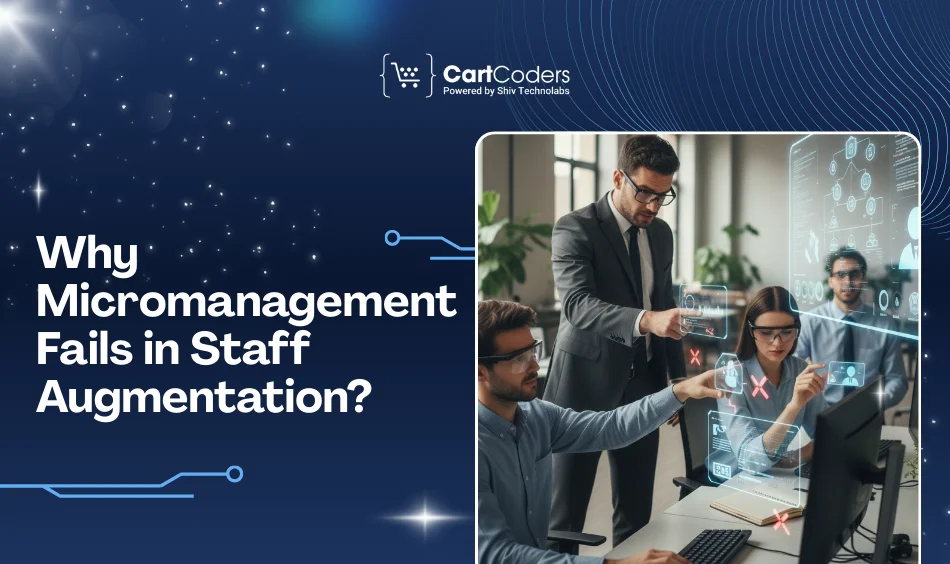
Why Micromanagement Fails in Staff Augmentation?
With augmented setups, micromanagement may seem like risk control, though, in this case, it always has the opposite effect.
Loss of Developer Ownership
When developers need to consult before making each decision, there is no ownership. By engaging in augmented development developers are not thinking proactively, but instead waiting to be instructed, which is the opposite of the idea of attracting experienced talent.
Slower Delivery Due to Constant Approvals
Each additional approval level introduces latency. Activities that may occur as parallel are transformed into sequences. This slows down the delivery, adds bottlenecks and demoralizes teams.
Reduced Trust and Communication Gaps
The presence of micromanagement depicts distrust. This eventually establishes defensive communication styles, a lack of transparency, and decreased engagement. Third-party developers are becoming more challenging to manage.
Common Signs You Are Micromanaging Augmented Developers
Status chasing on daily basis rather than reviewing based on milestones.
Instructions are based on tasks rather than on the outcomes.
Time tracking rather than success and quality tracking.
Early identification of these trends enables leaders to put things back on track before productivity declines.
Set Clear Expectations Before Starting to Manage Augmented Developers
Effective expectation-setting at the outset will eliminate most micromanagement problems going forward. Transparency brings trust on either side.
Define Role, Scope and Ownership
Well-defined what the augmented developer has possession of, what decisions can be made without approval, and what approvals are needed. Ambiguity requires managers to step into the picture many times over.
Boundaries of feature ownership.
Decision-making authority
Escalation paths
Align on Success Metrics
Before work starts, define the means of success measurement. Do not have vague goals like “move fast” or “improve quality.”
Delivery timelines
Quality benchmarks
Performance expectations
Plan Shopify Resource Augmentation With Specialists
CartCoders helps choose the right developer mix.
Create Communication Dynamics
Determine the frequency of updates and format. They need to be updated daily. The reviews can be done on a weekly or sprint basis.
Clarify Availability and Working Hours
Managing remote developers is easier when availability expectations are clear. Specify overlap time, response time, and escalation time.
Share Technical Standards Early
Upfront architecture guidelines, standards of coding and review. This saves on the rework and develops confidence in doing.
Discuss Decision-Making Structures
Indicate to developers when they should go on their own or to get aligned. This will avoid superfluous back and for.
Ensure Tool and Access Readiness
Late arrival causes wastage of time and frustration. On day one, repositories, project boards, documentation, and credentials should be available.
Set Expectations Around Feedback
Ascertain the manner in which feedback will be disseminated, the frequency of reviews, and how problems will be addressed positively.
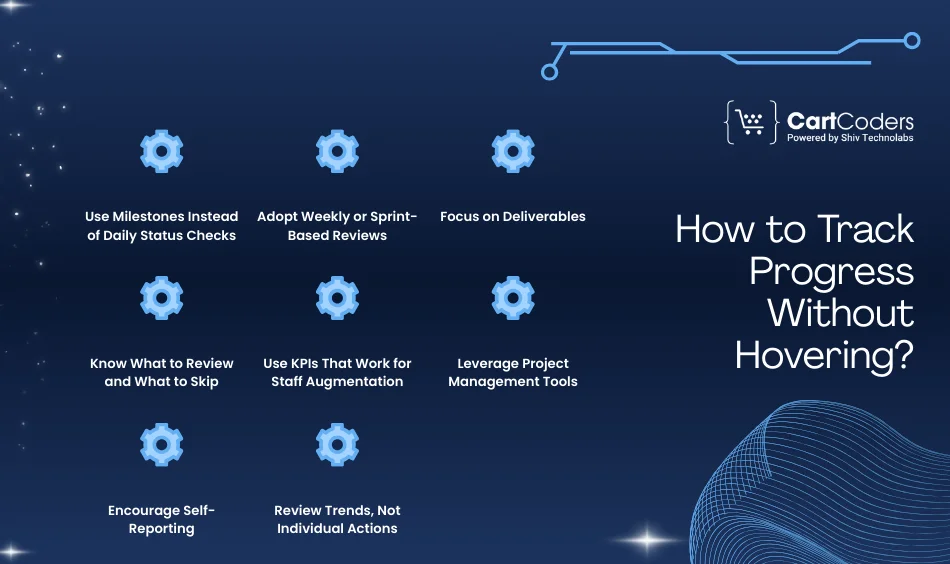
How to Track Progress Without Hovering?
Follow-through is not always about monitoring. It needs the appropriate signals and grades.
Use Milestones Instead of Daily Status Checks
Milestones are natural checkpoints that indicate progress without disruption. They also make developers think about outcomes.
Adopt Weekly or Sprint-Based Reviews
The feedback loops generated during Sprint reviews are predictable. They substitute regular check-ins with formal alignment meetings.
Focus on Deliverables
Check what was shipped and not the number of hours logged. Production is greater than hard work.
Know What to Review and What to Skip
Check architecture, critical points and integration points. Omit minor details of implementation unless there is a problem.
Use KPIs That Work for Staff Augmentation
Delivery predictability
Such code quality indicators as defect rates.
Issue resolution speed
Leverage Project Management Tools
The tools available today offer transparency without requiring manual reporting. Status emails will be substituted with dashboards.
Encourage Self-Reporting
Ask developers to highlight blockers. This has a top-down rather than a bottom-up shift of responsibility.
Review Trends, Not Individual Actions
See trends with time instead of responding to single problems. This makes management strategic rather than reactive.
Communication That Prevents Micromanagement
Effective communication systems do not require continuous monitoring.
Concentrate the Communication Channels.
Discontinuous communication leads to confusion. Have a single source of truth for updates, decisions, and documentation.
Establish Specific Escalation guidelines.
Developers must understand when and how to raise bugs without fear. This prevents silent delays.
Foster Open Problems Discussions.
Provide room to the developers to offer solutions as opposed to giving orders.
Avoid Overloading Developers with Messages
There are too many distracting messages. Discuss in batches and respect deep work time.
Common Mistakes While Managing Augmented Developers
Even seasoned leaders fall into traps they could avoid.
Treating Augmented Developers Like Freelancers: Augmented developers must be team players rather than a side resource.
Providing Unspecific or Changeable Priorities: Priorities should not be changed out of context as this results in rework and frustration.
Managing Individuals Instead of Outcomes: This tends to make them focus on people rather than results, which is subjective and biased.
Ignoring Onboarding for Short-Term Roles: Even brief interactions require onboarding. Omitting this step makes it risky.
Best Practices for Long-Term Staff Augmentation Success
Staff augmentation on a long-term basis works when it is handled as a strategic alliance instead of a stopgap measure. Companies that consistently benefit from augmented teams are structure-focused, alignment-focused, and result-focused rather than focused on constant supervision. These best practices help ensure that leaders create stable, high-performing augmented teams that deliver long-term results.
Start With a Structured Trial Period
A trial period will enable both parties to demonstrate their suitability before committing to it in the long term. It minimizes risk and creates fair expectations at the beginning of the engagement.
The trial period aids in assessing:
Administration skills and problem-solving strategy.
The clarity and responsiveness of communication.
Product awareness and priorities.
Self-control of working limits.
An efficiently conducted trial will avoid future performance problems and there will be no micromanagement of future performance.
Invest in Proper Onboarding, Even for External Developers
Onboarding is not provided to the augmented developers, which contributes to confusion, dependency, and delays. The only way to achieve long-term success is to make onboarding compulsory rather than optional.
A successful onboarding process must incorporate:
Product overview and business context
Architecture walkthrough and codebase access
Development workflows and release processes
Quality standards and review expectations
Clear points of contact
Define Outcomes, Not Just Tasks
Staff augmentation is well-suited in the long term when developers are expected to be responsible not only on a task-by-task basis but also for the results. This is a move towards impact instead of activity.
Outcome-based management involves:
Specific feature goals rather than ticket lists.
Milestones of delivery rather than daily check-ins.
Quality standards versus time monitoring.
Developers are more likely to make better technical decisions and need less supervision as developers know what they want.
Review Processes Before Questioning Performance
Delays in delivery or decline in quality should not be met with the initial reaction of blaming individual performance. The problem is in the process in most instances.
First areas of processes to be reviewed:
Not defined requirements or shifting priorities.
Approval/review bottlenecks.
Ineffective documentation or lack of context.
Congested communication channels.
The performance problems are frequently solved by improving the workflow, without developers or additional controls.
Maintain Consistent Communication Structures
It is a consistency rather than frequency. Successful performance over an extended period of time relies on predictable communication patterns that facilitate alignment without failure.
Best practices include:
Sprint or weekly review.
Communication channels are centralized.
Visible escalation routes of blockers.
Proven and registered decisions and updates.
This is a non-pressurizing, non-distracting structure that is easy to see.
Treat Augmented Developers as Team Members, Not Outsiders
Augmented developers would work best when they feel part of it. This makes them treat them as temporary or secondary resources, which lowers inquiry and ownership.
Inclusion drives:
Higher accountability
Better collaboration
Greater dedication to delivery.
Reduced dropout during prolonged fights.
Inclusion has nothing to do with the lowering of standards. It entails getting the expectations and appreciating contributions in tune.
Continuously Evaluate Fit and Scale Thoughtfully
Periodic review, not continuous observation, is needed to achieve long-term success. Reexamine the engagement periodically to assess what is going well and what needs adjustment.
Evaluation should focus on:
Delivery consistency
Effectiveness of communication.
Competence fit with changing requirements.
Scalability of the existing system.
In case requirements vary, redistribute roles, the number of people in a team, or the engagement model rather than trying to force a mismatched structure to operate.
Build Trust Through Transparency and Accountability
Sustainable staff augmentation is based on trust. Openness in objectives, communication and feedback creates trust on both parties.
Trust grows when:
Expectations are recorded and exposed.
Feedback is constructive and straightforward.
Not dictated, but explained decisions.
There is shared responsibility rather than one-sided responsibility.
Trustful cultures naturally deemphasize the feeling to micromanage.
When Management Issues Signal a Bigger Problem?
Micromanagement is sometimes a symptom, not the cause.
Skill Mismatch: If developers lack the necessary skills, no oversight will ensure delivery.
Weak Onboarding: Ineffective onboarding brings about confusion and dependency.
Weak Communication Framework: The managers who do not have clear channels of doing their work compensate by hovering.
Wrong Engagement Model: Not all jobs can be augmented. In some cases it takes a different model.
When to Adjust the Team or the Model: When problems continue with explicit expectations and organization, re-examine what makes up the team or how it is engaged.
Conclusion
Successful management of augmented developers is not about controlling. It focuses on outcome-based leadership, structure, and trust. Micromanagement is redundant when expectations are clear, there is deliberate communication, and progress is measured at the appropriate level.
Those companies that successfully balance themselves move quickly, deliver higher-quality performance, and maintain stronger partnerships. CartCoders is the best eCommerce web development agency, equipped with a team of experts and staff augmentation teams that facilitate effective management and deliver experienced developers, structured engagement models, and focused, delivery-oriented collaboration.
Whether you have a project that needs to grow and you do not want to lose control or quality, CartCoders provides established best practices for staff augmentation specifically suited for real-world delivery.
Frequently Asked Questions (FAQs)
What are the ways of managing augmented developers?
Successful management is result-oriented, with clear expectations, well-organized communication, and defined milestones. Having developers as part of your processes and letting them own them means you do not have to micromanage.
How do you avoid micromanaging remote developers?
To prevent micromanagement, establish clear goals, use transparent project tools, review milestones against daily activity, and trust the developers to execute the project within the established boundaries.
Is staff augmentation hard to manage?
Staff augmentation is not difficult to manage when expectations are clear, communication is strong, and accountability is established. The majority of the problems are caused by poor onboarding and unclear ownership, rather than the model.
How do you track augmented developers’ work?
Measure progress using milestones, sprint reviews, delivery metrics, and quality indicators, not time logs. Pay attention to results and patterns rather than to what people do.
What is the best management style for augmented teams?
The most appropriate style is outcome-based leadership and execution grounded in trust. The best results are achieved with a clear structure, little interference, and consistent feedback.
As the CTO at Shiv Technolabs & CartCoders, I am liable for instigating, planning, integrating, and implementing the organization's strategic orientation.
I gather the most significant tech news in addition to sharing the information I gained while serving as the CTO of Shiv Technolabs, a renowned web and mobile app development company. I am pleased to answer questions as a most valuable expert for Shiv Technolabs Private Limited and to share my experience. I offer a keen insider's perspective on technical advancements.
 eCommerce
Solution
eCommerce
Solution










 INDIA
INDIA


 USA
USA
 CANADA
 AUSTRALIA