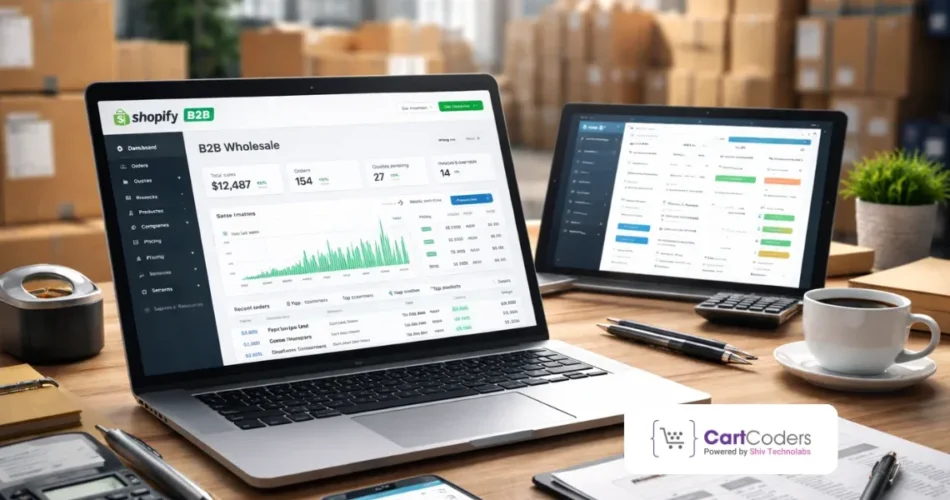

Wholesale business is experiencing a structural transformation. 70% of B2B buyers now prefer digital self-serve purchasing over traditional rep-driven ordering, even for high-value transactions. This implies that wholesale brands can no longer use email orders, fixed-price listings, or handwritten invoicing. They require organized online systems.
Get Expert Shopify Guidance Before Scaling Your Store
CartCoders plans improvements based on real store data.


Nevertheless, a wholesale establishment with Shopify Plus is not only about facilitating company accounts. It needs accurate pricing logic, account structures, credit policies, tax regulations, ERP system integration, and workflow automation. This is where a shopify b2b consultant is needed.
The issue with wholesale growth is that without an effective Shopify B2B setup and a planned Shopify B2B implementation, growth becomes a disaster rather than a scalable approach.
What Makes Shopify B2B Setup More Complex Than It Appears?
A lot of brands are searching for how to set up B2B on Shopify Plus, think of it as a feature switch. In fact, Shopify Plus offers the structure, but success depends on how it is set up. An appropriate shopify b2b configuration entails:
- Company profile architecture.
- Multiple buyers per account
- Account-level permissions
- Custom price lists
- Payment term enforcement
- Location-based catalogs
- Tax exemptions
- ERP sync logic
In case such layers are not lined, brands will experience:
- Margin leakage
- Order approval bottlenecks
- Reporting inconsistencies
- Distributor dissatisfaction
That is why it is important to have professional Shopify B2B development services.
Core Areas Where a Shopify B2B Consultant Adds Strategic Value
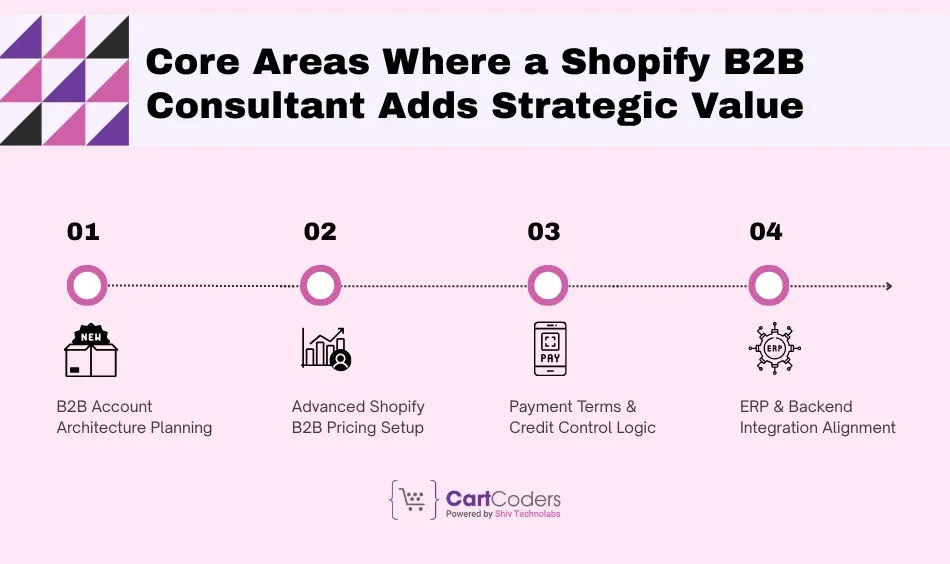
Wholesale must be planned out before development. A Shopify B2B consultant works at both the business and technical levels.
1. B2B Account Architecture Planning
Wholesale customers are companies, not individuals.
Each company may require:
- Multiple buyers
- Purchase approval workflows
- Spending limits
- Department-level permissions
Without a structured hierarchy, admin teams manually intervene in orders. That increases overhead by 15%–25%. A consultant builds account systems aligned with real-world distribution structures.
2. Advanced Shopify B2B Pricing Setup
Pricing architecture determines profitability.
Wholesale pricing may include:
- Volume-based discounts
- Contract pricing
- Region-based pricing
- Product-specific overrides
- Promotional layering
A poorly executed Shopify B2B pricing setup can reduce gross margin by 3%–10% annually due to incorrect logic. Consultants prevent pricing conflicts and automate rule governance.
3. Payment Terms & Credit Control Logic
Wholesale rarely runs on immediate payment.
Shopify Plus allows:
- Net terms
- Manual approvals
- Credit limits
- Partial payments
But these require correct configuration. If credit limits are not enforced, risk exposure increases. If approvals are misconfigured, order flow slows. A consultant ensures automated governance without slowing buyers.
4. ERP & Backend Integration Alignment
Wholesale systems must integrate with:
- ERP platforms
- Inventory systems
- Accounting software
- CRM systems
Improper integration causes:
- Inventory mismatches
- Duplicate invoices
- Reporting errors
A structured Shopify B2B implementation aligns front-end commerce with backend operations.
How Professional Shopify B2B Development Services Drive ROI
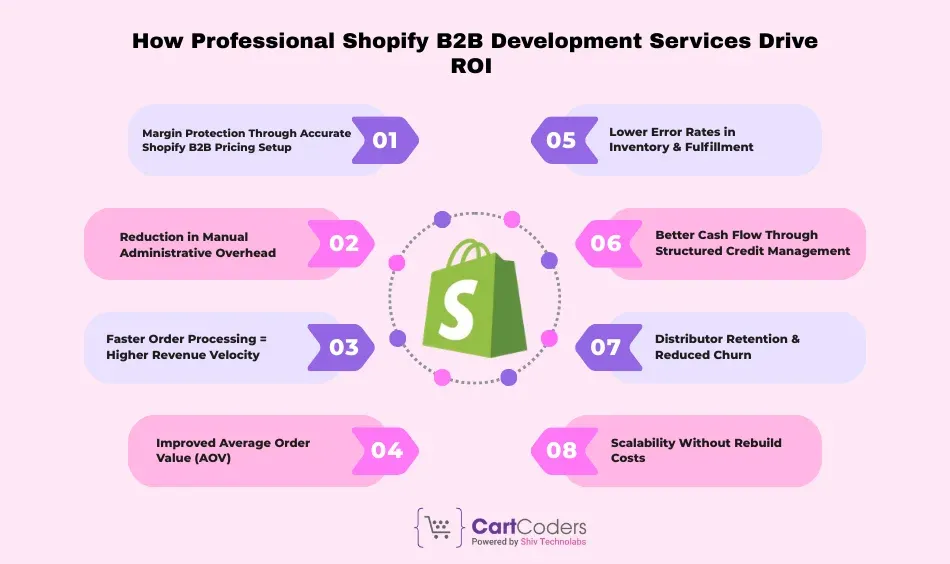
Traffic is not a driver of wholesale ROI. Margins protection, operational efficiency, and order velocity drive it. Custom-developed services from a professional Shopify B2B store can turn Shopify into a store with a built-in wholesale revenue engine. When done properly, B2B architecture enhances profitability through pricing, automation, fulfillment, and customer retention.
Here’s how.
1. Margin Protection Through Accurate Shopify B2B Pricing Setup
In wholesale, even a 2% pricing error at scale can translate into thousands or millions in lost revenue annually. A structured shopify b2b pricing setup ensures:
- Tiered pricing works correctly
- Volume breaks trigger properly
- Contract pricing overrides are applied accurately
- Regional pricing does not conflict
- Promotions do not stack incorrectly
Without governance, pricing conflicts can quietly reduce gross margin by 5%–10%.
Professional consultants design pricing logic that protects profit not just discounts products.
2. Reduction in Manual Administrative Overhead
Manual processes are the silent killer of wholesale scalability. Common inefficiencies include:
- Manual order approvals
- Invoice corrections
- Pricing adjustments
- Credit limit overrides
- Order modification emails
A properly executed shopify b2b implementation automates:
- Approval workflows
- Credit validation
- Customer segmentation
- Bulk ordering processes
This reduces the admin workload by 20%–40%, freeing internal teams to focus on growth rather than firefighting.
Plan Shopify Growth With Skilled Consultant Support
CartCoders reviews your store before suggesting changes.
3. Faster Order Processing = Higher Revenue Velocity
Wholesale buyers value speed. Delayed approvals or incorrect pricing frustrate distributors and reduce reorder frequency. Professional B2B setup enables:
- Instant price list recognition
- Automated checkout validation
- Bulk add-to-cart functionality
- Pre-approved payment terms
When friction decreases, reorder cycles shorten. Even a 10% improvement in order turnaround time can significantly increase lifetime value (LTV). Speed = revenue acceleration.
4. Improved Average Order Value (AOV)
Wholesale buyers respond strongly to structured quantity breaks and incentive pricing.
Consultants design:
- Volume discount ladders
- MOQ thresholds
- Bundled pricing incentives
- Cross-sell logic for B2B catalogs
When structured correctly, AOV increases by 10%–20% through predictable pricing psychology, not guesswork.
5. Lower Error Rates in Inventory & Fulfillment
Wholesale order sizes amplify mistakes.
A poorly integrated backend leads to:
- Overselling
- Duplicate shipments
- Incorrect stock visibility
- Delayed replenishment
Professional shopify b2b development services align:
- Inventory sync logic
- Multi-location stock mapping
- ERP integration
- Warehouse routing rules
6. Better Cash Flow Through Structured Credit Management
Wholesale frequently involves Net-15, Net-30, or Net-60 terms. A consultant configures:
- Credit limits per company
- Automated term enforcement
- Order holds when limits exceed
- Payment reminders
Without structured credit governance, brands risk:
- Uncontrolled exposure
- Delayed receivables
- Cash flow instability
7. Distributor Retention & Reduced Churn
Wholesale loyalty depends on ease.
Buyers stay when:
- Pricing is transparent
- Ordering is frictionless
- Reordering is fast
- Account dashboards are clear
8. Scalability Without Rebuild Costs
One of the biggest ROI drivers is avoiding rebuilds.
Brands that launch wholesale stores without expert planning often face:
- Pricing logic breakdowns
- Account permission issues
- ERP sync failures
- Performance bottlenecks
Hiring a shopify b2b consultant upfront protects long-term ROI by preventing architectural debt.
Real Cost of Shopify B2B Implementation
Cost should not be viewed as a development expense alone. It includes:
- Setup
- Automation
- Integration
- Performance optimization
- Future scalability
Let’s break this down clearly.
1. Basic Shopify B2B Setup (Small Wholesale Operations)
Best for:
- 10–40 wholesale customers
- Simple tiered pricing
- No heavy ERP integrations
Includes:
- Company accounts
- Basic price lists
- Tax rules
- Manual payment terms
Estimated Investment:
$4,000- $8,000
This works for early-stage brands but does not scale well.
2. Structured Shopify B2B Implementation (Growing Brands)
Best for:
- 50–250 wholesale accounts
- Region-based pricing
- Automated workflows
- Basic ERP sync
Includes:
- Advanced pricing setup
- Segmented catalogs
- Credit term configuration
- Workflow automation
Estimated Investment: $8,000 – $18,000
3. Enterprise Shopify B2B Architecture (High-Volume Wholesale)
Best for:
- 250+ accounts
- Multi-region distributors
- Contract-based pricing
- Complex ERP integration
Includes:
- Custom automation
- Bulk order UI optimization
- Multi-tier pricing logic
- Performance tuning
- Advanced reporting
Estimated Investment: $18,000 – $40,000+
Cost Comparison
| Level | Cost Range (USD) | Ideal For | Risk Without Expert |
| Basic Setup | $4,000 – $8,000 | Small wholesale | Moderate |
| Structured Implementation | $8,000 – $18,000 | Growing brands | High |
| Enterprise Architecture | $18,000 – $40,000+ | Large wholesale networks | Very High |
When Should You Hire a Dedicated Shopify Consultant?
You should consider hiring a specialist when:
- Wholesale revenue exceeds 25% of total sales
- Manual processing exceeds 10–15 hours per week
- Multiple pricing tiers exist
- Distributors operate across regions
- ERP errors are increasing
The decision of having a dedicated Shopify consultant with expertise will mean long-term stability.
Conclusion
The Shopify Plus subscription is insufficient for wholesale expansion. It requires engineering design, rigorous pricing, credit management, and integration congruence in the background. With a professional Shopify B2B consultant, you will ensure your wholesale business is done at scale, fully automated, and margin-secured on the first day.Our team of Shopify consultants at CartCoders specializes in B2B commerce architecture of wholesale brands. We develop systems capable of scaling at all levels, starting from strategy to implementation.
Frequently Asked Questions
Yes, Shopify Plus has features, but a Shopify B2B consultant has to ensure that pricing logic, account structures, and integrations are set up to enable wholesale operations to scale without margin or workflow issues.
Shopify B2B implementation is expected to be in the $4,000 to $40,000 range, depending on pricing complexity, account structure, ERP integration, and automation needs.
Yes, Shopify Plus offers tiered pricing, contract rates, volume discounts, and payment terms; however, it requires an accurate Shopify B2B pricing implementation to prevent conflicts and margin leakage.
Such pitfalls as pricing errors, system synchronization issues, manual administrative overload, performance bottlenecks, and expensive rebuilds within 12-24 months are typical.
Basic setups take 2–4 weeks. The projects associated with advanced development services for Shopify B2B, including automation and integrations, typically take 6-12 weeks, including testing and deployment.


