For B2B companies, Shopify becomes more complex when wholesale pricing, customer-specific catalogs, account permissions, and integrations come into play. What begins as a speedy storefront soon becomes a system that must support negotiated pricing, bulk orders, ERP sync, approvals and stable reorders all without breaking checkout.
Recent data indicate the B2B eCommerce market is expected to grow 56%, outpacing B2C growth as digital adoption accelerates and more manufacturers, distributors, and wholesalers move their operations online.
This creates a clean decision point for complex B2B processes and limited internal bandwidth. There are numerous cases where teams cannot decide when to outsource Shopify development until late schedules and failed pricing strategies exacerbate the problem.
Why B2B Shopify Breaks With “general Shopify dev?”
Shopify is well-suited to standard DTC use cases. B2B is different. Pricing isn’t public. Products are not visible to everyone. Logic ordering is based on contracts, territories and credit terms. Shopify developers often focus on themes, apps, and UI rather than enforcing business rules across pricing, catalogs, and accounts.
When B2B logic is layered onto a DTC-first build without proper architecture, issues compound fast. Minor errors not only lead to bugs but also revenue leakage, customer confusion and operational risk. This is why B2B Shopify builds often fail unless managed by teams familiar with the realities of B2B eCommerce.
Pricing logic isn’t “just a discount.”
Wholesale pricing is commonly customer-, volume, or contract-dependent. Treating it as a coupon creates inconsistencies and reduces margins.
Customer accounts behave differently
B2B requires roles, permissions and approval flows, not easy logins.
Apps collide under B2B load
Several apps for pricing, catalogs and checkout often clash in the actual B2B application.
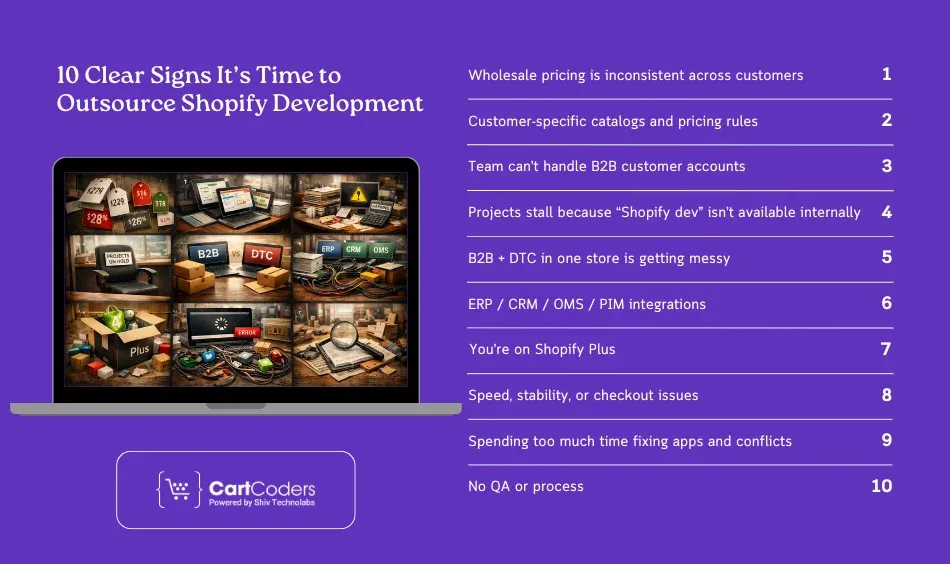
10 Clear Signs It’s Time to Outsource Shopify Development
At some point, internal fixes stop working. These are the real signals B2B leaders see before bringing in external help:
1. Wholesale pricing is inconsistent across customers
When the customer experiences different prices across sessions, products, or checkout points, you have a structural issue. This normally occurs where discounts, scripts, apps and manual overrides pile up uncontrollably.
Unpredictable wholesale prices cause conflict, erode trust and reduce margins. This is one of the most clear indicators that you need a Shopify development partner who understands pricing architecture.
2. Customer-specific catalogs and pricing rules
B2B buyers must only be presented with items they are cleared to purchase at negotiated prices. When your team is trying to address catalog visibility, tag logic, or price lists without disrupting another part of the build, the build has moved beyond ad hoc fixes. At this point, outsourcing Shopify development is more prudent than patching the logic.
3. Team can’t handle B2B customer accounts
B2B accounts entail buyers, approvers, purchasing functions and multiple ship-to addresses. When internal developers use this as standard customer login logic, permission leaks and ordering errors will occur. Correct account modeling will entail B2B Shopify experience not familiarity with a generic storefront.
4. Projects stall because “Shopify dev” isn’t available internally
Any B2B initiatives will grind to a halt when Shopify’s work relies on a single overwhelmed developer or even a shared engineering team. Pricing changes, new customer policies, or integration corrections are postponed. Outsourcing eliminates this bottleneck and restores delivery predictability.
5. B2B + DTC in one store is getting messy
Conducting wholesale and DTC from a single Shopify store is both strong and risky when not implemented properly. The rules of visibility, the logic of pricing, checkout behavior and content access should remain airtight. When internal teams continue to shatter one side and mend the other, it is high time to outsource the Shopify Plus development to the professionals.
6. ERP / CRM / OMS / PIM integrations
Integrations become small but build up. Orders, inventory, price, customers, invoices. When the scope continues to grow and internal developers respond rather than design, the risk increases. Integrations with external Shopify partners are not handled on a ticket-by-ticket basis.
7. You’re on Shopify Plus
Shopify Plus opens up B2B opportunities, but it is essential to use them effectively. Abuse of Plus capabilities makes complexity counterproductive. When your team lacks Plus experience, outsourcing eliminates costly errors.
8. Speed, stability, or checkout issues
Reorders from wholesale buyers are very frequent. When checkout is slow, or when there are errors or order changes, they lose confidence. The revenue loss here is muted yet significant. A hard signal to outsource is stability issues.
9. Spending too much time fixing apps and conflicts
Applicant programs are strong until they clash. B2B loads can conflict with pricing, catalog and checkout applications. External support is cost-effective when your team is taking more time debugging than building.
10. No QA or process
When all your releases risk destroying pricing, accounts, or catalogs, you do not have a dev issue; you have a process issue. It is common to find that agencies introduce QA, staging and release controls that internal teams lack.
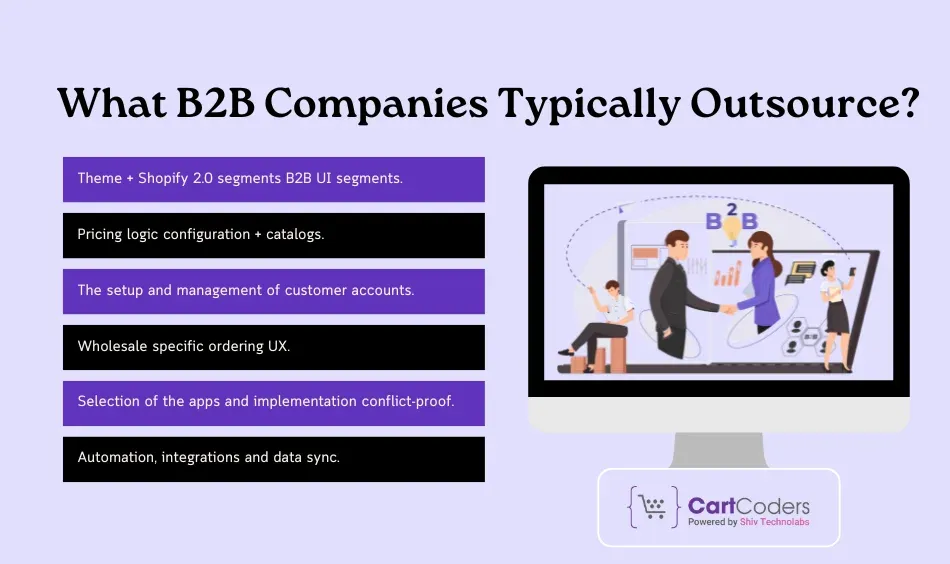
What B2B Companies Typically Outsource?
B2B brands do not outsource everything simultaneously. They begin at the point of the greatest risk and complexity.
Shopify Development Services Outsourced for B2B
B2B teams seem to outsource:
Theme + Shopify 2.0 segments B2B UI segments.
Pricing logic configuration + catalogs.
The setup and management of customer accounts.
Wholesale specific ordering UX.
Selection of the apps and implementation conflict-proof.
Automation, integrations and data sync.
These areas deliver the fastest ROI when handled by specialists.
Outsourcing Models That Work for B2B Teams
No single model fits all. Mature partners do not have strictness.
Project-Based (Fixed Scope): Best for defined builds, pricing reorganization, catalog reorganization, or a Plus upgrade. Defined scope, set timelines and a certain cost.
Devoted Developer(s) (Monthly): Optimal ongoing work on Shopify, but not full-time in-house. You have continuity without the risk of hiring.
Retainer (Continuing Improvements + Support): B2B application where the teams have frequent changes, pricing, integrations, QA and feature rollouts. Many partners combine ad hoc and retainer models to be more flexible.
Evaluation Checklist for Choosing the Right Shopify Development Partner
It is more expensive to make the wrong choice than it is to make the late choice.
Technical Fit (B2B + Plus)
Are they able to deploy the B2B features of Shopify, such as catalogs, accounts and pricing, properly? Are they aware of Shopify Plus limitations and capabilities? Request for real examples not demos
Process Fit (Risk Reduction)
How do they carry out their QA and release process? What is their documentation and work handover? What are Communication norms and SLAs? Promises are of less importance than process maturity.
Commercial Fit
The flexibility of engagement models. What support coverage do they have? Owning code, access and credentials? Certainty and clarity of ownership minimize risk in the long-term.
Outsourcing Readiness Scorecard
Trigger / Symptom
B2B Impact
What to Outsource
Best Fit
Wholesale pricing inconsistencies
Revenue leakage
Catalog + pricing setup
B2B Shopify agency
Customer account permission issues
Ordering errors
Account configuration
Agency
ERP integration needed
Operational risk
Integration build
Agency / Dedicated dev
Work with CartCoders for B2B Shopify Development
CartCoders collaborates with B2B brands and agencies on Shopify developments, Plus upgrades and wholesale pricing structures and long-term development services. We do not speculate, we plan, write and implement.
What B2B buyers value and what we deliver
Clear scope before code
Recorded logic (pricing, catalogs, accounts)
QA-driven releases
Specialized developer configurations.
Long-term support models
CartCoders grows as much as you need a Shopify partner, targeted assistance, or complete.
Conclusion
B2B businesses are experiencing a loss of control over pricing, catalogue leaks, misbehaving accounts and integration issues that are halting growth. It is time to outsource.
Freelancers suit small, confined tasks. Complex, high-risk B2B systems require an agency on Shopify. CartCoders is designed to handle that job in case you desire stability, speed and confidence as your B2B activities increase. We assist B2B brands in Shopify builds that grow without mess.
Frequently Asked Questions
When should I outsource Shopify development?
Outsource where internal teams are unable to provide pricing rules, customer-specific catalogs, integrations and stable releases reliably. Numerous fixes and delays are the sign of time.
How much does it cost to outsource Shopify development?
Outsourcing Shopify development in the USA typically costs $1,000 to $50,000+, depending on scope, integrations, and support needs. Minor projects cost less, while full B2B builds require higher investment but reduce long-term risk.
Do I need Shopify Plus for B2B eCommerce on Shopify?
Not always, at a small scale, Shopify Plus is not necessary, although more complex pricing, automation, and B2B features are available.
How do I set up wholesale pricing on Shopify for B2B customers?
Wholesale prices are determined by catalogs, price lists, or apps that are controlled, but not by coupons. When properly configured, it is consistent and does not leak.
As the CTO at Shiv Technolabs & CartCoders, I am liable for instigating, planning, integrating, and implementing the organization's strategic orientation.
I gather the most significant tech news in addition to sharing the information I gained while serving as the CTO of Shiv Technolabs, a renowned web and mobile app development company. I am pleased to answer questions as a most valuable expert for Shiv Technolabs Private Limited and to share my experience. I offer a keen insider's perspective on technical advancements.
 eCommerce
Solution
eCommerce
Solution







 INDIA
INDIA


 USA
USA
 CANADA
 AUSTRALIA