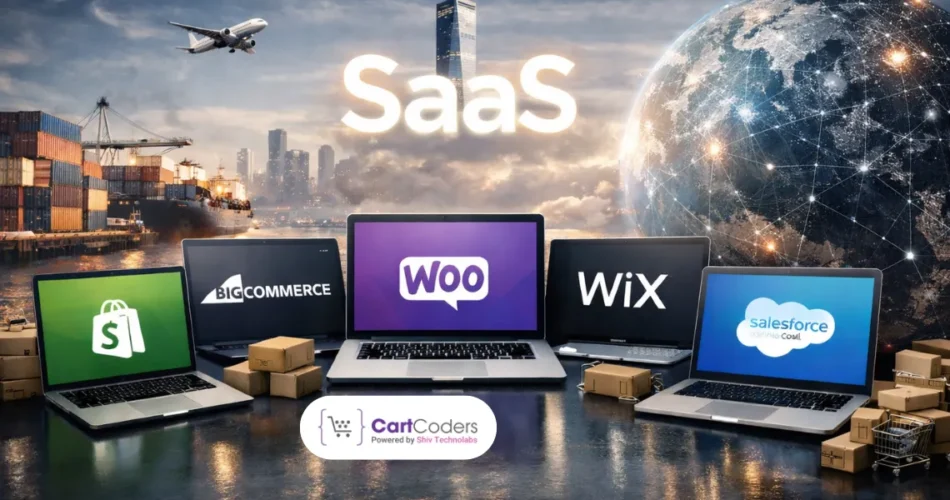

eCommerce growth in 2026 is not about a fast launch anymore; it is about a clean launch. Global eCommerce sales grew by 20% from online purchases. Brands are rapidly migrating to eCommerce SaaS solutions to mitigate infrastructure risk, streamline operations and facilitate international expansion.
This report compares the most popular SaaS ecommerce platforms currently used to run online enterprises. We focus on what really matters when comparing ecommerce platforms in 2026: features, pricing transparency, SEO control, B2B, global selling and long-term scalability.
Whether you are a startup founder, a developing DTC brand, or an enterprise eCommerce unit considering your next step, this guide will provide a well-organized framework for selecting a platform.
What Are eCommerce SaaS Platforms?
eCommerce SaaS services are hosted commerce systems in which the vendor is responsible for hosting, security, applications, updates and basic infrastructure, while the business is responsible for products, marketing and operations. The major distinguishing features are:
- Monthly and annual subscriptions.
- Monitored hosting + security (PCI, up-time, patches)
- Built-in checkout + payments
- App or extension ecosystems
- Manages without server management.
SaaS vs Self-Hosted eCommerce Platforms
Control vs. simplicity is the dilemma that always arises when choosing between SaaS and self-hosted ecommerce platforms.
- SaaS solutions → reduced maintenance, a predictable rate, rapid scaling.
- Self-hosted platforms → complete authority, increased maintenance and engineering cost.
In most growing businesses, SaaS is the winner due to faster speeds, reliability and a lower total cost of ownership (TCO).
Top 4 Quick Comparison of eCommerce SaaS Platforms (2026)
| Platform | Best for | Pricing Range | Transaction Fees | App Ecosystem | B2B Support | POS | Headless |
| Shopify | Growing DTC + B2B | $39–$399+ | 0%–2% | Massive | Yes | Yes | Yes |
| BigCommerce | Mid-market | $39–$299+ | 0% | Strong | Yes | Limited | Yes |
| Wix eCommerce | Small brands | $27–$159 | 0% | Limited | No | No | No |
| Squarespace | Content brands | $33–$65 | 0% | Small | No | Yes | No |
Top 7 eCommerce SaaS Platforms Compared
The new brands do not select platforms; they select operating systems to grow. A brief, business-oriented breakdown is provided below.
1. Shopify
Shopify is a popular hosted, infrastructure-free eCommerce SaaS optimized to meet the needs of scale, reliability, and speed for fast-growing brands. It drives millions of stores worldwide and facilitates DTC, B2B, subscriptions, POS, and international selling all with a single dashboard. Shopify has been characterized by predictable pricing, a good ecosystem, and feature rollout.
Key Features
- Complete security and infrastructure.
- Native checkout is highly converting.
- Extensibility (8,000+ apps) App-based.
- Shipping, tax, and built-in payments.
- Original B2B + wholesale strengths.
- Headless commerce preparedness.
Pricing
- $39/month → Basic
- $105/month → Shopify
- $399/month → Advanced
- Shopify Plus → Custom ($2,000+/month)
- Transaction charges: 0%- 2% (no charges with Shopify Payments)
Good Fit If / Not Ideal If
- May be a good use when: you need a quick launch, cost predictability and worldwide use.
- Not perfect when you require more low-level logic that Shopify does not offer.
2. BigCommerce
BigCommerce is a SaaS eCommerce platform for mid-market and enterprise merchants who prefer robust, built-in capabilities and fewer paid apps. It is more focused on performance, API flexibility and B2B readiness, which is why it is appropriate for businesses that rely on a catalog.
Key Features
- No extra charges on transactions.
- Inbuilt B2B and wholesale features.
- Good product and variant management.
- Headless and API-first.
- Multi-storefront capabilities
Pricing
- $39/month → Standard
- $105/month → Plus
- $399/month → Pro
- Enterprise → Custom
- Transaction fees: 0%
Good Fit If / Not Ideal If
- Good fit when: you desire native features and fewer applications.
- Not perfect when you are very much dependent on third-party SaaS integrations.
3. Wix eCommerce
Wix eCommerce is a user-friendly eCommerce platform, hosted and targeted at small businesses and individual entrepreneurs. It integrates web creation and basic online commerce in a visual, drag-and-drop environment.
Key Features
- Visual site editor
- Basic product and order management.
- Inbuilt payments and shipping.
- Simple SEO tools
- Low learning curve
Pricing
- $27–$159/month
- Transaction fees: 0%
Good Fit If / Not Ideal If
- A good fit when starting a side or small business.
- Not suitable when: you intend to scale up fast or have complicated processes.
4. Squarespace
Squarespace Commerce is an eCommerce SaaS powered by content-intensive brands, creators and lifestyle companies. It is a combination of storytelling, blogging and light ecommerce in one system.
Key Features
- Good quality design templates.
- Inbuilt blogging features and content features.
- Online subscriptions and products.
- Integrated analytics
- Basic ecommerce workflows
Pricing
- $33–$65/month
- Transaction fees: 0%
Good Fit If / Not Ideal If
- Good fitters in case branding and content are more important than scale.
- Not suitable where: your stores are large or complex.
5. Salesforce Commerce Cloud
Salesforce Commerce Cloud: an enterprise-level eCommerce SaaS platform, is intended to support global brands that have complicated personalization, omnichannel and CRM-driven commerce requirements.
Key Features
- Personalization based on AI (Einstein).
- Intensive Salesforce ecosystem integration.
- Enterprise-grade scalability
- Multi-site + multi-region support
- High-tech tools in merchandising.
Pricing
- Revenue-based pricing
- Typically $$$$ (enterprise-only)
Good Fit If / Not Ideal If
- Fit well when: you are an international enterprise brand.
- Not ideal when you need deployment speed or specific costs.
6. Shift4Shop
Shift4Shop is a US-based SaaS ecommerce platform that offers a free plan when using its payment processor. It is aimed at low-end merchants who prefer the simplicity of eCommerce with no monthly charges.
Key Features
- Free plan with lock-in on payment.
- Built-in SEO tools
- Simple inventory and order control.
- No app-heavy ecosystem
Pricing
- Free → with Shift4 payments
- Paid plans up to $299/month
- Transaction fees: 0%
Good Fit If / Not Ideal If
- A good fit when you are mostly price-conscious.
- Not appropriate when: you intend to grow internationally or complexly.
7. Ecwid
Ecwid is a small eCommerce SaaS designed to provide shopping functionality on existing websites, social media, or marketplaces, rather than replacing a complete eCommerce system.
Key Features
- Plug-and-play store widgets
- Integration in social commerce.
- Basic inventory control
- Multi-channel selling
Pricing
- $19–$99/month
- Transaction fees: 0%
Good Fit If / Not Ideal If
- Good fit when you want to introduce eCommerce to an existing site.
- Not best when: you require a complete ecommerce engine.
Best eCommerce SaaS Platform by Business Type
| Business Type | Best Platform | Why it Fits | Things to Consider |
| Startups | Shopify | Speed + apps | App costs |
| Small businesses | Shopify / Wix | Ease of use | Scaling limits |
| Growing DTC brands | Shopify | Ecosystem + scale | App governance |
| B2B sellers | Shopify/BigCommerce | B2B tools | Setup planning |
| Content brands | Squarespace | Design-led | Commerce depth |
| Multi-country sellers | Shopify | Multi-currency + tax | Localization setup |
Need Help Moving to Shopify the Right Way?
And it is not a button press to change platforms; it is a business-critical move. CartCoders is the best Shopify migration company, specializing in high-level Shopify migrations with no loss of SEO, clean data migrations and continuous business operations. Our team of migration experts is well-versed in performing migrations in stages, verifying data integrity, testing checkout processes and assisting with post-launch optimization.
We do not panic migrations; we design confidence.
Why CartCoders?
- Experience in migrating to Shopify.
- SEO-safe URL +redirect support.
- Clean information + transfer of order history.
- Post-launch performance support.
Conclusion
SaaS platforms used in eCommerce vary widely in versatility, pricing, search engine optimization and scalability. The platform you should use in 2026 is not the most popular; it is the one that aligns with your growth trajectory, operational maturity and global aspirations.CartCoders is one stop shopify migration company for brands to select, develop, transfer and expand on the appropriate SaaS basis, Shopify at its heart. As a reputable Shopify migration agency and SaaS commerce partner, we prioritize results over construction.
Frequently Asked Questions
eCommerce SaaS provider is a web-based service in which the hosting company takes care of hosting, security and updates and merchants operate stores through subscription. It minimises overheads and accelerates scaling.
SaaS solutions provide controlled infrastructure and predictable costs. Self-hosted platforms offer control but require hosting, security, updates and engineering resources.
Shopify is the most suitable eCommerce platform for startups and small businesses due to its ease of installation, scalability and app ecosystem.
The leading positions are held by Shopify and BigCommerce due to strong control over URLs, redirects, metadata and an SEO-optimized architecture.
Select Shopify as a platform of freedom and ecosystem. Select BigCommerce due to inbuilt features and free transactions.


