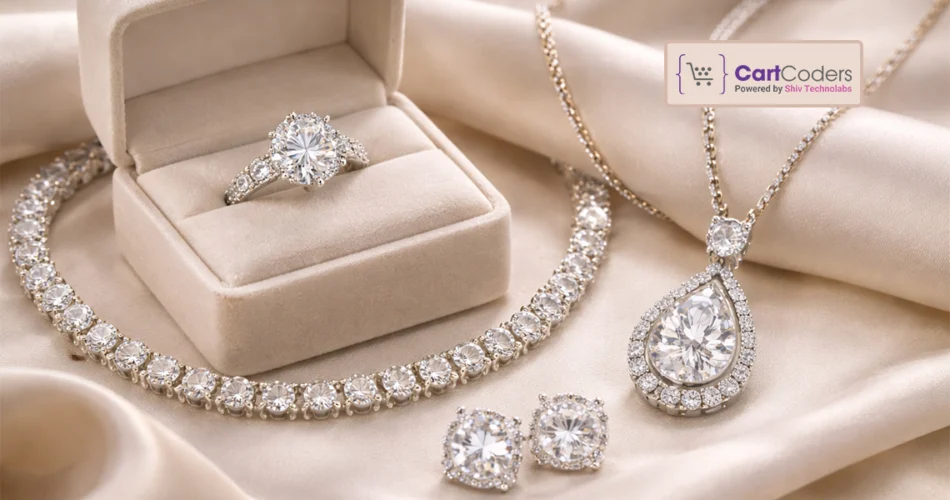
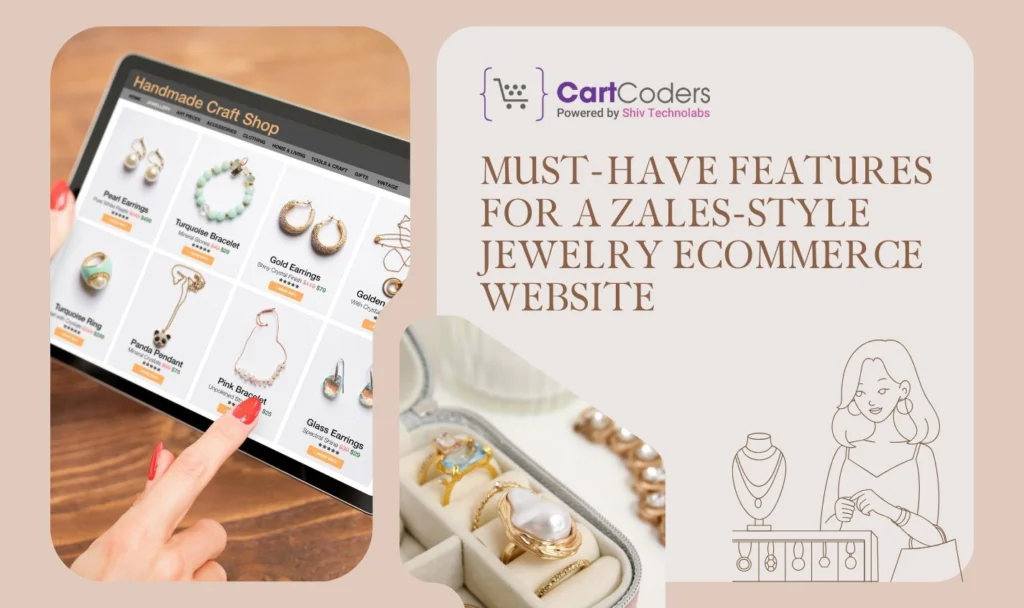
Purchasing jewelry online no longer involves viewing product images in motion. Customers now demand mentoring, personalization, and trust signals, such as those provided by brands like Zales. Statista predicts that the global online jewelry market will grow by 22% by 2029, and engagement rings and wedding jewelry will yield the highest average order values (AOV).
This change has compelled brands to invest in developing jewelry websites beyond a simple store. To address hesitation and boost confidence in conversion, a modern jewelry website should support the development of engagement ring websites, 3D ring builders and virtual ring try-on technologies to deliver a more immersive product experience.
Design Elegant Jewellery Websites That Reflect Luxury Brands
CartCoders crafts premium layouts for fine jewellery stores.
This guide is straightforward: it demonstrates how to create a Zales-like jewelry eCommerce website, what makes it special, which features are most important, how much it costs, and how long it takes in real life. At the end, you will know just what to plan in order to build without guessing.
What Makes a Zales-Like Jewelry Website Different?
When customers search for a site like Zales, they are not seeking a theme; they are seeking trust, guided purchasing, personalization and vivid images. The Zales-style sites are also meant to eliminate the hassles of making high-value purchases, particularly engagement rings.
Guided Buying Experience (Engagement-Focused)
A Zales-like site guides customers through the ring-shopping process one step at a time, rather than overwhelming them with too many options. This is why the engagement ring website focuses on education, prompts and comparison rather than product listings.
Multifunction Jewelry Product Filters.
Jewelry customers are demanding accuracy. Metal type, diamond shape, price range, carat weight and setting style filters are non-negotiable. The smart jewelry product filters reduce decision-making time and improve conversion quality.
Diamond Education Based on the 4Cs.
Zales-like websites incorporate diamond education in the purchase process. The description of the 4Cs of diamonds (cut, color, clarity, carat) helps instill confidence and position the brand as professional, not a salesperson.
Must-Have Features for a Zales-Style Jewelry eCommerce Website
Vernacular development of a jewelry store, such as Zales, emphasizes depth of features over feature count. All elements are designed to minimize uncertainty and support decision-making.
Product Browsing Features (Collection + PLP)
The nature of your category and listing pages sets the tone for the entire experience. An effective Zales-type of PLP involves:
Questions and answers and reviews to reduce apprehension.
This is aimed at addressing all questions before the customer asks them.
Guidance + Trust Features (Critical in Jewelry)
Jewelry purchases are emotional and financial. Trust features cannot be optional.
A strong setup includes:
Precise ring size guide (printable guide + calculator)
Diamond purchasing overview of the 4Cs and man-made vs natural.
Support options → chat, call, appointment booking (lead capture)
These factors significantly increase first-time purchaser conversion rates.
Build Your Own Ring” Setup (The Core Zales-Like Feature)
The build-your-own ring website experience is a strong differentiator for a Zales-like site. This aspect makes browsing more personalized.
Engagement Ring Builder Logic
An engagement ring builder lets one select:
Diamond shape and size
Metal type and band style
Setting design
Budget range
Selection and price, visuals and availability are dynamically updated. This provides non-confusion to the users.
Ring Configurator & Rules Engine
In the background, a ring configurator is based on compatibility rules:
What are the stones that suit what settings?
Metal availability by size
Price adjustments by combination.
This reasoning eliminates invalid configurations and post-order corrections.
3D Ring Configurator (Advanced Option)
A 3D ring configurator is another feature that adds depth, creating a realistic preview as the ring is customized. This is optional for MVPs, but it significantly increases buyer engagement time and confidence in premium catalogs.
Develop Scalable Jewellery Ecommerce Platform With Experts
CartCoders builds secure, fast, and feature rich stores.
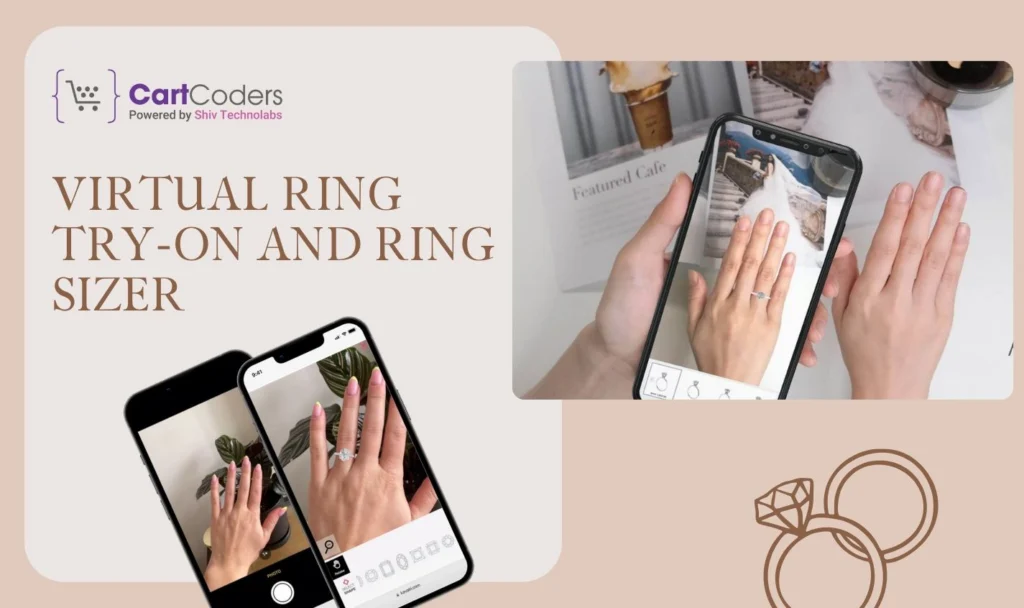
Virtual Ring Try-On and Ring Sizer
Virtual try-on is the solution to the biggest gap in online jewelry buying: “Will that really look good on me?
Where to Place Try-On (SEO + Conversion)
Positioning is important:
Product pages-> highest intent
Collection pages → fast surfing.
Landing pages of engagement ring → landing page conversion.
This provides optimum use and no friction.
What “Good” Virtual Ring Try-On Includes
Quality virtual ring try-on system provides:
AR-based realistic finger tracking.
Multi-ring / multi-stack support.
Built-in online ring sizer
AR ring try-on tools are advanced, reducing returns due to size or style mismatches.
Site Architecture That Helps SEO and AI Overviews
A Zales-like site is built on a clean, logical architecture that supports SEO and AI summaries.
Engagement Rings Hub
/engagement-rings/ Primary commercial page targeting high-intent keywords and filters.
Ring Builder Hub
/create-your-own/ Central location for ring builder, configurator and education links.
Diamond Education
/diamonds/ Authority hub for guides, 4Cs explanations and buying advice.
Ring Size Guide
/ring-size-guide/ Conversion-support page linked across PDPs.
The product structure, attributes, ring rules and content mapping are complete. This stage eliminates the need for costly rework in the future.
Week 3–6: UI + PDP + Filters
There are design, collection and filter pages, PDP layouts and trust components.
Week 11-14: Ring Builder v1.5 and Education Hub.
Ring builder logic, education pages and guided buying flows become operational.
Week 10–14: AR Try-On + QA + Launch
Try-on-integration, testing, performance tuning and launch-readiness.
What Delays Projects
Poor product data
Missing media assets
Ring rule amendments during construction.
Launch Checklist (So You Don’t Lose Sales on Day 1)
Before launch, confirm:
The product images comply with zoom + 360 requirements.
The ring size guide is active and connected.
Education pages (4Cs, lab-grown vs natural) published.
Shipping + returns are evidently apparent.
Reviews and trust badges are active
Conclusion
It is important to have the right combination of features, trust and technology to create a Zales-like jewelry eCommerce site. Advanced product filters, ring builders, virtual try-on and education hubs are all things that should enable confident buying. Prices vary based on experience level and deadlines are realistic only when the information and guidelines are provided in advance.
CartCoders comes in here as a leading jewelry website development company. As experts in custom jewelry website development, we create, build and scale high-conversion jewelry websites, engagement ring websites and high-tech design-your-own ring websites.
Frequently Asked Questions
What is the cost of constructing a jewelry eCommerce website?
Prices range from $5,000 for a base store to $40,000 and above for high-tech ring makers and AR try-on. The prices are based on catalogue size, level of customization and experience complexity.
What does a Zales-type website require?
Some of the fundamental requirements are guided buying, ring builder, strong filters, HD images, diamond education, ring sizing, trust badges and virtual try-on.
What is a build your own ring feature?
Users select stone, setting, metal and size. A rules engine will evaluate combinations and dynamically update prices and visuals in real time.
Would a 3D configurator or a 360-degree view be satisfactory?
The 360-degree views suit well with the MVPs, whereas the 3D configurators are valuable to the premium catalog and the experiences with heavy customization.
How can I add the virtual ring try-on to my site?
By using AR SDKs on product and collection pages, along with camera functionality and ring sizing logic.
What pages help jewelry SEO the most?
High-intent traffic is generated by engagement ring hubs, diamond education guides and ring size pages, as well as comparison content.
How should I handle ring sizing online?
Combine printable guides, calculators and AR-based sizing to ensure accuracy and confidence.
Grown vs natural diamonds: which one should I be selling?
Many brands sell both. Lab-grown diamonds target price-sensitive and eco-conscious consumers, whereas natural diamonds maintain a classic value.
As the CTO at Shiv Technolabs & CartCoders, I am liable for instigating, planning, integrating, and implementing the organization's strategic orientation.
I gather the most significant tech news in addition to sharing the information I gained while serving as the CTO of Shiv Technolabs, a renowned web and mobile app development company. I am pleased to answer questions as a most valuable expert for Shiv Technolabs Private Limited and to share my experience. I offer a keen insider's perspective on technical advancements.
 eCommerce
Solution
eCommerce
Solution






 INDIA
INDIA


 USA
USA
 CANADA
 AUSTRALIA