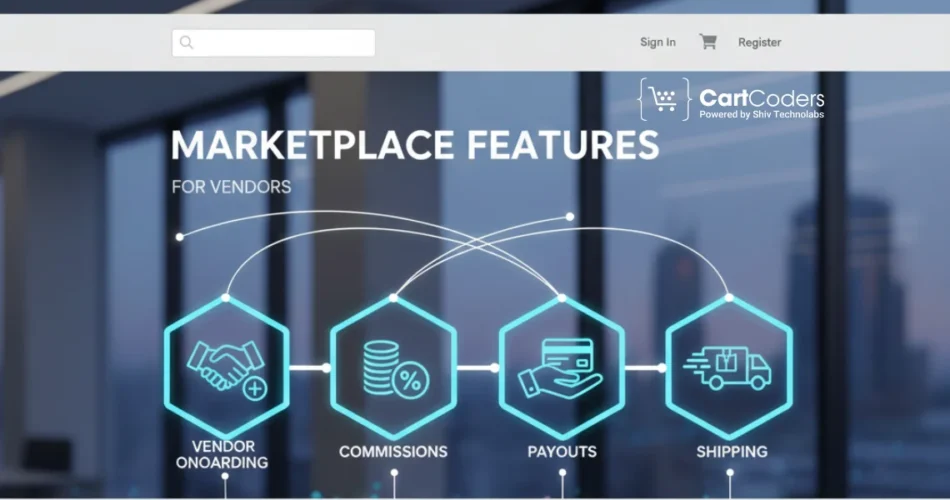
Starting a thriving marketplace is much more complicated than starting a typical ecommerce store. Most of these marketplace platforms are not failing because there is no demand to be met, but because they are built without a robust operational feature set. According to the reports, online sales account for 22% of total global retail sales.
Vendor onboarding, vendor commission structures, vendor payouts, shipping logic and tax compliance are not isolated features. They consist of closely interrelated operational mechanisms that directly affect trust, scalability, and legal compliance, particularly for USA based marketplaces.
Failure to plan well in any of these aspects may result in churn among sellers, payment delays, tax offences, and customer dissatisfaction.
Build A Scalable Online Marketplace For Your Business
CartCoders sets vendors, commissions, payouts, and workflows.
The guide is segmented into key marketplace specifics that any USA-focused platform must consider before launch, with particular attention to vendor integration, payouts, shipping, and compliance preparedness.
Understanding Vendor Onboarding in a Marketplace
Any multi-vendor marketplace is based on vendor onboarding. It determines the entry mode of the sellers in the platform, the speed at which they are operational and the level of trust that the marketplace will develop with the sellers or the buyers.
What Vendor Onboarding Means in a Marketplace Model
Onboarding in a vendor onboarding marketplace is the process of registering. It is a structured
method of verifying the sellers, gathering business information, granting privileges and preparing them to sell in a compliant manner. A robust onboarding program minimises fraud, enhances listing quality, and speeds up seller activation.
Multi-Vendor Onboarding vs Single-Seller
Single-seller platforms focus on internal processes. Multi-vendor marketplaces have to take care of external businesses that have different levels of compliance, tax liability and fulfillment models. The seller onboarding marketplaces thus necessitate verification processes, approval processes, as well as role-based access, which is never required in a single seller store.
Impact on Seller Activation and Marketplace Growth
Easy onboarding directly influences seller conversion rates. Complex or ambiguous flows boost drop-offs, and ineffective validated sellers pose long-term operational risk. The liquidity in the marketplace and the activation of sellers are often increased in marketplaces where the onboarding process has been optimized.
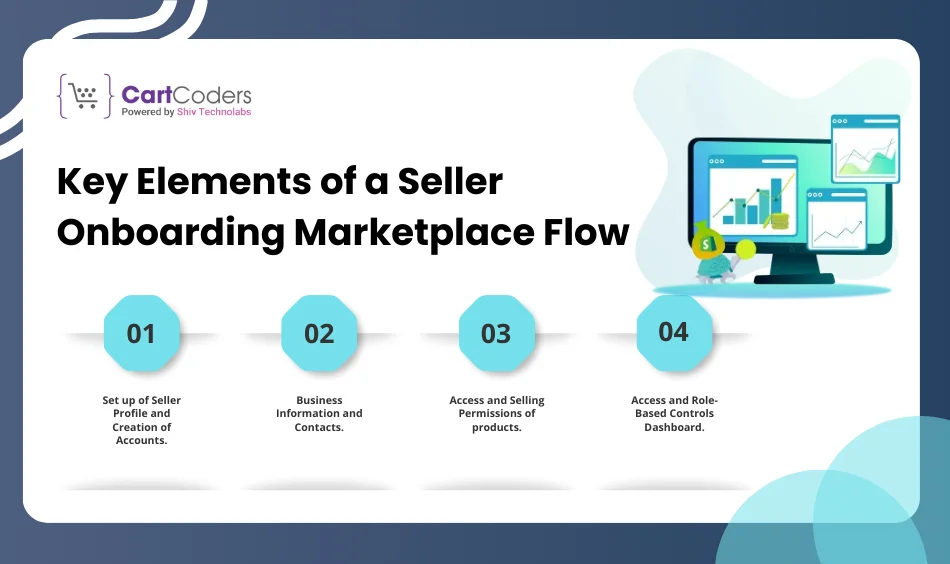
Key Elements of a Seller Onboarding Marketplace Flow
A strong marketplace onboarding flow includes:
Set up of Seller Profile and Creation of Accounts.
Sellers make accounts that include verified email address, passwords and profile information, which the buyer can see.
Business Information and Contacts.
First, the name of the business used legally, address, contact details of the support, and the place of business are obtained to facilitate compliance and payouts.
Access and Selling Permissions of products.
All categories should not be open to all sellers. Regulated permissions are used to ensure quality and regulatory congruence.
Access and Role-Based Controls Dashboard.
Sellers are given dashboards with limited access, based on role, to ensure they can access only certain features.
10 Must-Have Marketplace Features List to Consider
A marketplace will not collapse due to design or traffic. Major breakdowns occur when essential operational elements are either not provided or poorly planned. Such characteristics define the way vendors work, flow of money, the fulfilment of orders, and compliance. Here are ten features that any serious marketplace cannot afford to take for granted since its inception.
Vendor Registration and Approval Process
A marketplace has to regulate the sellers. Lack of an open registration model with no approval would be a source of fraud, low-quality listing, and compliance risk.
The platform can conduct a vendor registration flow through which it can review sellers’ details, check documents, and reject or approve applications according to predefined criteria.
This aspect inspires confidence among consumers and secures the brand in the marketplace at the same time creating a marketplace filled with only authentic sellers.
Seller Onboarding Dashboard
As soon as it is approved, sellers should have a practical, direct onboarding experience.
A specific vendor onboarding marketplace dashboard helps vendors complete setup tasks, including creating a profile, uploading products, and setting payment and shipping preferences. Clarity.
The onboarding process will reduce sellers’ confusion, accelerate activation, and reduce reliance on support during the initial interaction.
Flexible Marketplace Commission Model
Any marketplace should have a revenue engine. An adjustable marketplace commissioning model enables the platform to establish a percentage fee, a flat fee, a category fee or tiered pricing.
Flexibility is essential, as variations in seller types, products, or promotional campaigns may require different commission structures to remain competitive and profitable.
Automated Commission Management System
Commission calculation is not scalable. An automatic commission management marketplace system calculates platform fees at the order level, processes refunds and cancellations correctly, and generates accurate settlement reporting. This characteristic eliminates accounting errors, minimises disagreements among sellers, and provides financial transparency in the marketplace.
Seller Payout Schedule and Management
Sellers are concerned with the timing of payment to them. A reliable seller-payout-schedule marketplace feature defines payout frequency, minimum thresholds, and holding periods. It enables the site to control cash flow, ensure against chargebacks and create explicit expectations with the sellers. Open payout timetables enhance sellers’ retention and confidence.
Marketplace Settlement Cycle Management
The marketplace settlement cycle is the interval between order settlement and the payment to the seller. This is a critical window in fraud prevention, solid returns and payment processor compliance. An optimized settlement cycle satisfies sellers’ needs, manages platform risk, and enables scaled financial operations.
Vendor-Specific Shipping Rules
Shipping in a multi-vendor environment cannot be a one-size-fits-all. The rules of marketplace shipping should accommodate varying fulfillment points, carriers, delivery schedules, as well as calculations of the rate per seller. This is flexible in the way vendors can control logistics.
Transparency in the Order and Fulfillment
Marketplaces should offer real-time access to the status of orders for both sellers and buyers. This involves confirming the order, shipment, and tracking information, as well as delivery. Good visibility into fulfilment minimises support tickets, avoids conflicts, and builds confidence among buyers in the multi-seller setting.
Dispute, Refund, and Return Management
Conflicts bind the marketplaces. It has an integrated dispute management system that defines how returns, refunds, cancellations, and complaints are to be managed between buyers, sellers, and the platform. The use of clear workflows safeguards the marketplace against liability and maintains just resolution and a uniform customer experience.
Compliance-Ready Architecture
A marketplace to be run in the USA needs to be compliance-oriented from inception. This will involve tax management, seller validation, payout policies and audit-ready reporting. A system that is ready to comply with its architecture avoids the expensive rework that follows and makes the platform grow without legal or operational bottlenecks.
Marketplace Sales Tax and Compliance in the USA: What to Know
One of the most sensitive operations of a US marketplace is sales tax compliance.
Knowing Marketplace Sales Tax Responsibility. In some US states, marketplace facilitator laws shift sellers’ tax liability.
Platform.
Key considerations include:
Where the marketplace is mandated by law to collect and remit tax.
Where the sellers have to pay their own taxes.
Rules for marketplace facilitators specific to states.
Lack of control over sales tax compliance in the USA marketplace may lead to fines and audits.
Multi-Vendor Marketplace Taxations
Appropriate MVM marketplace taxation settings for the USA:
Nexus-based tax management on a state basis.
Classifications of tax on products.
Tax exemption and resale certificate support.
Calculation of taxes on checkout instead of after placing an order.
The logic of taxes should be programmable and recordable.
Plan Your Marketplace Build With Skilled Specialists
CartCoders reviews business model before development.
US Payout Requirements for Sellers (KYC & Verification)
US laws require that markets verify sellers before paying them.
Why Seller Verification Is Mandatory
Verifying the sellers helps to safeguard against fraud, money laundering, and regulatory breaches. Marketplaces need to authenticate the seller identities and release funds with the help of payment processors.
Common KYC Requirements for Marketplace Sellers
The US requirements of sellers in terms of payout amounts usually involve:
Business entity details
Social Security Number or Employer Identification Number.
Bank account verification
Physical address and identity verification.
Payouts may be blocked or postponed without proper KYC procedures.
US Shipping Carrier Integrations for Marketplaces
Shipping Multi-vendor platforms have shared responsibility.
Why Carrier Integrations Matter
The integration of the US shipping carriers allows:
Calculation of real-time shipping rates.
Automated label generation
Buyer and seller tracking.
Proper schedules of delivery.
Popular American Shipping Carriers applied in the Marketplaces.
UPS Shipping Integration
Enables business shipping, negotiated rates, and premium tracking.
USPS Shipping Integration
Perfectly suitable for small packages, PO boxes, and economical domestic delivery.
FedEx Shipping Integration
Delivers quickly and offers advanced international logistics.
Building a Marketplace That Scales in the USA
To create a thriving marketplace in the USA, appealing UI and product listings are not enough. It involves rigorous operational planning across onboarding, commissions, payouts, shipping, and compliance. All these systems need to operate in a manner that they do not expose the company to legal action, dissatisfaction with the seller, and also create a bottleneck in the operations.
CartCoders is a vendor onboarding marketplace development company focused on developing scalable, compliance-ready solutions that enable long-term growth. Our team is knowledgeable about US marketplace laws, multi-vendor workflows, payment settlement rationale, and carrier integrations at a deep technical level.
Why Feature-Level Planning Matters
Lowers long-term development and rework expenses.
Avoids payout delays and seller wrangles.
Provides day one tax and regulatory compliance.
Why CartCoders Is the Right Partner
Extensive experience in multi-vendor marketplace architecture.
Experience in compliance with US tax and payout.
Adaptable commission and payment logic.
Future-ready, scalable and secure systems.
Conclusion
The success of the marketplace is determined by the strength of operations and not on the visual design. Any scalable marketplace is based on vendor onboarding, commission management, payout cycles, shipping regulations, and compliance. These systems should not be added subsequently, but should be planned together.
For marketplace founders aiming to enter the US market, the most essential things before entering are compliance, automation, and sellers’ experience. CartCoders assists companies in creating a well-built marketplace commission model that meets regulatory requirements and scales for a confident launch that runs without issues.
Frequently Asked Questions (FAQs)
What is vendor onboarding in a marketplace platform?
Vendor onboarding is the process of registering, verifying, approving, and activating sellers on a marketplace with appropriate permissions and security measures in place.
What is the onboarding marketplace flow of a seller?
It involves the creation of accounts, the verification of business, the approval processes, access to dashboard, and selling permissions.
What is needed when registering a vendor in a marketplace?
Business information, taxation ID, bank data, contact information, category permission are normally needed.
Which is the most prevalent marketplace commission model in USA?
The most common one is the percentage-based commission per order.
How does commission management work in a multi-vendor marketplace?
The rules are used to automatically calculate commission at the order and settlement level based on the platform.
How are seller payout schedules defined in marketplaces?
As the CTO at Shiv Technolabs & CartCoders, I am liable for instigating, planning, integrating, and implementing the organization's strategic orientation.
I gather the most significant tech news in addition to sharing the information I gained while serving as the CTO of Shiv Technolabs, a renowned web and mobile app development company. I am pleased to answer questions as a most valuable expert for Shiv Technolabs Private Limited and to share my experience. I offer a keen insider's perspective on technical advancements.
 eCommerce
Solution
eCommerce
Solution










 INDIA
INDIA


 USA
USA
 CANADA
 AUSTRALIA