Search behavior has changed permanently. In 2026, users no longer scroll through ten blue links and compare options manually. They ask AI systems direct questions and accept answers instantly. Google AI Overviews, ChatGPT and Perplexity are now summarizing, comparing and giving recommendations even before a user clicks a page’s link.
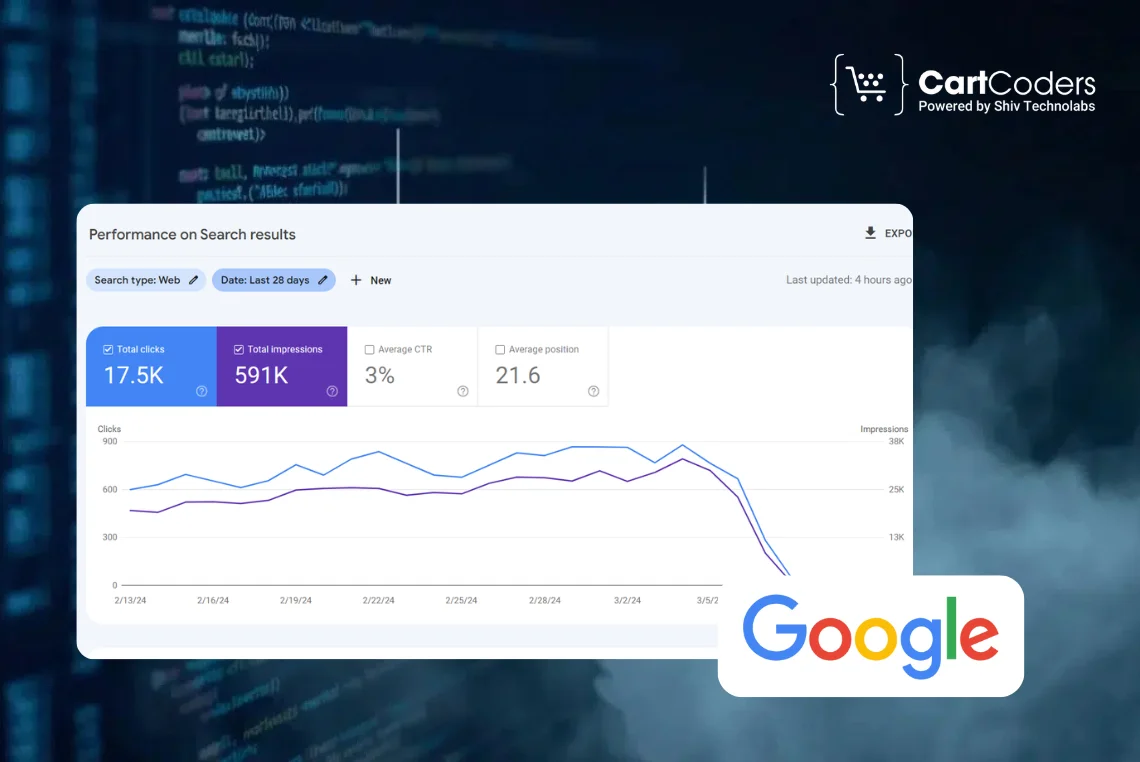
According to Gartner, there is something significant: over 40% of consumer search trips will terminate within AI-created responses by 2026. This will drastically reduce traditional organic traffic. People don’t “search” anymore. They have conversations with AI. These conversations create faster decisions. Users compare fewer options. The list of brands they consider gets smaller.
Manage Multi Store Shopify Inventory Without Manual Errors
Centralized stock updates across all connected stores.
Merchants face an invisible risk because of this shift. Your brand doesn’t exist if AI responses don’t mention it. No mention means buyers never compare you to competitors. No comparison means you lose the sale before it starts. This is why Generative Engine Optimization (GEO) and eCommerce AI store optimization become mission-critical for brands that want visibility in AI-generated answers, product recommendations, and transactional search results.
What GEO Means for eCommerce?
Generative Engine Optimization (GEO) means structuring your store, content and data in ways that AI systems understand. You want AI to trust your information. You want it to cite your brand. You want it to recommend your products in generative answers.
GEO works differently than traditional SEO. SEO focused on ranking pages high in search results. GEO focuses on becoming a source that AI relies on when generating responses.
Defining AI Search Optimization for eCommerce
AI search optimization for ecommerce centers on how large language models read product information. These models look at product data, customer reviews, schema markup, brand mentions and real-world signals. They pull information from across the web. Then they create answers instead of rankings.
Why Ranking Pages Is No Longer Enough
Getting ranked first doesn’t matter if AI summarizes everything without showing links. GEO pushes merchants through three stages that matter now:
Getting indexed by AI systems
Getting referenced in AI answers
Getting recommended to buyers
CartCoders works as a generative engine optimization expert for ecommerce stores. They help Shopify merchants especially. Their focus is moving brands from just being visible to becoming authorities in AI-driven search systems.
How LLMs Read and Interpret Your Store?
Large Language Models don’t crawl websites the way Googlebot does. They take in structured data and unstructured data. They find patterns. They figure out which sources to trust.
How AI Understands Product Pages
LLMs want clarity, not creative language. They pull meaning from several elements:
Product schema markup that’s properly implemented
Clean heading structures and bullet point lists
Attribute names that stay consistent
Clear statements about use cases and product limitations
Unclear copy confuses these models. Language that’s clear and descriptive increases your chances of getting cited.
Why Context Beats Keywords
AI systems care more about contextual depth than keyword repetition. They look at multiple factors:
How your product gets described across different sources
Whether benefits align with actual user feedback
If your claims get supported by outside references
When information stays consistent across your site and third-party content, AI systems trust you more.
Training Signals That Matter Most
LLMs learn which sources have authority by seeing repetition across credible websites:
Blogs written by experts
Articles in industry publications
Product comparison content
Discussions in communities
This explains why GEO work extends beyond just your own website.
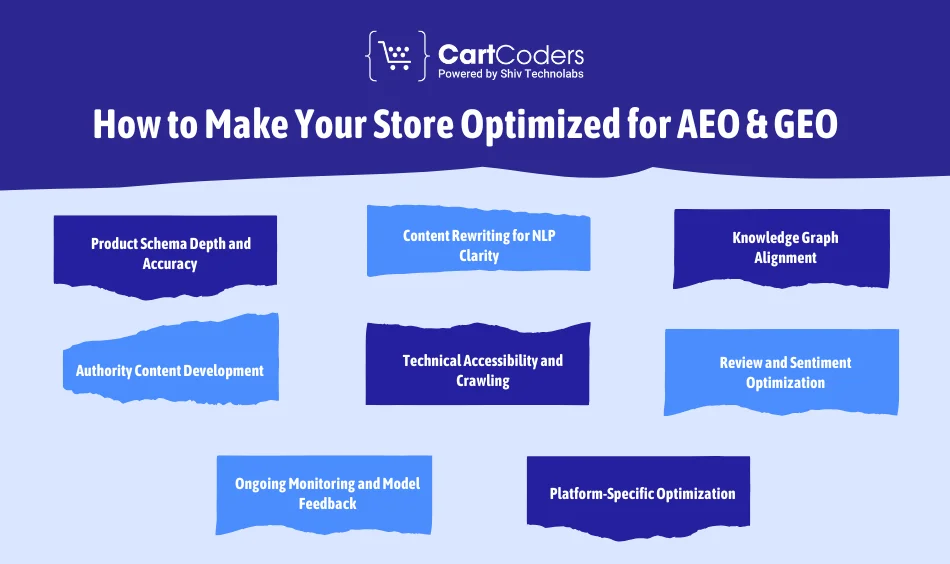
How to Make Your Store Optimized for AEO and GEO
Getting optimized for Answer Engine Optimization (AEO) and GEO takes investment in both technical work and content work. What it costs depends on your store size, how deep your catalog goes and gaps in your authority.
Factor 1: Product Schema Depth and Accuracy
Rich product schema markup ecommerce implementations directly change how AI understands your products. Detailed schema covers price, availability, attributes, FAQs and reviews. This lets models correctly interpret your products. Shopify stores usually need custom schema extensions because default themes don’t go far enough.
Factor 2: Content Rewriting for NLP Clarity
AI-friendly writing avoids vague marketing talk. Product descriptions need to explain what the product is, who should use it and how it compares to alternatives. Legacy content often needs complete rewriting. This affects your cost based on catalog size.
Factor 3: Knowledge Graph Alignment
Brands with inconsistent naming confuse AI systems. Variant logic that changes between products creates problems. Attribute usage that varies causes issues. Building a clean internal knowledge graph helps AI extract information better. It reduces confusion and ambiguity.
Factor 4: Authority Content Development
LLMs trust brands that show up repeatedly in authoritative content. This includes expert blog posts, comparison articles, buying guides and detailed long-form content. Promotional fluff doesn’t count.
Factor 5: Technical Accessibility and Crawling
AI crawlers need to access your content easily. This forms the foundation. You need clean robots rules. Proper rendering matters. Fast performance is essential. Optional llms.txt configuration helps too.
Factor 6: Review and Sentiment Optimization
AI systems summarize sentiment from reviews, not just star ratings. Merchants need to encourage detailed reviews. Reviews should mention shipping speed, product durability, customer support quality and real usage scenarios.
Factor 7: Ongoing Monitoring and Model Feedback
GEO isn’t something you do once and forget. Tracking how often AI mentions your brand requires regular audits. You need to keep iterating based on results.
Understanding how to add product schema in Shopify matters. You need to know how to extend Liquid templates. Controlling structured data output affects both effectiveness and costs.
How Brands Get Mentioned, Not Just Indexed?
Traditional SEO cared about getting indexed and achieving high rankings. Generative search completely changes what matters. AI systems don’t show long lists of options. They mention a small group of brands they trust. Getting mentioned is the new way to measure visibility.
This happens when your brand appears consistently across credible sources. It happens when you use clear and stable product naming. It happens when you demonstrate real relevance in the world. Merchants who only focus on their own website content become invisible in AI conversations.
Talk To Experts About Shopify Multi Store Inventory Sync
Discuss workflows, rules, and real-time updates.
Brands that actively build presence across trusted places are the ones AI systems remember. Those are the brands AI references and recommends.
What LLM Seeding Really Means?
LLM seeding is the intentional process of getting consistent, high-quality brand references placed where AI models learn. You can’t just wait for AI to find you on its own. Authority gets built through repetition across environments that AI trusts.
How Products Appear in Perplexity
Perplexity cites its sources rather than ranking pages. It prefers certain types of content:
Blog posts written by experts
Articles from industry sources
Community discussion threads
Independent product reviews
Consistency matters more than having lots of mentions. One unified story works better than scattered references.
Credibility Signals AI Trusts
AI systems favor specific signals:
Product names that stay consistent
Mentions across different domains
References to real-world product usage
Language that’s neutral instead of promotional
This directly impacts brand visibility in AI search. It affects how to show up in ChatGPT results. It determines how products are displayed in Perplexity.
Best Practices: Optimizing for Generative Prompts
Generative AI systems respond to prompts driven by intent, not keywords. Buyers don’t type broken-up queries anymore. They ask complete questions. These questions show comparisons they’re making. They reveal budgets. They express values. They describe personal situations. To appear in AI-generated answers, ecommerce content needs a structure that matches how people naturally ask questions.
Optimizing for generative prompts means merchants need to rethink product pages. Category descriptions need work. FAQs must directly address what buyers want to know. Stores that align content with real questions get summarized and recommended by AI systems far more often.
Comparison-Driven Prompts
Prompts like “Is Brand A better than Brand B for sensitive skin?” make AI create comparisons. Merchants need to structure category and product content to support fair comparisons. Show tradeoffs clearly. Make differentiators obvious.
Budget and Persona Prompts
AI filters products based on constraints such as price, value and buyer type. Example: “Best eco-friendly kitchen gadgets under $50”. Structured pricing helps. Clear sustainability attributes help. Apparent audience targeting improves your chances of inclusion.
FAQ Blocks That Trigger AI Summaries
Short, direct answers work better than long explanations. The FAQ schema supports Google AI Overviews ecommerce responses. It gives AI clean answer blocks that are easy to summarize.
Sentiment, Reviews and Social Proof: AI Supports Word of Mouth
Large language models look at patterns in customer sentiment. They use this to decide if a brand is reliable, consistent and worth recommending. AI doesn’t count up reviews. It summarizes how people talk about your products. It looks at what customers repeatedly experience.
Reviews, user-generated content and social proof now directly affect AI-powered recommendations. For merchants, managing sentiment isn’t just reputation management anymore. It’s a visibility strategy. It directly influences whether AI includes your brand in responses.
How AI Reads Reviews
AI summarizes sentiment patterns instead of counting stars. Phrases that repeat like “fast shipping”, “easy returns”, or “solid build quality” heavily influence what AI recommends.
User Content as AI Signals
AI trusts signals from real usage:
Photos uploaded by customers
Detailed review content
Descriptions based on actual scenarios
Why This Impacts Visibility
Consistent satisfaction signals improve AI search optimization ecommerce results. They reinforce trust in your brand.
The CartCoders AI-Readiness Framework
CartCoders helps merchants get ready for generative search. They use a structured, technical approach.
Step 1: Audit Product Schema Depth
Review structured data you already have
Find attributes that are missing
Extend schema, so AI can comprehend your products
Step 2: Fix Crawler Access and Add llms.txt
Make sure AI crawlers can render your content
Control which paths AI systems ingest
Improve overall accessibility
Step 3: Rewrite Product Copy for NLP Clarity
Make language simpler
Remove anything ambiguous
Align benefits with actual use cases
Step 4: Build an LLM Seeding Plan
Publish content that shows authority
Get mentions on third-party sites
Keep consistency across all platforms
Step 5: Track Share of Model Visibility
Monitor when AI tools mention your brand
Compare your visibility against competitors
Keep iterating based on what you learn
Conclusion
In 2026, the best merchants aren’t gaming systems. They are becoming the most straightforward, most reliable answers.
AI search rewards structure, honesty and usefulness. Brands that invest in generative engine optimization today will dominate AI-driven buying decisions tomorrow.
Is your store ready for AI-powered commerce?
CartCoders helps merchants rebuild their technical and content architecture for generative search systems, with precision, not guesswork.
Frequently Asked Questions (FAQs)
What is Generative Engine Optimization?
GEO focuses on making brands understandable and recommendable inside AI-generated answers rather than traditional search rankings.
How is GEO different from SEO?
SEO targets rankings. GEO targets AI citations, mentions and recommendations.
How do I show up in ChatGPT results?
By improving structured data, authority mentions and consistent brand references across trusted sources.
Do Google AI Overviews affect ecommerce traffic?
Yes, AI summaries reduce clicks but increase the importance of being mentioned.
Is GEO important for Shopify stores?
Absolutely. Shopify stores must extend schema and content for AI comprehension.
What role does product schema play?
It helps AI systems extract accurate product attributes and comparisons.
How long does GEO take to show results?
Initial signals appear in weeks, authority builds over months.
Can small brands compete in AI search?
Yes, clarity and consistency matter more than brand size.
What is LLM seeding?
Strategic placement of brand mentions where AI models learn.
Does sentiment affect AI visibility?
Yes, AI summarizes sentiment patterns, not ratings.
How does CartCoders help with GEO?
Through audits, schema optimization, authority content and AI visibility tracking.
Is GEO a one-time task?
No, it requires ongoing optimization and monitoring.
As the CTO at Shiv Technolabs & CartCoders, I am liable for instigating, planning, integrating, and implementing the organization's strategic orientation.
I gather the most significant tech news in addition to sharing the information I gained while serving as the CTO of Shiv Technolabs, a renowned web and mobile app development company. I am pleased to answer questions as a most valuable expert for Shiv Technolabs Private Limited and to share my experience. I offer a keen insider's perspective on technical advancements.
 eCommerce
Solution
eCommerce
Solution







 INDIA
INDIA


 USA
USA
 CANADA
 AUSTRALIA