

Online marketplaces have become one of the most successful digital business models. Platforms like Amazon, Etsy, and niche industry marketplaces allow multiple vendors to sell products through a single website while the platform owner manages the system and earns revenue through commissions or vendor subscriptions.
Many businesses choose Shopify for building online stores because of its reliability, strong ecosystem, and ease of management. However, Shopify is designed primarily for single-vendor stores. To create a marketplace where multiple sellers can list and sell products, additional tools or custom development are required.


The cost of Shopify multivendor marketplace development depends on several factors, such as vendor management features, commission systems, payment workflows, integrations, and marketplace scale. Small marketplaces using marketplace apps require a lower budget, while large platforms with advanced vendor dashboards and automation systems require custom development.
This guide explains the typical cost ranges, development approaches, feature pricing, and important factors that influence the cost of building a Shopify multivendor marketplace.
Quick Answer: Shopify Multivendor Development Cost
| Marketplace Setup | Estimated Cost | Timeline |
|---|---|---|
| App-based marketplace | $2,000 – $6,000 | 2–4 weeks |
| Hybrid marketplace solution | $6,000 – $18,000 | 4–8 weeks |
| Custom multivendor marketplace | $18,000 – $60,000+ | 8–16 weeks |
A small marketplace can start quickly using marketplace apps available in the Shopify ecosystem. Growing platforms often move toward hybrid development where apps are combined with custom features. Large marketplaces with advanced vendor management systems usually require fully customized development.
What Is a Shopify Multivendor Marketplace?
A Shopify multivendor marketplace is an online platform where multiple vendors can sell their products through a single Shopify store. The marketplace owner manages the platform while independent vendors manage their own product listings, inventory, and order fulfillment.
In this model, the platform owner controls vendor onboarding, commission rules, and marketplace operations. Vendors gain access to a marketplace audience without building their own store.
Common examples of multivendor marketplaces include:
- large product marketplaces similar to Amazon
- handmade product marketplaces similar to Etsy
- niche marketplaces for specific industries
- B2B supplier marketplaces
A marketplace platform typically includes several important components.
Key marketplace features include:
- vendor dashboards
- commission management systems
- vendor product approval workflows
- order management and order splitting
- vendor payout systems
Since Shopify does not include these features by default, marketplace apps or custom development are required to build a complete marketplace system.
Can Shopify Support a Multivendor Marketplace?
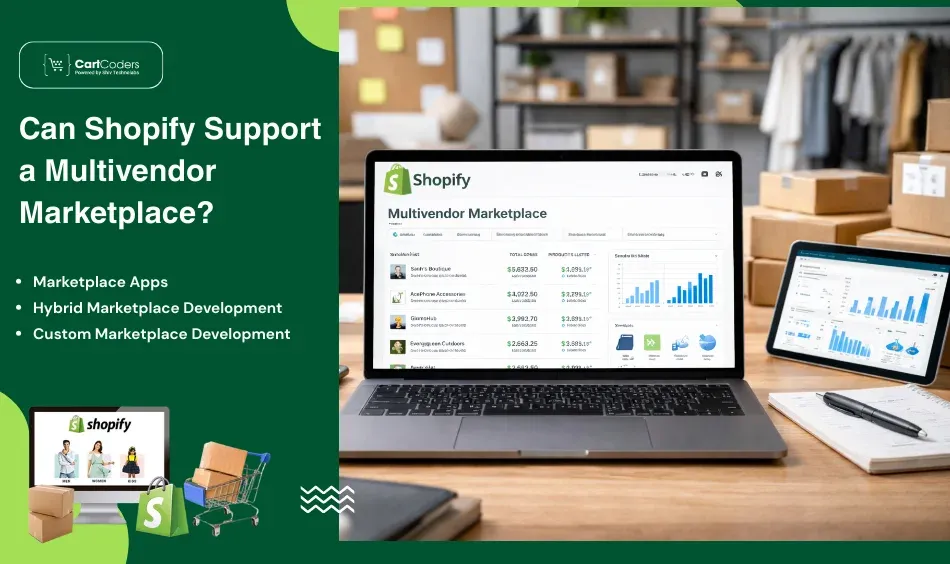
Yes, Shopify can support a multivendor marketplace, but it requires additional tools or custom development because the platform does not provide built-in vendor management features.
Businesses generally build Shopify marketplaces using three main approaches.
Marketplace Apps
The easiest way to launch a multivendor marketplace is by using marketplace apps available in the Shopify App Store. These apps extend Shopify’s functionality by adding vendor management tools.
Marketplace apps usually include features such as:
- vendor registration and onboarding
- vendor product management
- vendor dashboards
- commission management
- vendor order management
This approach works well for startups or businesses that want to launch a marketplace quickly without heavy customization.
Hybrid Marketplace Development
Hybrid marketplace development combines a marketplace app with custom development. Businesses start with a marketplace app and then build additional custom features to support specific workflows or integrations.
Hybrid marketplaces are commonly used when platforms need:
- custom commission rules
- vendor analytics tools
- ERP or inventory integrations
- custom vendor onboarding processes
This approach offers more flexibility while still keeping development costs manageable.
Custom Marketplace Development
Large marketplaces often require fully customized systems. In this case, developers build vendor dashboards, commission systems, payout automation, and vendor workflows directly within the Shopify environment.
Custom development is usually required for marketplaces that need:
- complex vendor management workflows
- automated vendor payout systems
- advanced commission structures
- marketplace-specific integrations
- scalable vendor management tools
Although custom development requires a larger investment, it provides greater control and scalability for growing marketplaces.
Build Your Shopify Vendor Marketplace
Start a multivendor marketplace with custom vendor management and scalable marketplace workflows.


What Shopify Provides vs What Requires Marketplace Development
Understanding what Shopify provides by default helps businesses estimate development costs more accurately.
What Shopify Provides by Default
Shopify already includes many core eCommerce features.
These include:
- product catalog management
- checkout and payment processing
- order management tools
- store management features
- payment gateway integrations
These features support standard online stores but are not enough to run a multivendor marketplace.
What Requires Apps or Custom Development
A marketplace requires additional vendor management functionality.
Important marketplace features include:
- vendor dashboards
- vendor onboarding systems
- vendor product approval workflows
- commission management systems
- vendor payout systems
- order splitting between vendors
These features require marketplace apps or custom development to function properly.
Factors That Affect Shopify Marketplace Development Cost

The cost of building a Shopify multivendor marketplace depends on several technical and operational factors.
Each feature, integration, or automation layer increases development complexity and overall cost.
Vendor Management System
Vendor management is the core component of any marketplace. It allows sellers to register, manage products, and track orders.
Typical vendor management features include:
- vendor registration forms
- seller dashboards
- vendor product management tools
- vendor order tracking
Advanced marketplaces may also include vendor analytics dashboards and automated vendor approval systems.
Commission Management
Marketplace owners typically earn revenue by charging vendors a commission on each sale.
Common commission models include:
- fixed percentage commission
- category-based commissions
- vendor-specific commission rules
- tiered commission structures
Complex commission rules require additional customization during development.
Order Management and Split Orders
When customers purchase products from multiple vendors in a single checkout, the system must automatically split the order and send each part to the correct vendor.
This process involves:
- vendor-specific order notifications
- vendor shipping management
- vendor order tracking
- customer order updates
Order splitting increases development complexity for large marketplaces.
Vendor Payment and Payout System
A marketplace must track vendor earnings and distribute payouts accordingly.
Vendor payout workflows may include:
- automated vendor payouts
- manual payout approvals
- payment gateway integration
- vendor payment reports
Advanced marketplaces often require automated payout scheduling.
Vendor Subscription Plans
Some marketplaces charge vendors a monthly subscription fee to access the platform.
Subscription systems may include:
- vendor membership plans
- tiered subscription levels
- subscription billing automation
- feature access based on vendor plan
Adding vendor subscription functionality increases development effort.
Marketplace Integrations
Many marketplaces require integrations with external systems.
Common integrations include:
- payment gateway integrations
- shipping provider integrations
- ERP systems
- accounting platforms
Each integration adds development complexity.
Marketplace Design and User Experience
Marketplace platforms require multiple interfaces for different users.
These interfaces include:
- vendor dashboards
- marketplace admin panels
- customer product pages
- vendor analytics dashboards
Advanced user interfaces require additional design and development effort.
Shopify Marketplace App vs Custom Development Cost
| Approach | Cost | Customization | Best For |
| Marketplace apps | lower | limited | startups |
| Hybrid marketplace | medium | moderate | growing marketplaces |
| Custom marketplace | higher | full control | enterprise marketplaces |
Marketplace apps allow businesses to launch quickly, but customization options are limited. Hybrid development provides additional flexibility. Custom development allows complete control over vendor workflows and marketplace features.
Feature-Wise Shopify Multivendor Development Cost Breakdown
| Feature | Estimated Cost |
| Vendor dashboard | $2k – $5k |
| Vendor onboarding system | $1k – $3k |
| Commission management | $1k – $4k |
| Vendor product management | $2k – $6k |
| Vendor payout system | $2k – $5k |
| Order split system | $3k – $8k |
| Vendor analytics dashboard | $2k – $4k |
The total marketplace development cost depends on how many of these features are required and how complex they are.
Cost to Build a Shopify Marketplace by Business Type
Small Marketplace
A small marketplace typically includes a limited number of vendors and basic marketplace features.
Estimated cost
$3,000 – $8,000
Growing Marketplace
Growing marketplaces usually require advanced vendor management tools and integrations.
Estimated cost
$8,000 – $20,000
Large Marketplace
Large marketplaces support hundreds of vendors and require advanced workflows and automation systems.
Estimated cost
$20,000 – $60,000+
Real Marketplace Development Example
Example scenario:
A niche fitness equipment marketplace required the following features:
- vendor dashboards
- commission management system
- vendor payout automation
- product approval workflow
- vendor analytics dashboard
Estimated development cost
$12,000 – $18,000
Estimated timeline
6–8 weeks
Shopify Marketplace Development Timeline
| Marketplace Type | Development Time |
| App-based marketplace | 2–4 weeks |
| Hybrid marketplace | 4–8 weeks |
| Custom marketplace | 8–16 weeks |
Marketplace development usually includes planning, development, testing, and launch phases.
Marketplace Revenue Models
Commission-Based Marketplace
The marketplace earns revenue by charging vendors a commission on each sale.
Example:
10–20% commission.
Vendor Subscription Model
Vendors pay a monthly fee to sell on the marketplace.
Example:
$29 per month vendor subscription.
Hybrid Model
Some marketplaces combine subscription plans and sales commissions.
Shopify vs Other Marketplace Platforms
| Platform | Marketplace Cost | Complexity |
| Shopify | $3k – $60k | moderate |
| WooCommerce | $5k – $30k | moderate |
| Magento | $20k – $100k | high |
| Custom platform | $60k – $200k | very high |
Shopify is often preferred because it offers a balance between scalability, development speed, and ecosystem support.
Shopify Marketplace Launch Checklist
Before launching a marketplace, businesses should confirm the following:
- vendor onboarding process
- commission structure
- vendor payout workflow
- shipping configuration
- vendor support system
- tax configuration
Proper planning reduces development issues later.
Common Mistakes When Building a Marketplace
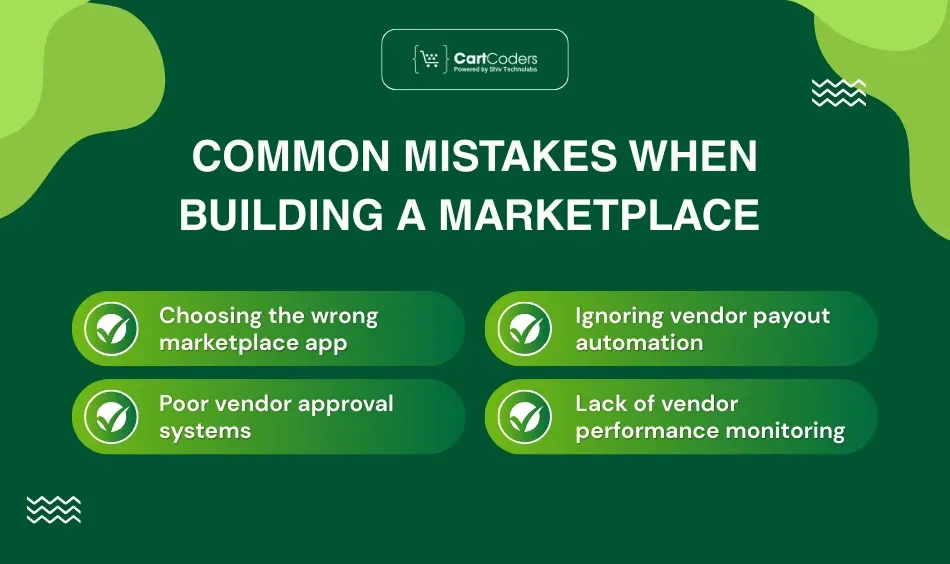
Common marketplace development mistakes include:
- Choosing the wrong marketplace app
- Ignoring vendor payout automation
- Poor vendor approval systems
- Lack of vendor performance monitoring
These mistakes can affect marketplace scalability and vendor satisfaction.
How to Scale a Shopify Marketplace
Marketplaces often grow in stages.
Start With Marketplace Apps
Launch quickly with basic vendor management.
Add Hybrid Development
Introduce custom features as the marketplace grows.
Build Custom Marketplace Modules
Large marketplaces require fully customized vendor management systems.
Best Shopify Apps for Multivendor Marketplaces
Popular marketplace apps include:
- Webkul Multivendor Marketplace
- Shipturtle Marketplace
- Puppet Vendors
- Multi Vendor Marketplace by Shopfox
These apps add vendor dashboards, commission management, and vendor order workflows to Shopify stores.
How to Choose a Shopify Marketplace Development Company
Businesses planning a marketplace should evaluate development partners carefully.
Important factors include:
- marketplace development experience
- vendor management expertise
- integration capabilities
- long-term support options
Choosing an experienced development team helps avoid costly mistakes during marketplace development.
Build Your Shopify Multivendor Marketplace with CartCoders
Launching a successful marketplace requires careful planning of vendor workflows, commission systems, and marketplace architecture.
CartCoders helps businesses build scalable Shopify marketplaces with custom vendor dashboards, commission management tools, and vendor payout systems.
Our Shopify developers assist with:
- marketplace architecture planning
- vendor management system development
- custom marketplace integrations
- long-term marketplace scaling
Businesses planning to launch a marketplace can consult with our Shopify team to estimate development costs and plan the right marketplace architecture.
Conclusion
Shopify can support multivendor marketplaces with the help of marketplace apps or custom development. The total development cost depends on vendor management features, marketplace workflows, integrations, and platform scale.
Small marketplaces can launch quickly using marketplace apps, while growing platforms often require hybrid solutions. Large marketplaces typically require custom development to support advanced vendor workflows and automation systems.
Businesses planning to launch a marketplace should carefully evaluate their feature requirements, budget, and long-term growth plans before choosing a development approach.
Frequently Asked Questions
The cost usually ranges between $3,000 and $60,000, depending on the number of vendors, required features, and level of customization.
Yes. Shopify can support multivendor marketplaces through marketplace apps or custom development.
Apps such as Webkul Multivendor Marketplace, Shipturtle, Puppet Vendors, and Shopfox Marketplace help create multivendor platforms.
Development time usually ranges from 2 weeks for simple app-based marketplaces to 16 weeks for complex custom platforms.


