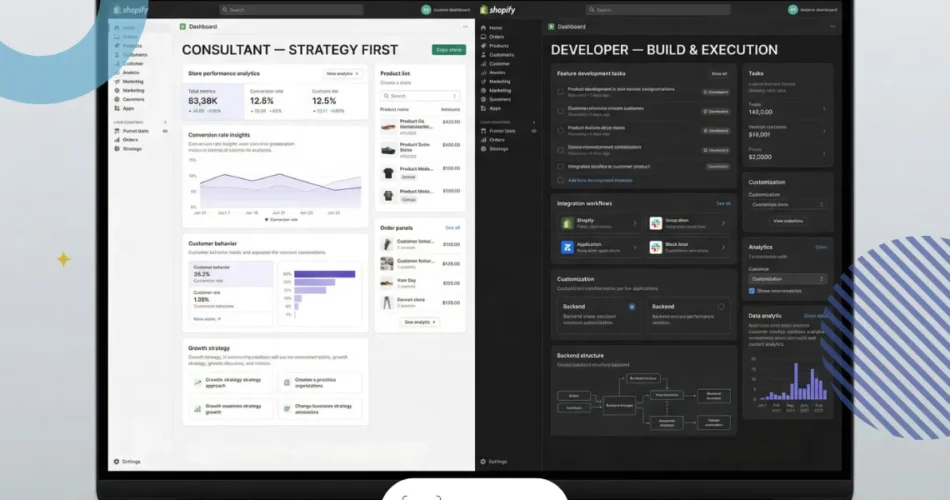
Many Shopify store owners finally find that their sales growth is leveling off, their conversion rates are declining, or that minor updates no longer improve their performance. After that, the Shopify owners were stuck between an important decision: bring on a Shopify consultant or go with a Shopify developer?
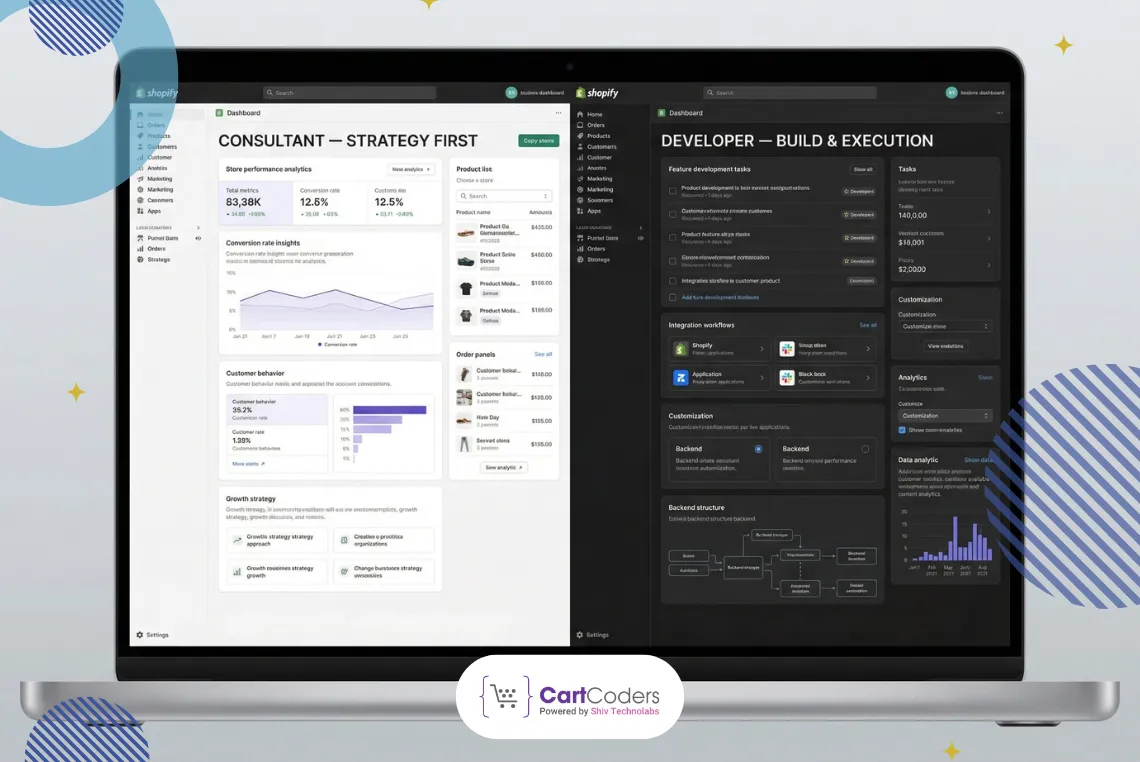
Each role tackles distinct challenges. Developers focus on code work, including theme tweaks, app integrations, checkout adjustments, and bug fixes. Consultants look at the store through the lens of business operations, revenue potential, and expansion possibilities.
Shopify’s own figures indicate that merchants who apply thoughtful optimization methods frequently boost conversion rates once the store structure and setup are properly aligned.
Work With Shopify Consultants For Better Store Decisions
Each Shopify consultant focuses on clear growth steps.
Understanding how these roles differ prevents costly errors. Projects priced between $2,000 and $10,000 are a constant failure when the strategy behind them is faulty.
What Does a Shopify Consultant Do?
Shopify consultants review an online store purely from the viewpoint of business expansion and revenue improvement, skipping the coding side entirely.
They hold off on adding features right away. First, they examine actual store results, including where traffic comes from, buyer journeys, product display choices, checkout patterns, and the complete shopping experience. The main objective is to identify the sales obstacles and recommend specific business-level solutions.
Key Responsibilities of a Shopify Consultant
Shopify Store Audit: Thorough check of layout design, site speed, checkout sequence, and product organization.
Conversion Rate Analysis: Examine visitor actions closely to find exit points and explain persistently low purchase numbers.
Checkout Drop-Off Analysis: Look into cart abandonment figures, payment hurdles, surprise shipping fees, and trust gaps that stop completions.
Product Page Review: Break apart descriptions, photo quality, trust elements, price formatting, and signals that shape buyer certainty.
Shopify Growth Strategy Planning: Outline a clear plan for traffic growth, product lineup expansion, funnel refinements, and app arrangement tuning.
What Does a Shopify Developer Do?
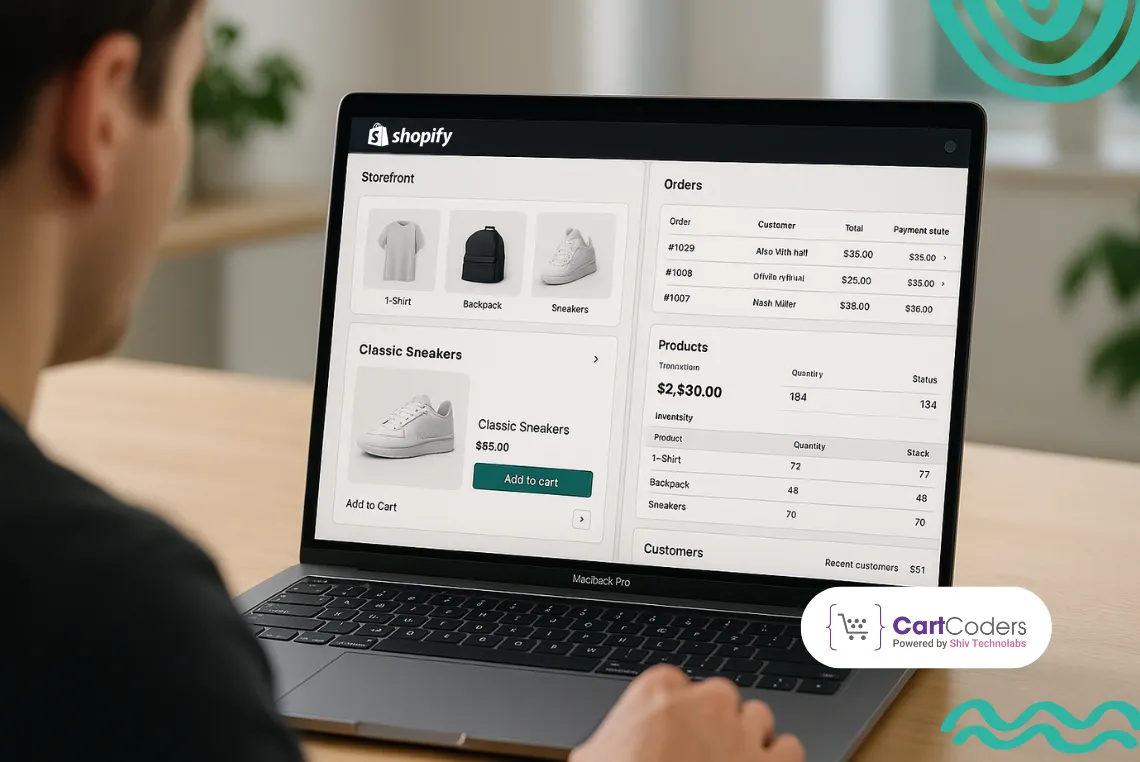
Shopify developers handle the practical, hands-on building and updating of stores. They rely on Liquid, HTML, CSS, JavaScript, and Shopify APIs to create or alter functionality.
Consultants map customer patterns and overall direction, while developers handle the hands-on coding required for new elements or visual updates.
Developers normally receive tasks centered on theme adjustments, connection builds, or speed enhancements.
Secure API links and consistent data exchange become essential for these.
Signs You Need a Shopify Consultant Instead of a Developer
Specific patterns reveal shortcomings in strategy rather than coding gaps.
Traffic Increases but Sales Stay Flat
Visitor numbers rise by 20%–40% with no corresponding sales lift, suggesting conversion leaks over tech constraints. Consultants track user habits to expose the genuine sales drag.
Your Store Looks Good, but Customers Leave Quickly
Good-looking stores still lose people fast due to awkward navigation, delayed product assessment, or absent trust markers. Consultants study session data, recordings, and metrics to explain the drop-offs.
Plan Your Shopify Growth With Skilled Consultants
A Shopify consultant reviews your store step by step.
You Run Ads, but ROAS Is Low
Poor ad returns commonly stem from page-level or product-level weaknesses rather than from campaign setup alone. Consultants strengthen conversion sequences so ad budgets deliver stronger returns.
Apps Create Confusion Instead of Results
Excessive apps frequently bog down sites and duplicate capabilities. Consultants streamline the setup and select tools that genuinely help.
How to Decide Between a Shopify Consultant and Developer
Your specific issue determines the better choice.
Hire a Shopify Consultant If
You Need a Store Strategy
You Want Conversion Improvements
Your Shopify Store Is Not Generating Sales
You Need A Shopify Store Audit
You Face Shopify Store Strategy Problems
Hire a Shopify Developer If
You Need Custom Features
You Want Integrations
You Require Theme Development
You Need Technical Fixes
Recognizing this split allows businesses to pick the correct specialist precisely when required.
Conclusion
The call between a Shopify consultant and a developer hinges entirely on the exact difficulty your store is facing.
Conversion struggles, unclear direction, or slowing momentum make starting with a consultant before coding work the path toward stronger, sustained outcomes.
Businesses seeking reliable Shopify consulting turn to CartCoders. As a Shopify Development Company, we provide strategy guidance, detailed audits, and end-to-end build assistance to accelerate brand growth.
Our team focuses on uncovering overlooked growth areas and turning weak-performing stores into powerful sales-generating e-commerce setups.
Frequently Asked Questions
When should you hire a Shopify consultant?
Bring in a Shopify consultant during conversion struggles, foggy expansion plans, or sales drops despite steady visitors. They evaluate performance and propose business moves that drive revenue upward.
Can a Shopify consultant improve conversion rates?
Yes, they inspect product pages, checkout sequences, and buyer patterns to remove purchase obstacles. After solid adjustments, conversion gains of 10%–30% are regularly achieved.
Do Shopify consultants write code?
No, Consultants concentrate on direction, audits, and revenue planning. Developers manage coding, connections, and technical execution.
How much does a Shopify consultant cost?
Pricing varies by expertise and project size. Shopify consulting usually ranges from $100 to $300 per hour or uses fixed project rates based on audit depth.
Can a Shopify consultant help a new store?
Yes, Consultants guide brand-new stores, avoid common setup errors, improve product presentation, and outline early growth before launching marketing efforts.
As the CTO at Shiv Technolabs & CartCoders, I am liable for instigating, planning, integrating, and implementing the organization's strategic orientation.
I gather the most significant tech news in addition to sharing the information I gained while serving as the CTO of Shiv Technolabs, a renowned web and mobile app development company. I am pleased to answer questions as a most valuable expert for Shiv Technolabs Private Limited and to share my experience. I offer a keen insider's perspective on technical advancements.
 eCommerce
Solution
eCommerce
Solution







 INDIA
INDIA


 USA
USA
 CANADA
 AUSTRALIA