Traffic is not enough to create profitable Shopify stores. Many merchants on Shopify spend thousands of dollars on advertising, influencers, and search engine optimization, but most visitors do not make a purchase. Traffic quality is not always a problem. The actual issue is usually within the funnel of conversion product pages, cart flows, trust signals, checkout friction, or unclear pricing.
Work With Shopify Consultant For Clear Store Direction
CartCoders reviews store structure, apps, and workflows.
This is the point when a Shopify CRO audit is of utmost importance. Rather than making assumptions about why buyers leave a shop, a systematic Shopify conversion rate optimization audit will pinpoint the specific point at which users leave and the reason.
Businesses can use tools such as Shopify funnel analysis, Shopify-specific heatmaps, and cart abandonment analysis to identify areas of friction and optimize conversions more systematically.
What Is a Shopify CRO Audit?
A Shopify CRO audit is a methodical examination of the consumer experience within a Shopify store. It does not just look at traffic acquisition but also considers user interactions with pages and their abandonment rates prior to purchase.
An effective audit of the Shopify conversion rate optimization looks at:
Product Page Behaviour
Cart Abandonment Patterns
Checkout Friction
Trust Indicators And Credibility Signals.
Shipping Cost Transparency
Mobile Usability Issues
The aim is straightforward, to increase the proportion of visitors who make a purchase. For example:
10,000 monthly visitors
1% conversion rate: 100 orders
2% conversion rate: 200 orders
Improving conversion by just 1% can double revenue without increasing traffic spend.
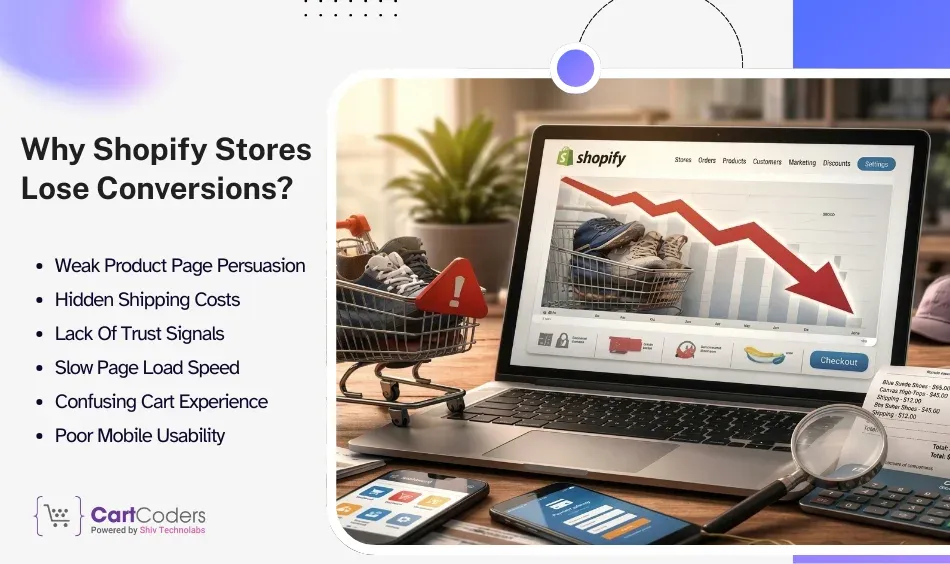
Why Shopify Stores Lose Conversions?
It is worthwhile to know the most frequent reasons of the loss of conversions before carrying out a CRO audit. The stores of typical Shopify lose users because:
Weak Product Page Persuasion
Hidden Shipping Costs
Lack Of Trust Signals
Slow Page Load Speed
Confusing Cart Experience
Poor Mobile Usability
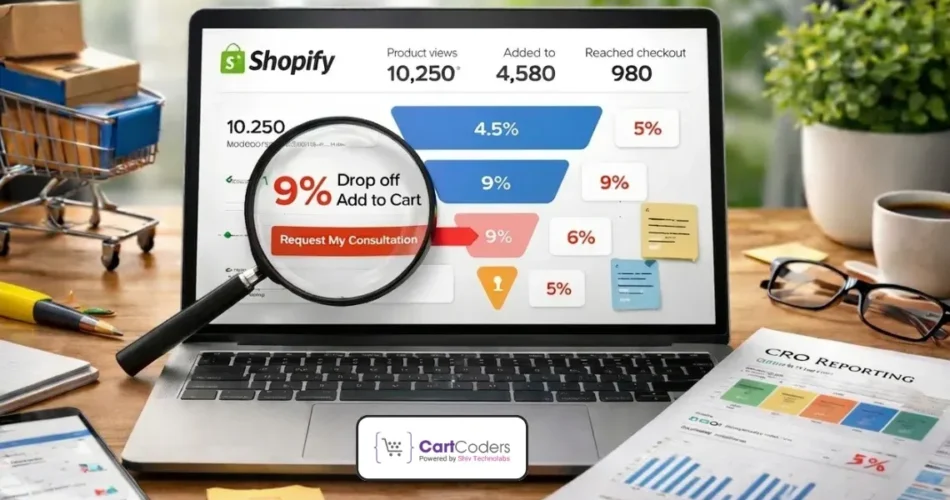
Shopify Funnel Analysis: Where Users Actually Drop Off
An effective Shopify funnel analysis reviews each step of the purchase process. Typical Shopify funnel structure:
There are three major areas of conversion drop-offs.
Product Page Drop-Off
The most important step in the funnel is the product page. Unless the users press Add to Cart, the rest of the funnel will not begin. Some of the problems that have been found during the Shopify product page conversion audit are:
Weak Product Descriptions
Missing Social Proof
Unclear Product Benefits
Low-Quality Images Or Videos
Slow-Loading Product Galleries
Product page improvements alone can increase conversion rates by 15–40%.
Cart Page Drop-Off
The second step, once all products have been added to the cart, is to audit the Shopify cart page.
The common reasons that result in users giving up are:
Surprise Shipping Costs
Unclear Return Policies
Discount Code Distractions
Lack Of Trust Signals
Shipping cost transparency would be necessary here.
Checkout Drop-Off
Checkout abandonment rates up to 60%-70% vary by store design. Common issues include:
Too Many Form Fields
Slow Checkout Loading
Lack Of Payment Options
Unexpected Taxes Or Shipping Fees
Frictional checkouts are another problem that can be solved by reducing immediate conversion.
Discuss Shopify Store Challenges With Professionals
Get clarity on fixes and future direction.
Shopify Cart Abandonment Analysis
The Shopify cart abandonment analysis will help a person understand why people add items to their carts but do not make purchases. The typical Shopify cart abandonment rate is 65%–75%. Key causes include:
Unexpected Shipping Costs
Forced Account Creation
Complicated Checkout Flow
Slow Payment Processing
Solutions include:
Open Shipping Prices.
Guest Checkout
Progress Indicators
Trust Badges
Cart optimization can reclaim 10-20% of lost revenue.
Conversion Audit Checklist for Shopify Stores
A checklist for the structured conversion audit will ensure that all elements of conversion are checked.
Homepage Trust Signals
It takes visitors up to 3 seconds to form impressions of trust. Critical trust indicators are:
customer reviews
media mentions
security badges
return policies
guarantee messaging
These indicators decrease anxiety about purchasing and increase confidence.
Through these services, brands can enhance conversions systematically rather than through guesswork.
How CartCoders Conducts Shopify CRO Audits?
At CartCoders, our CRO specialists perform data-driven audits to identify conversion leaks.
The Shopify CRO audit processes that we have in place are:
Shopify funnel analysis
Cart Abandonment Analysis
Shopify Behaviors heat maps.
Trust signal evaluation
conversion improvements of product pages.
checkout flow optimization
Conclusion
An effective Shopify CRO audit can improve store performance. Businesses need to maximize the funnel they already have rather than spend time on traffic acquisition. Using Shopify funnel analysis, cart abandonment analysis, and Shopify heatmaps, brands can identify user drop-off points and eliminate friction to boost conversions.
When traffic to your Shopify store is high, but conversion rates are low, it is time to have a formal Shopify conversion rate optimization audit.
CartCoders is a Shopify Conversion Rate Optimization company focused on Shopify Conversion Rate Optimization Services, aimed at maximizing revenue through a data-driven approach to CRO.
Our specialists conduct intensive enterprise Shopify conversion audits, identify drop-off points, and implement optimization strategies to ensure the highest ROI.
Frequently Asked Questions
What is a Shopify CRO audit?
A Shopify CRO audit examines the customer journey from landing pages to checkout to identify conversion drops. It analyzes product pages, cart experience, trust signals, and checkout friction to enhance conversion rates.
How does Shopify funnel analysis help improve conversions?
Shopify funnel analysis measures the flow of users through the homepage, product page, cart, and checkout. By identifying users’ exit points, companies can correct errors and increase purchases.
Why do customers abandon Shopify carts?
These are the most frequent causes, such as the obscure cost of shipping, slow checkout, the lack of trust indicators, and a complex checkout form. A cart abandonment analysis will help reveal these problems with Shopify.
How do heatmaps help Shopify CRO?
Heatmaps reveal how people engage with a Shopify store, including clicks, scrolling, and engagement. This helps identify neglected CTAs, disorienting designs, and navigation issues.
What conversion rate is good for Shopify stores?
Average Shopify conversion rates range between 1.5% and 3%. Well-designed stores with good CRO policies usually achieve 4%-6% conversion rates.
As the CTO at Shiv Technolabs & CartCoders, I am liable for instigating, planning, integrating, and implementing the organization's strategic orientation.
I gather the most significant tech news in addition to sharing the information I gained while serving as the CTO of Shiv Technolabs, a renowned web and mobile app development company. I am pleased to answer questions as a most valuable expert for Shiv Technolabs Private Limited and to share my experience. I offer a keen insider's perspective on technical advancements.
 eCommerce
Solution
eCommerce
Solution








 INDIA
INDIA


 USA
USA
 CANADA
 AUSTRALIA