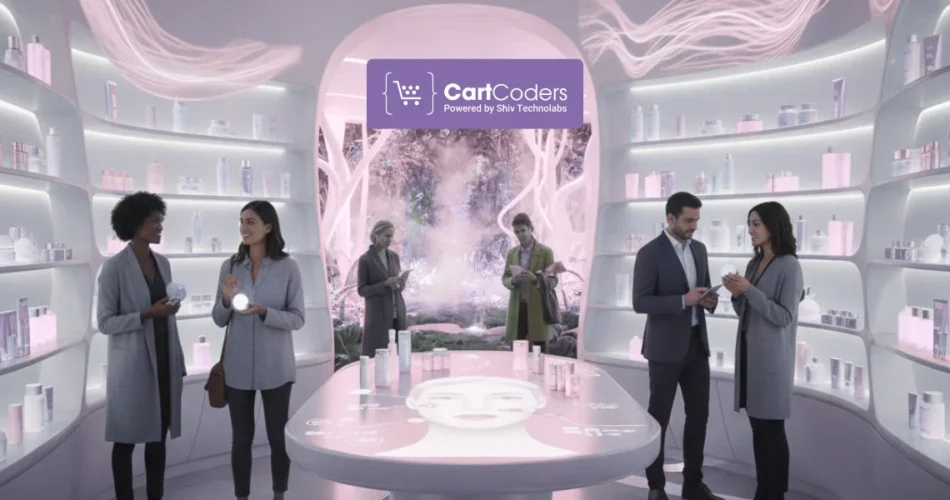
When online shoppers browse skincare products, they make a decision based on how they are presented. The feel of a cream, the glow on real skin, the color of packaging, these visuals of beauty brand storytelling immediately shape perception. In the beauty industry, emotion sells better than words. One picture of radiance, purity, or care can elicit a stronger emotional response than an entire product description.
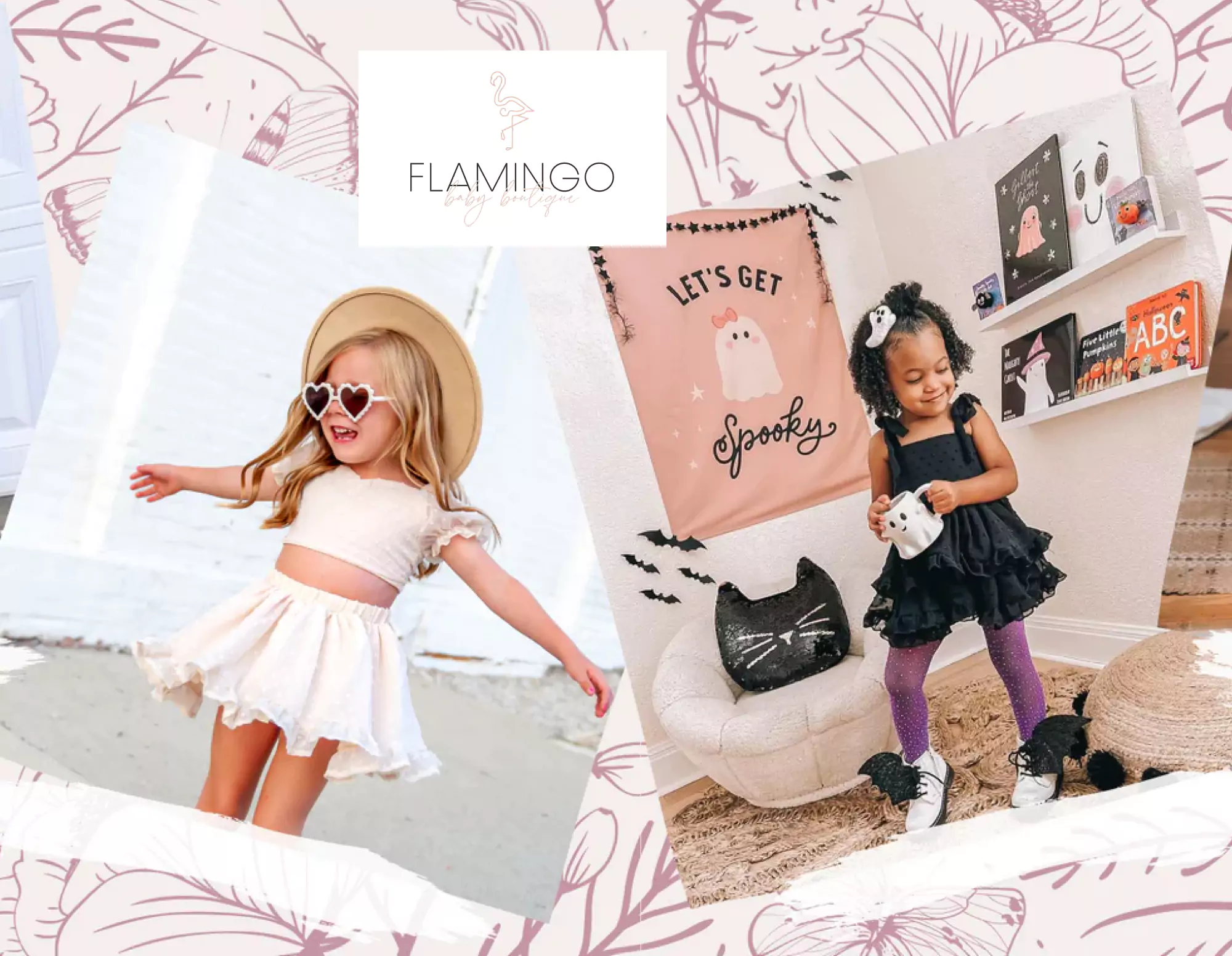
Cosmetic Website With Product-First Experience
From filters to glow-up galleries included
Recent statistics indicate that more than 82% of online skincare buyers feel images influence their confidence and buying decisions. Shoppers don’t want to view a basic jar anymore. They want visual storytelling—the glow after application, the difference in before-and-after shots, and a routine that fits their lifestyle. This shift is also reshaping how brands plan their skin care store development, as visuals now play a major role in product discovery and conversions.
Visual storytelling serves as a bridge between that desire, brand identity, and human emotion. A visual brand story for skincare products turns product descriptions into mini content, with reels, close-ups, and testimonial-driven stories.
Why Visual Storytelling Matters in Skincare eCommerce?
The core of every successful skincare eCommerce store is visual storytelling. The beauty products are sensory in nature; they promise touch, feel, or transformation. Customers cannot touch the product online, so the visuals should mimic the experience of touching it. Below, we have put together the importance of integrating the best background for skincare photos:
Buyer Psychology
Cosmetic and skincare buyers tend to make purchases driven by immediate emotional responses. Subconscious trust is activated by the image of a smooth feel, a shiny bottle or a neat label. Research indicates that over 70% of initial beauty product buyers make purchases based on visual displays rather than reading the product description. When a product appears to be effective, it is half sold.
Building Trust Through Emotion and Clarity
Skincare sales are vulnerable, as consumers are applying something to their skin (and, in most cases, their face) and are not certain of its safety. That is why images that evoke a sense of cleanliness, stillness, and authenticity convey credibility. Present actual textures, not only smooth-surfaced packaging. Present pre- and post-changes to report actual results. Visuals that evoke emotion build long-term trust and loyalty.
Visual-First Behavior on Mobile
Mobile shopping has become visual-first. An average consumer scrolls and views a short video and makes an immediate choice. Text becomes secondary. You need to ensure that your images are small-screen-friendly, vertical, high-contrast, and have minimal background noise.
Emotional Cues: Clean, Glowing, Luxurious
Each skincare company needs to choose the attitude it would like to adopt. “Clean” communicates purity. “Glowing” evokes freshness. Luxurious is the word that addresses indulgence. Make your photography and colour scheme harmonise with that emotional identity. A serum brand will emphasize dew drops on skin in soft lighting to mean they are hydrating, whereas a luxury moisturizer can have gold accents and velvet backgrounds to mean it is rich.
Consistent Color Palette and Product Mood
This is because consistency in tone and colour helps your brand to become easily recognizable. When the palette of your Instagram feed, packaging, and website is consistent, they are considered reliable by customers. Make sure your imagery style, light, and saturation match in all touchpoints.
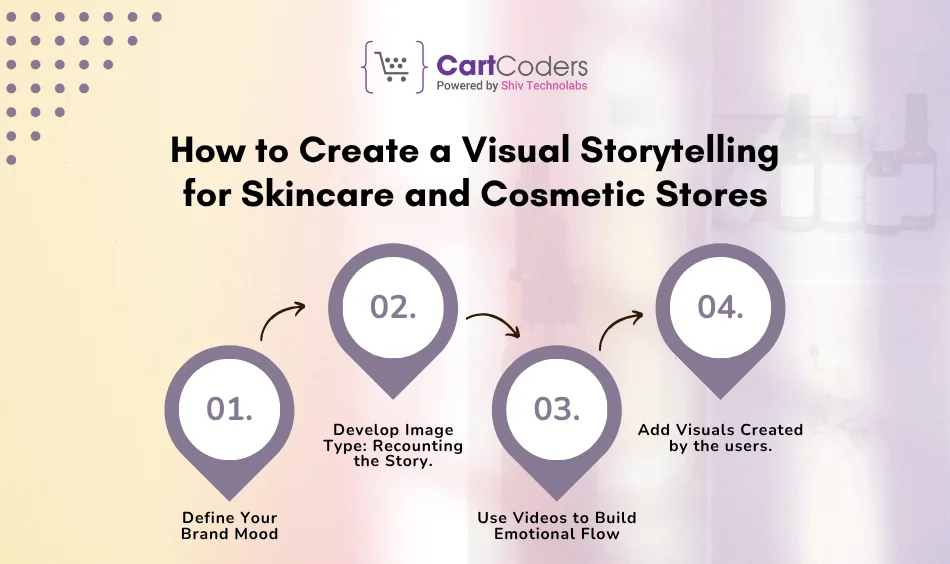
How to Create a Visual Storytelling for Skincare and Cosmetic Stores: Step by Step
A disciplined approach will help develop skincare brand storytelling that will connect. Imagery is not haphazard; it is a carefully edited progression that creates emotion, trust, and a longing.
Step 1: Define Your Brand Mood
The emotional space that your images will occupy is determined by your brand mood. Find your tone before you make your first shot of your image:
Clean and Minimal: White color, transparent bottles, gentle lighting. (Example: The Ordinary)
Eco and Natural: Natural colors, green background, shots of raw ingredients.
Luxury and Premium: Metallic underlights, Reflective matrices, and slow-motion videos.
Fun and Youthful: The playful typography, light colors and poses.
This mood should be reflected in every aspect, color palette, typography, packaging, and even photography angles. The Ordinary is built on clinical minimalism, sterile backgrounds and neutral fonts, whereas Drunk Elephant focuses on bright colors and packaging that reflect vitality.
Step 2: Develop Image Type: Recounting the Story.
Visual Type
Purpose
Example
Texture Shots
Show quality and feel
Cream swirl, serum drop, oil reflection
Lifestyle Shots
Show results in use
Morning skincare routine, user applying toner
Before/After
Build trust
Acne-prone to clear skin journey
Ingredient Close-up
Educate the buyer
Vitamin C crystals, aloe leaves
Tutorial Reels
Drive social engagement
10-second “how to apply” video
This format will give your visuals a cohesive brand story rather than separate product photos. Close-ups of texture emphasize the quality of a product, lifestyle pictures demonstrate actual outcomes, and ingredient close-ups support transparency.
Step 3: Use Videos to Build Emotional Flow
The most formidable marketing tool in skincare is now video. Produce tutorials on how to use your products, stories about the origins of your ingredients, or behind-the-scenes videos that make your brand seem more human.
Videos should be brief, no longer than 15-30 seconds.
Play soothing background music like spa music to help instil peace and trust.
Shoot upwards to have a mobile-first experience.
Look at individuals who are using your product, not models posing with their heads held straight.
The feel of videotape should not be too production-like. Get shots such as a drop of serum injected into the skin, or an individual smiling after the application. Such tiny bits form an emotional progression that keeps viewers watching.
Step 4: Add Visuals Created by the users.
Authenticity is the new advertising. Present actual customer, real-life skin, and actual experiences. Request that your users like your brand on social sites and repin their results.
The community-created imagery of close-ups of freckles, pores, and unfiltered smiles became the foundation of brands.
In a similar manner, Minimalist takes advantage of user testimonials that indicate slow improvement rather than perfection. Make your before-and-after gallery skincare with this.
Where to Use Visual Storytelling on Your Store
It is also about creating the visuals and knowing where to put them. The key location affects the buying habits and the duration of stay.
Product Pages
Your strongest conversion point is your product page. Use several graphics- texture shots, scale comparisons, and actual application photographs. Insert 4-6 images of each product to demonstrate all angles and effects.
Add a short video clip right after the purchase button to give an immediate effect. Cosmetic products should use a 360 view for cosmetic products to demonstrate packaging and texture from every angle.
Homepage
Your homepage must be emotive at a glance. Have a full-width hero image or video banner that indicates what you are all about: clean, luxurious or natural. Incorporate short narrative items such as Our Ritual, Behind the Glow, or Ingredients that Heal. This makes your home page a telling experience, not merely a product description.
Social and Email
Newsletters and social platforms enhance your image. Create a shoppable Reel or carousel post featuring skincare product photography at home. Share user-created content and DIY light setup for cosmetics photography. Using email, match brief text with powerful visuals such as a 3-frame change or an ingredient macro shot.
Common Mistakes to Avoid
Even a beautiful visual would not work without a strategy. Below, we have put together common mistakes you must avoid while working on creating Visual Storytelling
Overediting or Filters that Misrepresent Results
Customers crave honesty. Overuse of filters or smoothing devices can lead to inaccurate expectations, which can hurt trust. Make it natural; have texture and imperfections to give credence.
Inconsistent Color Tones Across Social and Web
Your appearance should be consistent. Using a steady palette makes your brand unforgettable. Lack of consistency creates confusion among the audience and undermines perception.
No Story or Narrative Flow
Posting random pictures without a series does not attract the audience. Each before and after gallery skincare visual must have a logical connection to the next, revealing the journey, usage, and benefits.
Forgetting Accessibility
Alt text on each image, video captions and appropriate labelling of visual materials. Availability will make your brand equally attainable to all.
Have pictures 80% informative and 20% aesthetic. Trust is established more quickly when honesty is used.
Real Examples from Successful Skincare Brands
Below are some crucial real-time examples of Visual Storytelling from Successful Skincare Brands:
Glossier: Authentic User Visuals, Pastel Tones
Glossier transformed beauty marketing through its authenticity. All pictures are close-ups- pink, cushy backgrounds, natural pores, natural lighting. Its images communicate: “We glorify skin, not perfection.
The Ordinary: Clean White, Lab-Style Storytelling
Clinical storytelling is adopted in the Ordinary. Its science-based brand promise is supported by white backgrounds, sparse packaging, and medical-style photography. They are designed to talk of trust and transparency, and not glamour.
Cosmetic Shopping Site With Smart Layouts
Shade finders, combos, and user ratings
Drunk Elephant: Bold Packaging with Playful Storylines
Drunk Elephant applies color, as does emotion, bold, bright, full of life. Its imagery is based on youth and energy, consistent with its promise of fun-to-use, effective, and barrier-friendly skincare.
All these brands turned images into story brands rather than product showcases.
How to Measure Visual Story Impact?
As with any conversion tactic, visual storytelling should be monitored. Test the stimulation of your visuals, not only traffic.
Engagement Metrics: Monitor the number of click-throughs, time spent on the product pages, and the number of likes/shares on social networks. Increased involvement means emotional attachment.
Conversion Signals: Compare video-led add-to-cart rates and the static-image add-to-cart rates. When visuals are good, conversion rates are high.
Tools to Measure: Measure behaviour with Shopify Analytics, engagement performance with Meta Insights, and visualise customer targeting with Hotjar.
How CartCoders Helps Beauty Brands Build Story-Driven Stores?
The CartCoders is the preferred Shopify development agency to skin and cosmetic brands that aim to engage the emotions with visuals and convert well. We combine design, narrative, and conversion planning to create Shopify stores that look beautiful and work perfectly.
Brand Identity Design
Each beauty company has a personality: calm, natural, luxurious, or clinical. CartCoders transforms that image into a design by matching colours, typography, and imagery to your brand voice. The outcome is an online identity that already exists as real and familiar.
Story-Driven Selling
CartCoders develops storytelling into your physical store experience. Since there are before-and-after galleries, 360-degree product views, and story highlights, all the visual elements convey the message of trust and transformation. Each design opportunity makes the customers feel, view, and believe in your products.
Performance Optimization
Appearance is not enough; it is a smooth experience that sells. The developers of our Shopify assure high loading speed, responsiveness, and visual flow optimisation on mobile and desktop. Beauty is not compromised with performance.
Proven Shopify Expertise
CartCoders builds emotion-to-action Shopify stores, with skincare startups to luxury cosmetic brands. Each pixel is made to attract, motivate, and sell. When you are ready to turn your beauty store into a selling story, reach out to a Shopify development company like CartCoders, your reliable partner in the development of your Beauty and Cosmetic Store on Shopify.
Visit our Shopify Beauty and Cosmetics Store Development Services at cartcoders.com.
Conclusion
Stunning Graphics are worth selling, not just products. Radiance, purity, and transformation are qualities a buyer in the skincare eCommerce space can see and believe in. This is why your images should convey the touch, confidence, and honesty in each frame.
With a powerful visual storyline, you create experiences that make people believe and become loyal.
To update your beauty store design, we suggest you emphasise story-first images that are emotionally compelling and authentic.
Let CartCoders help you turn that story into a high-performing Shopify store that captivates your audience at first glance. As a leading Shopify design and development company, we focus on bespoke Shopify design, integrating brand stories and creating interactive product experiences tailored to beauty brands.
So, are you ready to use your skincare images as your best-selling narrative?
Visit Cartcoders.com today with your requirements and let a team of expert developers and creative heads create a story that’s worth remembering.
Frequently Asked Questions
How do I make my skincare brand visuals stand out online?
Apply regular colour schemes, ingredient-centred photos, and the use of a real skin model. Showcase textures and shine in natural light to produce an original, scroll-stopping effect.
What kind of videos increase beauty product sales?
Shorter, more natural tutorials featuring real outcomes such as morning routines, application instructions, and customer reviews help customers visualise benefits at first.
How many images should each product page have?
Target 4-6 of good quality pictures of each product, both packaging, application and before-and-after shots, to create credibility.
Can I use AI tools for skincare visuals?
AI tools are great to use on layout previews or lighting mockups, but real photography is needed to be authentic and trusted by the customers.
Does storytelling really improve conversions?
Yes. Research indicates that skincare stores that employ aggressive visual storytelling can boost conversions by up to 45%, suggesting that emotionally evocative visuals can turn browsing into purchasing.
As the CTO at Shiv Technolabs & CartCoders, I am liable for instigating, planning, integrating, and implementing the organization's strategic orientation.
I gather the most significant tech news in addition to sharing the information I gained while serving as the CTO of Shiv Technolabs, a renowned web and mobile app development company. I am pleased to answer questions as a most valuable expert for Shiv Technolabs Private Limited and to share my experience. I offer a keen insider's perspective on technical advancements.
 eCommerce
Solution
eCommerce
Solution







 INDIA
INDIA


 USA
USA
 CANADA
 AUSTRALIA