Shopify’s automatic discounts are meant to eliminate the hassle of the purchasing process by offering deals immediately, so customers do not have to use promo codes. Simply put, such discounts are applied automatically when the cart’s conditions are met.
According to Shopify’s internal benchmarks, stores that use auto-applied discounts achieve up to a 15% higher checkout completion rate. In the meantime, Baymard Institute documents that 18% of customers have an experience of dumping carts in frustration over promo codes.
Automate Shopify Discounts To Increase Average Order Value
CartCoders sets smart rules that apply instantly.
Automatic discounts can be displayed across major touchpoints, such as product pages, cart drawers and checkout summaries. Merchants use them to make flash sales, promotions, bundles, cart gifts and retention programs. These discounts save the user effort, unlike manual codes, but have strict platform limits.
Shopify only lets you create a single automatic discount, which may affect a campaign’s plans. ADL can be implemented with Shopify Plus or developed with Shopify Functions.
How Shopify Automatic Discounts Work In Simple Steps?
Shopify automatic discounts are incentives programmed and managed in the Shopify administration. They are automatically activated and used when a condition is met. Knowing their mechanics will ensure no conflicts, no lost revenue and no broken campaigns.
Where Automatic Discounts Live Inside Shopify Admin
Automatic discounts are created in the Shopify Admin → Discounts → Automatic Discount section.
When it becomes active, it will be able to equal cart conditions in real time and apply without customer involvement. These discounts are displayed in both the cart and the checkout summary, making them transparent and easy to use. This is where the learning on setting up automatic discounts in Shopify begins. The types of automatic discounts that Shopify supports include:
Percentage off
Fixed amount off ($)
Buy X Get Y
Free shipping
Every discount type may have a minimum quantity or a minimum cart value. This is flexibility that enables merchants to strike a balance between incentives and margin protection. These guidelines determine the essence of automatic discounts in Shopify’s functionality.
Minimum Quantity and Minimum Value Rules
Profitability is dependent on minimum thresholds. You can require:
Minimum cart value is $75+
Minimum order quantity is 3+ units.
The rules ensure that discounts do not apply to low-value carts, maintaining healthy margins when promotions are sitewide or bundled.
One Active Automatic Discount Rule
Shopify views one automatic discount in the future as a firm limit. In case there are several automatic discounts, Shopify will automatically use the most valuable one on the customer and disregard the rest. This is an uncompromising platform requirement.
Step-By-Step Setup for Shopify Automatic Discounts
To make the right choice of discount type, it is necessary to adjust the discount automation. All the choices of configuration influence the eligibility, the change in margin and a checkout.
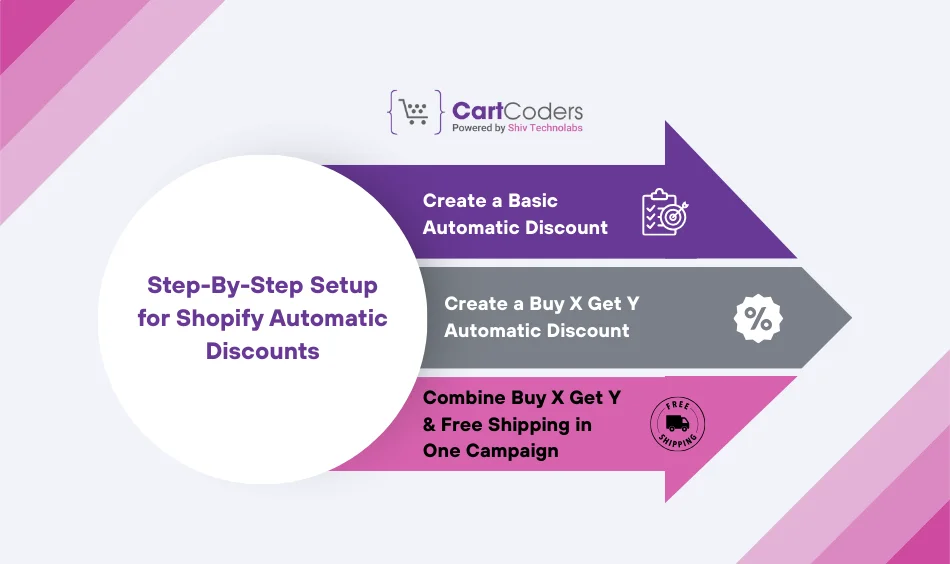
Create a Basic Automatic Discount
The first step to create a simple, automatically calculated discount is to access the Shopify Admin and select Automatic Discount. Choose between a percentage banked and a set-dollar price discount. The next step is to establish minimum purchase criteria, such as the value of the cart or the number of items, or to define what qualifies as a purchase.
Customer eligibility may also be limited when necessary. This configuration is most effective when the target market is sitewide sales, seasonal sales, as well as loyalty incentives, where simplicity and clarity is highly important.
Create a Buy X Get Y Automatic Discount
Buy X and get Y at a discount. Shopify can be used to deal with bundle-type incentives. Buy two and get one, buy three and get 20% off. These deals are good with BOGO and clearance items, and product pairing.
The correctness in the specification of trigger products and reward products is necessary. With misconfiguration, either over-discounting or the inclusion of free items can occur.
Combine Buy X Get Y and Free Shipping in One Campaign
The question many merchants will have is How do I have automatic discounts in Shopify Buy X Get Y and free shipping in a single campaign? As a matter of fact, Shopify cannot offer this as a single automatic discount.
The maximum number of running automatic discounts is one. Examples of workarounds are Buy X Get Y automatic discount plus free shipping with a manual code, shipping profile logic, or the Shopify Plus custom discount feature. Multi-rule campaigns must have a different architecture.
Innovative Ways To Use Automatic Discounts (Without Hurting Profit)
Strategic application of automatic discounts should be used to maximize order value without impairing margins.
Minimums That Protect Margins
Minimum thresholds are the surest way of safeguarding profitability. For example, a 10% discount should be applied only after the cart total exceeds $80, to increase revenue per order. This is the most appropriate strategy for using automatic discounts in Shopify without damaging profits, because it strikes a balance between incentive and sustainability.
Excluding Low-Margin Products
Discounting of all products should not be made. Products with margins below 25% or high fulfillment costs are to be dropped. Collection-based management of eligibility enables the merchants to scale the promotion without continuous manual adjustments and also minimizes the chances of the leakage of the margin.
Applying Discounts to Collections Only
Collection-based targeting is easy to manage and more consistent. Discount rules are automatically inherited when new products are added to a collection. This method proves particularly efficient in the case of rapid sales, where manual product selection increases the risk of errors.
Avoiding Discount Stacking
The use of discount codes in Shopify and auto-discounts should be implemented as different strategies. When they are run at the same time, it creates conflicts and confusion of customers. Stacking should not be done unless it is done deliberately and the logic is well advanced.
An example of a simple margin reference is shown below:
Margin 60% → Discount 10% → Risk Low
Margin 45% → Discount 15% → Risk Medium
Margin 30% → Discount 20% → Risk High
Running Short-Term & Seasonal Deals
Automatic discount works well, particularly when the promotion is time-bound and has a strong sense of urgency.
Running Weekend-Only Discounts
In order to deal with how I use sitewide automatic discounts on Shopify only on weekends, the merchants must rely on scheduling. Shopify allows start and end dates for automatic discounts. Time zone settings in stores should be thoroughly checked to ensure the discount is applied and deducted at the desired time.
Common Seasonal Use Cases
Automatic discounts are available to weekend flash sales, holiday offers, clearance and payday campaigns. Including announcement bars or banners is essential to ensure customers understand the offer before they check out.
Limits, Rules and Where Shopify Hits a Wall
Shopify automatic discounts have clear limits, even though they are pretty helpful.
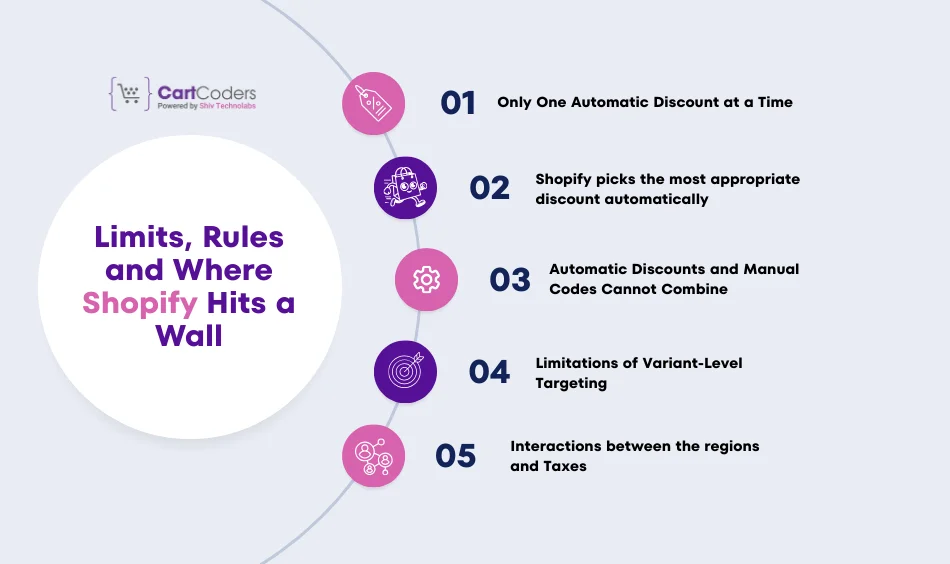
Only One Automatic Discount at a Time
This is the most significant automatic discount limit in Shopify. On purpose or not, one cannot combine more than one automatic discount offered by merchants.
Shopify picks the most appropriate discount automatically
If there are multiple automatic discounts, Shopify will evaluate them and apply the one with the most excellent customer value. This is selection logic that merchants cannot control.
Automatic Discounts and Manual Codes Cannot Combine.
Automatic discount codes cannot be used together with manual discount codes by default. Any effort to permit this needs workarounds or application logic.
Limitations of Variant-Level Targeting
Shopify does not support exact variant-based targeting for automatic discounts. Merchants are usually dependent on product tags or smart collections to emulate variant logic.
Interactions between the regions and Taxes
Different regions have tax and duty as well as shipping regulations that may influence the end-of-day discounted prices. International outlets should also experiment with discounts depending on the regions so that they do not get any surprises.
Troubleshooting Guide
Automatic discounts may fail due to rule conflicts, eligibility mismatches, or cart conditions. This segment helps determine the reasons for discount failures and how to correct them effectively.
Shopify Autonomous Discount Not Operating
The most frequent reasons that may lead to the failure of a Shopify automatic discount are wrong customer eligibility, collection errors, minimum requirements, active manual codes, or shipping profiles that disallow free shipping. Systematic testing reveals the problem quickly.
Discount Works for Some Products Only
When merchants report that their Shopify automatic discount is applied to some products but not others, the problem is usually due to product tags and variant mismatches, draft products, hidden collections, or third-party applications overriding prices.
Customer Wants to Enter a Code
Shopify does not allow customers to use a manual code when the auto-discount is in effect. Examples of workarounds include coding the automatic discount as a manual code, using auto-apply links in a campaign, or using a cart drawer app to enable discount triggers.
Advanced Logic for Bigger Brands
With larger brands, automatic Shopify discounts are usually limited rather than helpful. This is not advanced discount architecture, which is the provision of significant discounts, but the provision of the correct incentive to the correct customer at the correct time, without the need to do it manually and without the need to have a margin risk.
When to Switch to Shopify Plus or Custom Discount Functions
When the rules of discounts clash with business reality, the question arises of when to leave basic Shopify discounts to Shopify Plus or even to custom discount functions. Standard Shopify discounts are not made to be scale-oriented. The ability to make dynamic decisions during checkout with Shopify Plus and custom discount features allows the company to make decisions that are not reliably available to basic plans.
Indicated indicators that you are above basic discounts are:
Operating two pricing levels of B2B and D2C in a single store.
Giving discounts based on regions, taxation, shipping areas, or regulations.
The necessity to have tiered incentives, such as spend $500 and get $5, spend $1000 and get $10.
The use of pricing regulations based on customer tags or wholesale agreements.
Develop multi-level bundles that are dynamically valued.
Funding retroactive pricing, e.g., volume breaks or contract corrections.
When such situations arise, proceeding with simple discounts results in manual operations, checkout errors and lost revenue.
Discuss Shopify Discount Automation With Professionals
Get clarity on stacking, limits, and exclusions.
Can Shopify Plus Create Complex Discounts for B2B and Retail Together?
Indeed, using Shopify Functions, checkout extensibility, and ERP price synchronization, Shopify Plus can build complex automatic discounts with varying B2B and retail customer rules.
Real-life examples are:
Wholesale customers receive tier-based pricing based on the quantity of orders they place and retail customers receive cart-based promotions.
International markets offer region-specific discounts and loyal customers receive bonuses in their domestic markets.
Negotiated pricing is synchronized between the ERP systems and contract customers are given a different pricing, whereas the general public pricing is still maintained.
Smart Use Cases Based on Store Type
There are various industries with various discount strategies. Automatic discounts applied in a one-size-fits-all manner are primarily associated with low performance, margin loss, or customer confusion. The best Shopify automatic discount strategies are based on customer purchasing behaviour, repurchase frequency and price sensitivity in that category.
Fashion and clothing
Collection-based auto discounts and minimum cart amounts, such as 10% off over $100, are the most effective with fashion brands.
Beauty and skincare
Beauty shops enjoy the benefits of Buy X Get Y sales, which can help maintain a cleanser, serum, and moisturiser routine.
Supplements and health
Automatic discounts, such as buy 3 get 15% off, should be based on a minimum quantity of the size of the supplement brands used.
Electronics and bundles
Electronics retailers experience higher returns when using bundle-based discounts rather than individual-item discounts.
Flows and accessories are seasonal.
Accessories are suitable for short-term automatic discounts with seasonal events or trends.
B2B wholesale
B2B outlets demand progressive pricing and customer-tag-based discount logic.
International stores
Multinational companies require region-specific discount plans. Taxes, shipping and local regulations should be included in automatic discounts, which may need varying discount logic by country or market division.
Conclusion
Shopify’s automatic discounts are an effective way to reduce friction, increase checkout completion rates and scale promotions. They are, however, deliberately restricted. Standard plans have no support for advanced logic, stacking is limited and only one automatic discount can run at a time.
This is where expert advice is vital. CartCoders is a leading Shopify Development company that focuses on Shopify discount architecture, Shopify Plus discount solutions, and custom logic using Shopify Functions.
From simple automation to enterprise-level pricing systems, CartCoders assists brands in scaling up promotions and also cushions margins by helping with promotional systems.When your store reaches Shopify discount limits, runs ineffective promotions, or requires sophisticated pricing logic, it is time to take action. Turn to cartcoders.com and collaborate with Shopify experts who develop high-discount programs that generate more revenue and scale profitably.
As the CTO at Shiv Technolabs & CartCoders, I am liable for instigating, planning, integrating, and implementing the organization's strategic orientation.
I gather the most significant tech news in addition to sharing the information I gained while serving as the CTO of Shiv Technolabs, a renowned web and mobile app development company. I am pleased to answer questions as a most valuable expert for Shiv Technolabs Private Limited and to share my experience. I offer a keen insider's perspective on technical advancements.
 eCommerce
Solution
eCommerce
Solution





 INDIA
INDIA


 USA
USA
 CANADA
 AUSTRALIA