If you’re running a B2B eCommerce operation and still relying on a traditional platform, you’re likely managing outdated workflows, manual order entry, rigid pricing structures, and checkout experiences built for retail shoppers, not wholesale buyers.
It’s the enterprise-grade version of Shopify, built specifically to handle the complexity of B2B commerce like custom pricing per customer, net payment terms, multi-location inventory management, high-volume order processing, and deep ERP integrations, all within one platform.
This guide breaks down what makes Shopify Plus the best B2B eCommerce platform in 2026, how its native B2B features work, and how it compares to legacy platforms like Magento, SAP Commerce, and BigCommerce.
Sell Smarter with Shopify Plus
Switch to Shopify Plus and cut your maintenance costs in half.
What Is Shopify Plus B2B?
Shopify Plus B2B is a dedicated B2B sales channel built directly into the Shopify Plus admin. Unlike older platforms, where B2B was enclosed via plugins or workarounds, Shopify Plus treats B2B as a first-class experience.
Key B2B-specific capabilities include:
Company Profiles: Create company accounts with multiple contacts, locations, and permission levels, so a procurement manager and regional buyer both operate under one parent account.
B2B Price Lists: Assign fixed prices or percentage discounts to specific companies or customer segments, with no need for third-party apps.
Net Payment Terms: Set Net 15, Net 30, Net 60, or custom terms per company, enabling standard B2B invoicing workflows.
B2B Checkout: A streamlined checkout built for wholesale buyers, with company-level saved payment methods, draft orders, and PO references.
Vaulted Credit Cards: Approved buyers can save payment methods for repeat purchases without re-entering details each time.
Quantity Rules & Order Minimums: Enforce minimum order quantities, case pack multiples, and quantity increments at a product or variant level.
Why B2B Businesses Choose Shopify Plus
Shopify Plus works best for B2B brands that need more control, better buying experiences, and a platform that can support long-term growth without adding more operational complexity.
1.
Your annual revenue is above $1M and growing.
2.
You manage multiple buyers with different pricing tiers.
3.
You need custom checkout flows such as purchase orders, net terms, or approval workflows.
4.
You want to unify B2B and D2C under one platform.
5.
You are using Magento, WooCommerce, or a legacy ERP-connected storefront and dealing with high maintenance costs.
Quick takeaway: If you run a small wholesale operation, standard Shopify with a B2B app may be enough. But for scaling B2B brands, Shopify Plus offers native infrastructure that reduces technical overhead and supports smoother growth.
What Are the Top 10 Best Shopify Plus Benefits for B2B eCommerce?
Running a B2B store often feels heavy. Orders come from emails. Pricing lives in spreadsheets. Teams spend hours fixing small issues.
That is where Shopify Plus changes the workflow. It brings structure, control, and speed into one system built for scale.
Let’s break down the benefits that matter.
1. Native B2B Channel Without App Dependency
Shopify Plus includes a dedicated B2B sales channel inside the admin. You do not need third-party apps to manage wholesale operations.
You can create company accounts, assign pricing, and manage B2B checkout from one place. This reduces tool dependency and keeps your system stable. It also lowers app costs and avoids conflicts between tools.
2. Custom Price Lists Per Buyer or Company
B2B pricing changes based on agreements, volume, or customer type. Shopify Plus handles this with built-in price lists.
You can assign pricing to specific companies or groups. Set fixed prices or percentage discounts per product. The system applies it automatically at checkout, which removes manual updates and errors.
3. Net Payment Terms Built Into the System
B2B transactions often follow delayed payment cycles. Shopify Plus allows you to set payment terms directly in the admin.
You can offer Net 15, Net 30, Net 60, or custom terms per company. Buyers see their terms during checkout. Your team can track payments without using external invoicing tools.
4. Company Account Management With Multiple Contacts
Wholesale clients often have multiple buyers, roles, and locations. Shopify Plus supports this with company profiles.
You can add multiple users under one account and assign roles based on responsibilities. Each user can place orders independently while staying linked to the same company and pricing structure.
5. B2B Optimized Checkout Experience
B2B buyers expect a fast and structured checkout. Shopify Plus provides a checkout designed for business transactions.
It supports purchase order numbers, saved payment methods, and company billing details. Returning buyers can reorder quickly, which improves efficiency and reduces friction.
6. Shopify Flow for Wholesale Automation
Manual processes slow down operations. Shopify Flow helps automate key tasks without coding.
You can tag new accounts, send reorder reminders, and flag large orders for review. You can also trigger internal alerts for your team. This keeps operations consistent and saves time.
These integrations sync orders, inventory, and customer data across systems. Your team works with accurate data, which reduces manual effort and errors.
8. Unified B2B and D2C Operations
Many brands sell to both businesses and consumers. Shopify Plus allows you to manage both from one admin.
You can show different pricing and experiences to each audience. Wholesale buyers see negotiated rates, while retail customers see standard pricing. You do not need separate systems.
9. Headless Commerce for Custom Experiences
Some businesses need full control over the frontend. Shopify Plus supports headless development using Hydrogen.
You can build custom buyer portals, reorder systems, or product tools. Shopify manages backend operations like inventory and payments, so your system stays reliable.
Your B2B eCommerce Store Deserves the Best
Get expert Shopify Plus setup, custom pricing, net terms, and wholesale checkout done right.
10. Dedicated Support and Scalable Infrastructure
Shopify Plus provides priority support and onboarding guidance. You get access to a launch engineer during setup.
It also offers higher API limits for handling large order volumes and integrations. This keeps your operations stable as your business grows.
What are the Top Shopify Plus B2B Features?
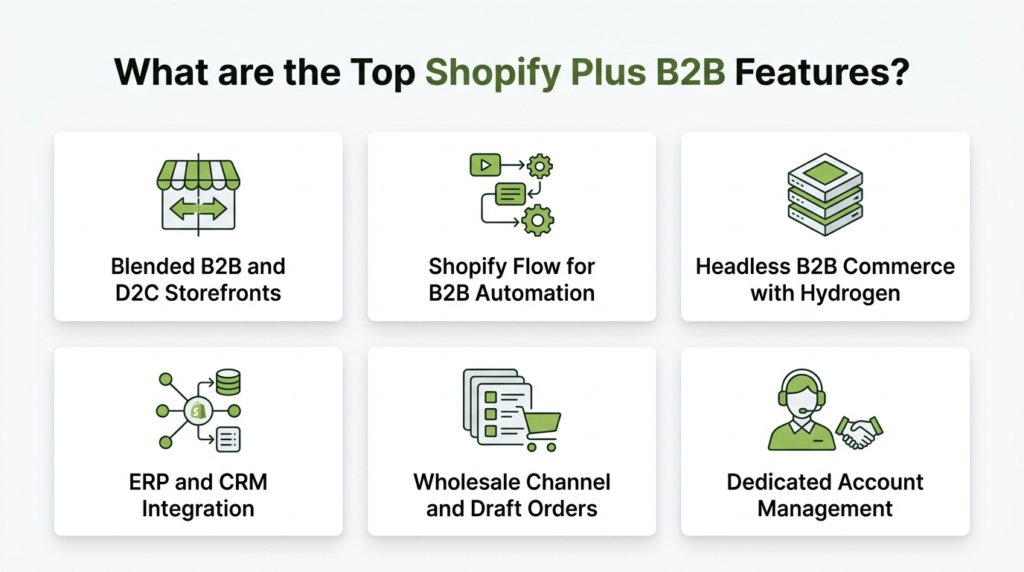
1. Blended B2B and D2C Storefronts
Shopify Plus lets you run B2B and direct-to-consumer (D2C) operations from a single store or separate storefronts, all managed from one admin. Wholesale buyers see their pricing; retail customers see theirs. No duplicate product catalogs, no separate admin panels.
2. Shopify Flow for B2B Automation
Shopify Flow is Shopify Plus’s built-in workflow automation tool. For B2B, it means you can auto-tag new company accounts, trigger reorder reminders based on purchase history, flag high-value orders for review, or send custom notifications, without writing a single line of code.
3. Headless B2B Commerce with Hydrogen
For brands that need a fully custom buyer experience, Shopify Plus supports headless development with Hydrogen (Shopify’s React-based framework). You control the entire frontend while Shopify manages fulfillment, pricing logic, inventory, and payments on the backend.
4. ERP and CRM Integration
Shopify Plus natively integrates with major enterprise systems like NetSuite, SAP, Microsoft Dynamics, Salesforce, and Odoo, so your B2B orders, inventory, and customer data stay in sync across your entire operation.
5. Wholesale Channel and Draft Orders
Sales representatives can create draft orders on behalf of buyers, apply negotiated pricing, and send invoices directly from the admin. This is essential for B2B businesses where sales-assisted ordering is part of the workflow.
6. Dedicated Account Management
Every Shopify Plus merchant gets a dedicated Launch Engineer during onboarding, and ongoing access to Shopify Plus Support, not a generic helpdesk.
Shopify Plus B2B vs. Traditional Platforms: Key Differences
This is where most businesses are losing time and money without realizing it.
Feature
Shopify Plus B2B
Traditional Platforms (Magento, SAP)
B2B native setup time
Setup completes in days with ready-to-use B2B features available inside the admin. No dependency on external tools or long development cycles.
Setup often takes weeks to months due to custom development, configuration, and testing before going live.
Custom pricing per buyer
Built-in price lists allow you to assign fixed or percentage-based pricing per company or group. Changes apply automatically at checkout.
Requires developer support or plugins to create pricing logic. Ongoing updates may need technical involvement.
Net payment terms
Native support for Net 15, Net 30, Net 60, or custom terms per company. Buyers can view and use terms directly during checkout.
Usually handled through plugins or custom modules. Payment workflows often need manual setup and maintenance.
Checkout customization
Supports no-code and low-code customization using Liquid and native tools. Faster changes without heavy development effort.
Full customization requires development resources. Even small changes may need code updates and testing cycles.
ERP/CRM integrations
Pre-built connectors and structured APIs allow smooth integration with systems like NetSuite, SAP, Salesforce, and Odoo.
Integration often depends on custom APIs or middleware. Setup and maintenance require continuous developer support.
Maintenance overhead
Fully managed SaaS platform. Hosting, updates, and security are handled by Shopify, reducing internal workload.
Self-hosted or semi-managed systems require ongoing maintenance, server management, and security handling.
Headless commerce
Supported with the Hydrogen framework. Enables custom frontend experiences while keeping the backend stable and managed.
Headless capability varies by platform. Often requires a complex setup and higher development investment.
Traditional B2B platforms offer deep customization, but that customization comes at a cost: long implementation timelines, expensive development retainers, and ongoing maintenance. Shopify Plus experts change this model by giving you enterprise-ready B2B features, with the flexibility to customize further when needed.
Ready to Build Your B2B Store on Shopify Plus with CartCoders?
Running a B2B business means dealing with complex pricing, bulk orders, multiple buyers, and tight operational workflows. Your platform needs to keep up, and Shopify Plus is built exactly for that.
But getting it right from day one matters. A poorly configured B2B store means lost orders, frustrated buyers, and revenue left on the table.
That’s where we come in. Our certified Shopify Plus developers specialize in:
B2B store setup: Company accounts, price lists, and net payment terms configured correctly from day one
Custom checkout flows: Purchase order fields, approval workflows, and buyer-specific experiences
Wholesale + D2C blended storefronts: One admin, two seamless buying experiences
ERP & CRM integrations: NetSuite, SAP, Salesforce, Odoo, and more kept in sync
Platform migrations: From Magento, WooCommerce, or any legacy platform to Shopify Plus
Whether you’re starting fresh or switching platforms, contact CartCoders.
Conclusion
Shopify Plus isn’t just a bigger version of Shopify; it’s a purpose-built platform for B2B commerce that combines enterprise-grade features with the simplicity and speed of a SaaS solution. Native company accounts, custom price lists, net payment terms, ERP integrations, and no-code automation make it a better traditional B2B platforms that cost far more to implement and maintain.
If your B2B store is outgrowing your current platform, Shopify Plus is worth evaluating. And if you want a partner who knows B2B Shopify Plus implementation inside out, CartCoders is ready to help.
Frequently Asked Questions
What is Shopify Plus B2B, and how does it differ from standard Shopify?
Shopify Plus B2B is a native wholesale and enterprise selling channel available exclusively on Shopify Plus. It includes features like company profiles, custom price lists, net payment terms, and B2B-specific checkout, which are not available on standard Shopify plans without third-party apps.
Can Shopify Plus handle both B2B and B2C (D2C) on the same store?
Yes. Shopify Plus supports blended B2B and D2C operations. You can show different prices and experiences to wholesale buyers and retail customers, either within one storefront or via separate storefronts managed from a single admin.
How does Shopify Plus B2B compare to Magento for enterprise commerce?
Magento offers deep customization but requires significant development resources, hosting management, and ongoing maintenance. Shopify Plus offers key B2B features out of the box, with faster setup and lower costs, making it a strong choice for growing B2B brands.
Does Shopify Plus support net payment terms for wholesale buyers?
Yes. Shopify Plus allows you to set net payment terms (Net 15, Net 30, Net 60, or custom terms) on a per-company basis directly from the admin, no third-party app required.
What integrations does Shopify Plus support for B2B?
Shopify Plus integrates natively with major ERP systems (NetSuite, SAP, Microsoft Dynamics, Odoo), CRMs (Salesforce, Zoho), and logistics platforms. These integrations keep order data, inventory, and customer records synced across your entire business stack.
How much does Shopify Plus cost?
Shopify Plus starts at $2,300/month for standard plans, with enterprise pricing available for high-volume merchants. The cost is typically justified by reduced development overhead and the elimination of expensive plugin stacks required on other platforms.
As the CTO at Shiv Technolabs & CartCoders, I am liable for instigating, planning, integrating, and implementing the organization's strategic orientation.
I gather the most significant tech news in addition to sharing the information I gained while serving as the CTO of Shiv Technolabs, a renowned web and mobile app development company. I am pleased to answer questions as a most valuable expert for Shiv Technolabs Private Limited and to share my experience. I offer a keen insider's perspective on technical advancements.
 eCommerce
Solution
eCommerce
Solution







 INDIA
INDIA


 USA
USA
 CANADA
 AUSTRALIA