Online shopping keeps getting faster, but one problem stays the same: shoppers still hesitate before paying. They can’t touch the product, they can’t judge true size, and they can’t see how it fits their life. That hesitation shows up as abandoned carts, long decision time, and returns.
Augmented Reality (AR) is becoming the practical answer to this gap. It gives buyers a quick way to check “Will this work for me?” by placing a digital version of the product into the shopper’s real space, or onto the shopper’s face/body using a phone camera. BigCommerce describes AR in eCommerce as a way for customers to preview products in their own environment before buying.
This article covers what’s changing in 2026, what shoppers expect from AR experiences, where brands go wrong, and how Shopify-based stores can plan AR in a way that helps sales and cuts returns.
AR Shopping Experiences Built Right
Add product previews that help shoppers check size, fit, and placement before buying.
AR Is Changing How Shoppers Decide, Not Just How Products Look
Most eCommerce stores already have good photos and videos. The issue is not visual quality. The issue is decision confidence.
AR adds a “final check” layer. Buyers stop guessing and start seeing. Reydar explains AR in eCommerce as letting customers preview products in their own environment and helping them make more confident purchase decisions, with fewer returns as a result.
AR vs traditional product presentation
Images show fixed angles. Videos add motion, but the shopper still watches someone else’s view. AR flips that control.
With AR, shoppers can:
Place the item in their room and judge the spacing
Check the scale against familiar objects
Switch variants (color, style) and compare quickly
Feel more certain before payment
This “control” factor is why AR often performs best on products where a wrong choice is expensive or annoying to return.
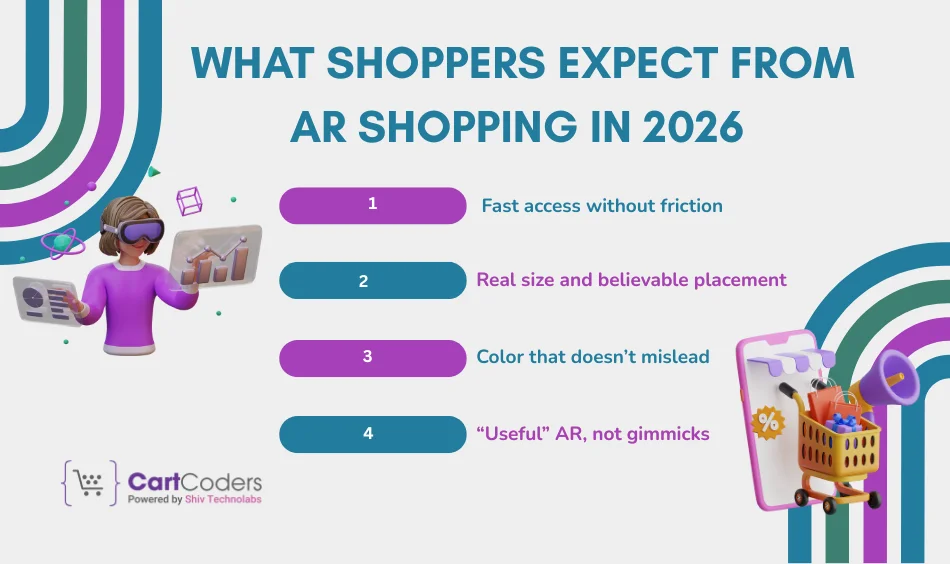
What Shoppers Expect From AR Shopping in 2026
In 2026, shoppers don’t want AR that looks fancy. They want AR that answers buying doubts fast.
1) Fast access without friction
If AR takes too long to load, most shoppers won’t try again. AR needs to be one tap from the product page, especially on mobile.
BigCommerce frames AR as helping customers preview products “on their own time” in their own environment. That only works when access is simple.
2) Real size and believable placement
AR must get scale close enough to reality to be useful. Threekit’s IKEA example highlights that IKEA Place scans the room and shows furniture fit with high accuracy, which is why it works for big-ticket items that are hard to return.
3) Color that doesn’t mislead
Paint, décor, fashion, and lighting are sensitive to color. AR helps, but shoppers still notice when the lighting or display shifts the look.
Threekit’s Dulux example is popular for a reason: it helps buyers see paint colors on their own walls instead of trying to imagine from small samples.
4) “Useful” AR, not gimmicks
If AR feels like a toy, shoppers treat it like entertainment and move on. If AR feels like a shopping tool, they use it to decide.
Salesforce describes AR as changing the eCommerce customer experience and improving connection through more immersive shopping. The key is: the immersion must support purchase decisions, not distract from them.
How AR Fits Into the Actual Buying Journey
AR is most helpful at two moments:
When shoppers are comparing options
This is where doubt grows. AR helps shoppers compare:
Size and spacing
How variants look in their own context
Which option suits their room or personal style
When shoppers hesitate right before payment
Many buyers reach checkout and pause. AR is a fast “confidence check” that helps them commit.
Reydar ties AR to more confident decisions and fewer returns, which is exactly what happens when AR is placed near the decision point (product page and cart area).
AR Experiences Becoming Normal in eCommerce
By 2026, several AR experiences will be expected in specific categories.
Try-on for face and body products
Beauty and accessories have trained shoppers to expect try-on experiences. Salesforce points to AR-powered makeup try-on as a leading example in social commerce contexts.
Common use cases:
Glasses and sunglasses
Cosmetics shade try-on
Jewelry preview on hand/neck
Shoes preview and “look” matching (varies by platform)
Appinventiv also discusses AR, allowing customers to visualize products in their environment and interact with objects in 3D, supporting suitability checks before purchase.
Real-space preview for home products
This is where AR can reduce expensive returns.
Best fits:
Furniture and home décor
Lighting placement checks
Appliances and large electronics sizing
Threekit’s IKEA example is a classic for this exact reason.
Turn Product Views Into Clear Decisions
Give buyers a real-space look at products where hesitation usually happens.
Why AR Impacts Conversions and Returns
AR helps when it removes the most common reasons shoppers back out.
It can:
Reduce “will it fit?” doubt
Reduce “will it match?” doubt
Shorten the time between interest and payment
Cut returns caused by wrong expectations
Salesforce also notes consumer preference for AR shopping experiences in its merchandising guidance, linking AR try-outs with fewer returns.
BigCommerce has also referenced research where shoppers felt more confident after using technologies, including AR/VR.
Product Categories With the Highest AR Impact
AR doesn’t need to be for every product. It matters most when size, appearance, or placement creates doubt.
High-impact category groups:
Fashion + accessories (fit and look)
Beauty + personal care (shade and style)
Furniture + décor + lighting (space planning)
Large electronics/appliances (size and setup)
Threekit’s brand examples show AR adoption across exactly these categories.
AR in Shopify-Based eCommerce Stores
For Shopify stores, AR works best when it’s part of product content planning, not a last-minute add-on.
Where AR fits on a Shopify store
Product page: primary “View in your space” / “Try it on” entry
Variant selection: switch colors or styles before buying
Gallery/media: AR should sit alongside images and video
Two practical implementation paths
Native product media route (3D assets + compatible viewer)
App-based route (good for quick rollout or specific use cases)
Your goal should be to make AR easy to try and easy to trust.
Real Challenges Brands Face With AR
AR can backfire when it’s inaccurate or hard to access.
Common issues:
Poor scale (product appears too large/small)
Bad color behavior (lighting mismatch makes it feel fake)
Slow load time (mobile shoppers drop off)
Wrong product selection (AR added to items that don’t need it)
Appinventiv frames AR as helping customers visualize and assess suitability; that value disappears when accuracy is weak.
How eCommerce Brands Should Prepare for AR in 2026?
Start with what drives buying doubt, not what looks impressive.
Step 1: Pick the right products
Choose products with:
Higher return rates
Bigger size/fit uncertainty
Bigger price points
Frequent “will this work?” questions
Step 2: Keep AR placement obvious
If shoppers can’t find AR within seconds, they won’t use it.
Step 3: Treat AR as a “decision helper”
Write microcopy that frames AR as a quick check:
“See the size in your room.”
“Check the color on your wall.”
“Try the shade on your face.”
Step 4: Measure what matters
Track:
AR engagement rate (who clicks it)
Conversion rate lift on AR-enabled products
Return rate shift (before vs after)
Time on product page
Why eCommerce Brands Choose CartCoders for AR Shopping?
CartCoders helps eCommerce brands add AR shopping experiences that support real buying decisions. Our focus is not on visual gimmicks, but on practical AR that helps shoppers check size, fit, and placement before checkout.
With deep experience in Shopify store builds, custom features, and advanced product setups, CartCoders plans AR around how customers actually shop.
From selecting the right product categories to setting up AR-ready product pages, every step is designed to reduce buyer doubt and return risk.
Whether you are running a growing online store or managing a large Shopify setup, CartCoders provides the best Shopify development services in UAE that fit naturally into your existing product flow and work smoothly across devices.
AR in eCommerce is moving from novelty to expectation because it solves a basic problem: decision confidence. BigCommerce and Reydar both frame AR as a way to preview products in real environments before purchase, which leads to better choices and fewer returns.
In 2026, shoppers will reward stores that help them choose correctly the first time. The best AR experiences won’t feel like “tech.” They’ll feel like a natural part of shopping.
FAQs
What is AR shopping in eCommerce?
AR shopping lets buyers preview products in their own space or on themselves using a device camera before paying.
Does AR work on mobile browsers?
Many AR experiences are designed for mobile-first usage, and browser-based AR is common for fast access.
Is AR useful for small eCommerce stores?
Yes, if you start with products where shoppers often hesitate (size, fit, high returns). The goal is better buying decisions, not adding AR to every item.
Can AR reduce returns?
It can reduce returns caused by expectation mismatch by helping shoppers preview products more accurately before buying.
Which products benefit most from AR?
Furniture, décor, paint, beauty, eyewear, and other categories where look, size, and context drive uncertainty tend to benefit the most.
As the CTO at Shiv Technolabs & CartCoders, I am liable for instigating, planning, integrating, and implementing the organization's strategic orientation.
I gather the most significant tech news in addition to sharing the information I gained while serving as the CTO of Shiv Technolabs, a renowned web and mobile app development company. I am pleased to answer questions as a most valuable expert for Shiv Technolabs Private Limited and to share my experience. I offer a keen insider's perspective on technical advancements.
 eCommerce
Solution
eCommerce
Solution









 INDIA
INDIA


 USA
USA
 CANADA
 AUSTRALIA