eCommerce website development packages help businesses launch, rebuild, or scale online stores with a clear scope, defined deliverables, and predictable costs. Instead of negotiating every feature separately, these packages bundle design, development, integrations, and setup into structured plans that match different business stages.
Search data shows growing interest in terms like eCommerce website development packages, eCommerce development packages, and eCommerce web development packages, mainly from business owners comparing options before committing budget. What they want is simple: what’s included, how pricing works, and which package actually fits their store’s requirements.
This guide breaks down everything you need to know about eCommerce website development packages. You’ll see common package types, typical inclusions, real pricing factors, comparison tables, and a clear way to choose the right package based on products, integrations, and growth plans. By the end, you’ll know exactly which package makes sense for your business, and what to avoid before signing up.
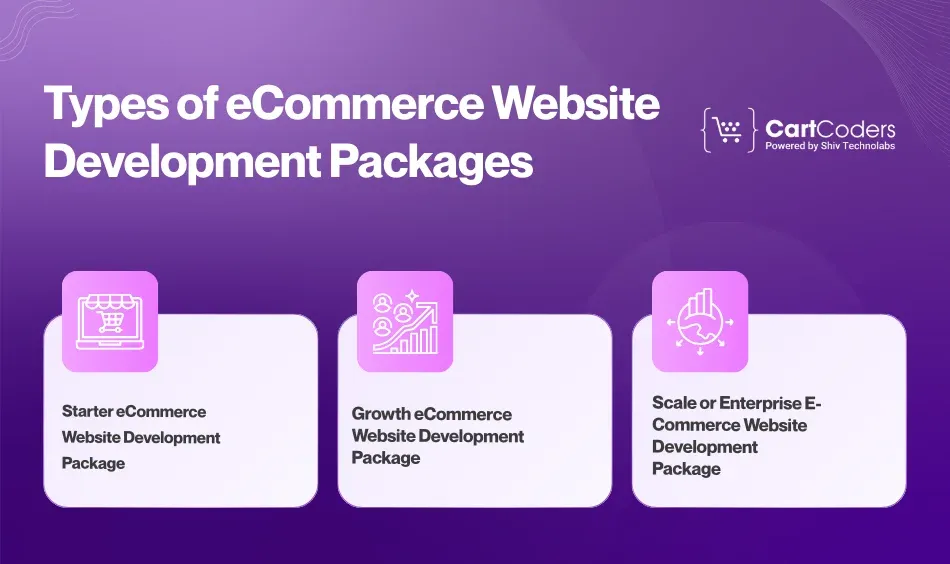
Types of eCommerce Website Development Packages
Most eCommerce website development packages fall into three broad categories. Each package type is designed around store size, feature needs, and growth stage. Understanding these differences helps you avoid paying for features you don’t need or missing ones you will need later.
Starter eCommerce Website Development Package
This package is built for businesses launching a new online store with a limited product range and simple operations.
Starter eCommerce development packages focus on speed and cost control, making them suitable for quick launches.
Growth eCommerce Website Development Package
Growth packages are designed for stores that need better user experience, higher conversions, and automation.
Best for
Growing brands
50–500 products
Marketing and sales-driven stores
Typical inclusions
Custom sections and layout adjustments
Advanced product structure and filters
Conversion tracking and analytics setup
Email, marketing, and third-party app integrations
This is the most commonly chosen eCommerce web development package for businesses planning steady growth.
Scale or Enterprise eCommerce Website Development Package
These packages handle complex requirements, higher traffic, and system integrations.
Best for
Large catalogs and multi-region stores
B2B eCommerce setups
Brands with ERP, CRM, or custom workflows
Typical inclusions
Custom functionality and logic
Multi-currency and multi-language setup
Performance and scalability optimizations
External system integrations
Enterprise eCommerce website development packages are built for long-term scale rather than fast launch.
What’s Included in eCommerce Website Development Packages?
While inclusions vary by provider, most eCommerce website development packages cover a standard set of features required to launch and operate an online store. The difference between packages usually lies in depth, customization, and integrations, not in the fundamentals.
Storefront Design and User Experience
This part focuses on how your store looks and how users move through it.
These features help stores start collecting data from day one.
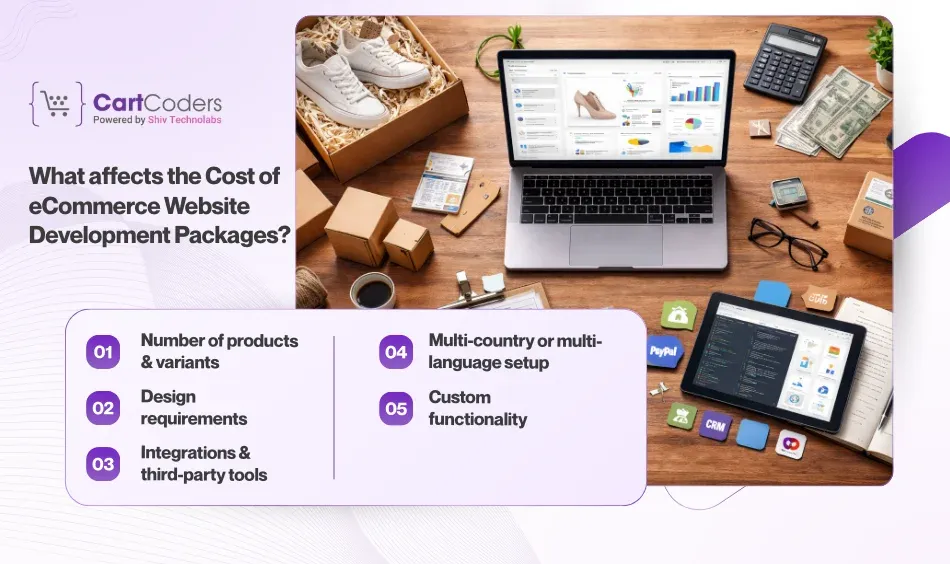
What Affects the Cost of eCommerce Website Development Packages?
The cost of eCommerce website development packages is not fixed across businesses. Even when two stores choose the same package tier, pricing can vary based on scope, complexity, and future requirements. Most pricing differences come from how much customization and integration work is involved.
Understanding these cost drivers helps you compare eCommerce development packages more accurately and avoid unexpected add-ons later.
Number of products and variants
Stores with larger catalogs require more setup time, complex navigation, and structured product data.
Design requirements
Theme-based designs cost less, while custom layouts, unique sections, and advanced UI patterns increase effort and pricing.
Integrations and third-party tools
Connecting payment providers, shipping tools, ERP, CRM, subscription systems, or marketing platforms adds to the package scope.
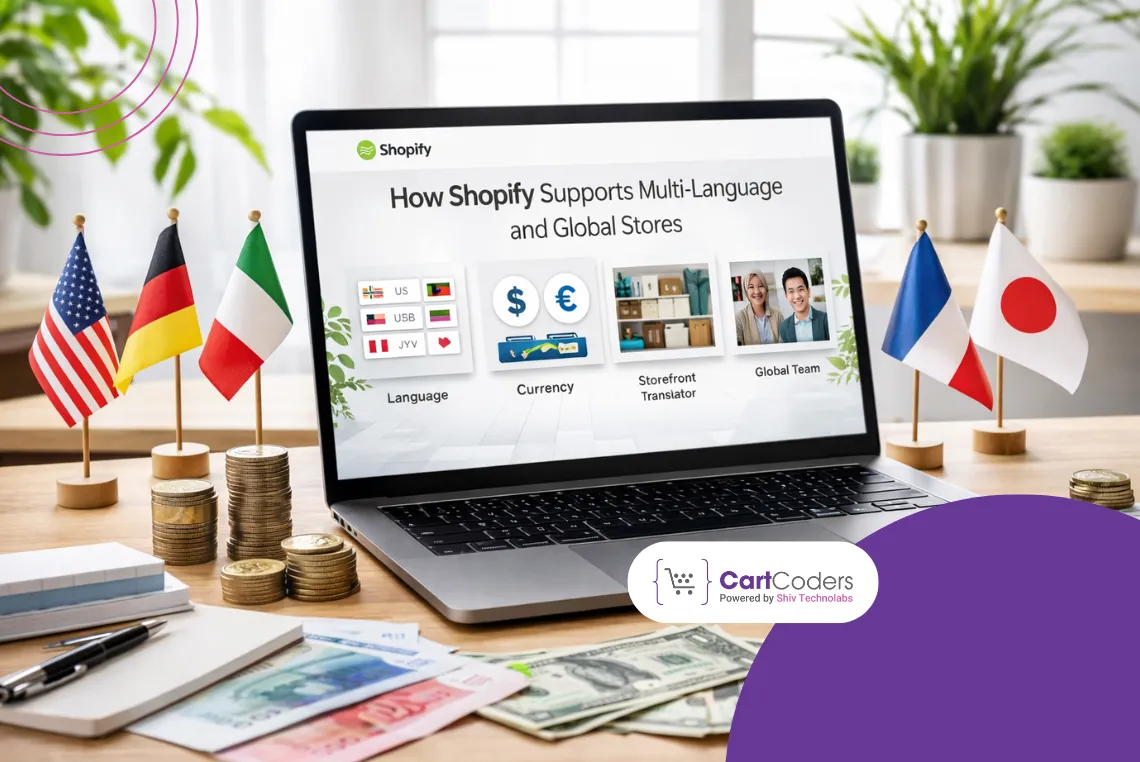
Multi-country or multi-language setup
Selling in multiple regions increases complexity due to currencies, taxes, shipping rules, and translations.
Custom functionality
Features like tiered pricing, bundles, B2B accounts, or approval-based checkout usually fall outside basic eCommerce website packages.
Typical Pricing for eCommerce Website Development Packages
eCommerce website development packages are usually priced in tiers based on store size, customization level, and technical scope. These pricing ranges help businesses estimate budgets before requesting a detailed proposal. The values below reflect common industry benchmarks rather than fixed quotes.
eCommerce Website Development Packages – Pricing Overview
The table below shows the most common package types, their typical use cases, and realistic pricing ranges. These packages are structured to cover different business stages, from new launches to complex eCommerce operations.
These price ranges give a practical reference point. Final costs vary based on requirements, integrations, and the level of customization involved.
Monthly eCommerce Development Packages
Some businesses prefer ongoing eCommerce development packages instead of a one-time build. These monthly packages focus on continuous improvements, updates, and technical support rather than initial setup alone.
Package Type
Typical Monthly Pricing (USD)
Suitable For
Starter Monthly
$800 – $1,500
Maintenance, minor updates, bug fixes
Advanced Monthly
$1,800+
Continuous improvements, integrations, and optimization work
Monthly eCommerce web development packages are often chosen by growing stores that need regular updates, feature enhancements, and ongoing technical support.
What Drives Pricing Differences Across Packages
Pricing for eCommerce website packages can vary even within the same tier. The factors below explain why two similar stores may receive different quotes.
Pricing Factor
Impact on Cost
Product volume & variants
Larger catalogs require more setup and testing
Design customization
Custom UI costs more than theme-based layouts
Integrations
ERP, CRM, shipping, or subscription tools add scope
Multi-country setup
Currency, tax, and shipping rules increase complexity
Custom logic
B2B pricing, bundles, or approvals raise effort
Understanding these pricing drivers helps businesses choose the right eCommerce website development package and avoid unexpected costs later.
How to Choose eCommerce Website Development Packages – Common Mistakes to Avoid!
Many businesses select eCommerce website development packages based on price alone, only to face limitations or extra costs later. Avoiding these common mistakes can save time, budget, and rework.
Choosing the Cheapest Package Without Reviewing the Scope
Low-cost eCommerce development packages often exclude critical items like analytics, SEO setup, or scalable structure. These gaps usually surface after launch.
Ignoring Future Growth Requirements
Packages that only fit current needs can block expansion. Product growth, integrations, or multi-country selling may require rebuilding if not planned early.
Assuming All Features Are Included
Not every eCommerce website package includes content upload, SEO setup, or post-launch fixes. Always confirm what is included versus treated as an add-on.
Skipping Analytics and Tracking Setup
Without proper tracking, it’s difficult to measure performance or improve conversions. This is often overlooked in basic eCommerce web development packages.
Overlooking Ownership and Access
Some packages limit access to code, hosting, or admin accounts. Clear ownership should be defined before starting development.
Why Businesses Choose CartCoders?
CartCoders works with ecommerce brands that want clear scope, predictable pricing, and scalable builds. Instead of forcing one-size-fits-all plans, we structure eCommerce website development packages around real business needs such as product volume, integrations, and growth plans.
From starter stores to complex eCommerce operations, we focus on clean architecture, performance-ready builds, and future-proof setups. Each package is designed to reduce rework, support integrations, and allow businesses to grow without rebuilding their store every year.
Businesses choose us when they want eCommerce development packages that balance speed, flexibility, and long-term stability.
Conclusion
eCommerce website development packages provide a structured way to build online stores with clear scope, predictable cost, and defined timelines. Instead of guessing what is included or paying for unnecessary features, businesses can choose packages that match their product size, technical needs, and growth plans.
The right package depends on more than budget. Product volume, integrations, multi-region selling, and post-launch requirements all play a role in determining which eCommerce development package makes sense. Taking the time to evaluate these factors early helps avoid rework, delays, and hidden costs later.
Whether you are launching a new store or upgrading an existing one, understanding how eCommerce website packages are structured puts you in a stronger position to make informed decisions and plan for long-term growth.
For businesses looking for well-defined ecommerce website development packages with room to scale, CartCoders offers structured options built around real-world ecommerce challenges. Contact us today and get more info!
Frequently Asked Questions
What are eCommerce website development packages?
eCommerce website development packages are predefined service plans that include design, development, and store setup tasks. They offer a fixed scope and clearer pricing compared to fully custom eCommerce builds.
How much do eCommerce website development packages cost?
The cost depends on package scope, product volume, design requirements, integrations, and customization. Starter packages cost less, while growth and enterprise eCommerce development packages are priced higher due to added complexity.
What is usually included in eCommerce development packages?
Most packages include storefront setup, product structure, payment and shipping configuration, basic SEO setup, and analytics tracking. Higher-tier eCommerce website packages may include integrations and custom functionality.
Can I add features later if I start with a basic package?
Yes. Many businesses start with a starter eCommerce web development package and upgrade later. However, skipping required features early can increase costs due to rework.
Are eCommerce website packages suitable for B2B stores?
Yes, but B2B stores often require growth or enterprise packages. These include features like customer-specific pricing, account login, approval workflows, and system integrations.
Do eCommerce web development packages include SEO?
Most packages include basic technical SEO setup, such as site structure, indexing, and tracking. Advanced SEO work is usually offered as an add-on or part of higher-tier packages.
How long does it take to build an eCommerce website using a package?
Timelines vary by package type and scope. Starter eCommerce website development packages are faster, while enterprise builds take longer due to custom logic and integrations.
What is the difference between eCommerce website packages and custom development?
Packages follow a fixed scope with predictable pricing. Custom development starts with discovery and evolves over time, offering flexibility but higher cost and longer timelines.
As the CTO at Shiv Technolabs & CartCoders, I am liable for instigating, planning, integrating, and implementing the organization's strategic orientation.
I gather the most significant tech news in addition to sharing the information I gained while serving as the CTO of Shiv Technolabs, a renowned web and mobile app development company. I am pleased to answer questions as a most valuable expert for Shiv Technolabs Private Limited and to share my experience. I offer a keen insider's perspective on technical advancements.
 eCommerce
Solution
eCommerce
Solution







 INDIA
INDIA


 USA
USA
 CANADA
 AUSTRALIA