One of the most frustrating things Shopify store owners face is growing traffic with the same sales. You pay for ads, SEO, influencers or social media, your analytics indicate hundreds or even thousands of visitors, but the sales are barely coming through.
Data indicates that the conversion rate in Shopify is between 2.5% and 3% on average, meaning that even minor friction can end sales if the shop is not optimised.
The bitter fact is that traffic alone is not sales. Visiting is the initial step in gaining visitors. Visitors need to be very confident, informed and feel safe to make a purchase and this is when sales occur.
Turn More Visitors Into Buyers With CRO Services
Clear testing, better layouts, and stronger calls-to-action.
In this article, we will cover reasons for the lack of sales on Shopify, rather than speculation.
What “Traffic but No Sales” Really Tells You?
Shopify traffic that isn’t converted isn’t a mystery when it happens to a store like this. Traffic is an indicator, but not a precursor to buying behavior. When visitors visit your store, they come for various reasons; not everyone is ready to make a purchase.
Many visitors are:
Product research but not purchase.
Comparison of prices, features or brands.
Seeking information, reviews or inspiration.
Clicking out of curiosity, not purpose.
Not all Shopify stores make sales because traffic is low; rather, it’s because there is on-site friction that stands in the way of the sales process. The most frequent areas of friction are:
Unclear calls to action
Confusing navigation paths
Weak trust signals
Inequality between promise and reality.
That is why, when there are no sales, Shopify is usually a conversion problem, not a traffic problem. To know whether sales are occurring on Shopify, it is necessary to understand visitor intent.
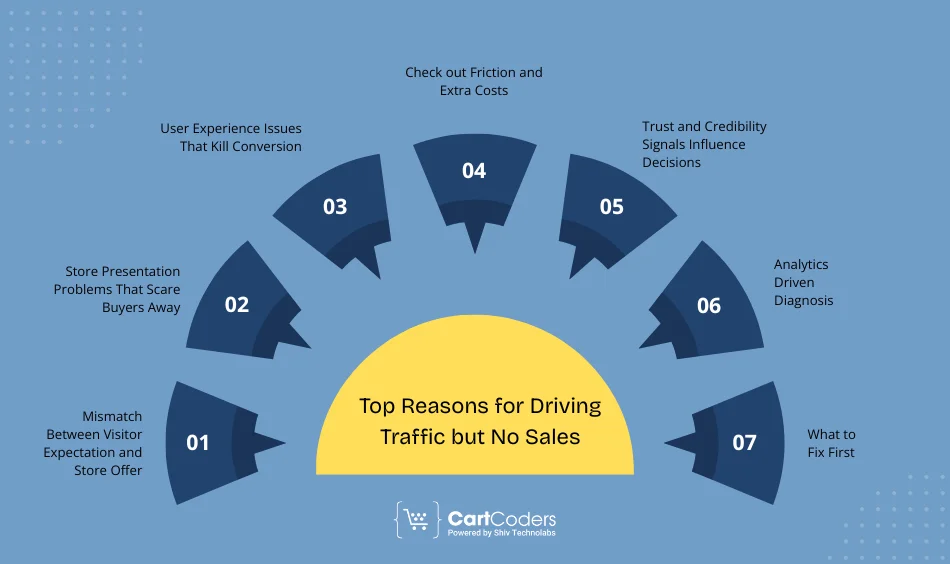
Top Reasons for Driving Traffic but No Sales
1. Mismatch Between Visitor Expectation and Store Offer
Nobody comes without a specific vision created by advertisements, search engine results or social media. When the landing page fails to do so, they abandon it in a few seconds.
What usually goes wrong
Ad offers what the product page fails to provide.
SEO keywords attract browsers, not purchasers.
Social traffic lacks purchase intent.
What to check
Google search console queries and the landing pages.
Headlines of ad copy and product page headlines.
Traffic source quality
It is a typical Shopify bad traffic issue: why a Shopify store would receive traffic yet no sales.
2. Store Presentation Problems That Scare Buyers Away
Any poorly structured store will decrease trust.
Navigation issues
Too many menu options
Confusing category names
Products hard to find
Homepage problems
No clear next step
Weak value proposition
The homepage is not working as a virtual shop front.
Product page problems
Low-quality images
Lack of particularizations or bonuses.
Vague descriptions
These are the problems that directly affect the non-conversion of Shopify stores and in most cases, the problem can only be resolved through professional Shopify design services.
3. User Experience Issues That Kill Conversion
Most Shopify stores lose customers before they reach the checkout.
Before adding to the cart
Slow page loading
Broken mobile layout
Buttons are hard to tap
After adding to the cart
Confusing cart page
Unexpected steps
Redirect loops
This brings about one of the most common grievances: add to cart, no sales. The UX kills silently without any discernible mistakes.
Talk To Experts About Conversion Rate Optimization
Discuss drop-offs, heatmaps, and test ideas.
4. Check out Friction and Extra Costs
The last conversion gate is checkout and the weakest.
Common blockers include:
Alaska tax or shipping surprises.
Forced account creation
Limited payment methods
Complex or lengthy checkout paperwork.
Checkout problems alone can lead to no sales on Shopify, even when the rest is in place. Most of the revenue losses occur here.
5. Trust and Credibility Signals Influence Decisions
First-time visitors do not automatically suspect you.
Fundamental trust gaps include:
None of the customer reviews and testimonials.
Lacking a policy of returning or refunding.
Lacks a visible brand narrative or contact details.
Generic store appearance
Visitors are reluctant to provide payment information without any assurances. That is why Shopify visitors without trust in the store are a significant trigger of low conversion rates.
6. Analytics Driven Diagnosis
Correction of conversion problems without data results in wasted effort.
Use GA4 to analyze:
High bounce rate pages
Exit pages
Funnel drop-off points
Compare:
Informational Keywords vs Buyer Intent Keywords.
Huge session pages and low conversion pages.
In the case of no sales, Shopify-wide and GA4 show traffic; the issue can be observed in the data. GA4 traffic and no sales Shopify problems should never be left undiagnosed.
7. What to Fix First
Rather than random changes, use a checklist:
Correlate landing page messages with traffic purpose.
Enhance the product page images and readability.
Streamline checkout and cart.
Add visible trust signals.
Test the full mobile experience.
Review GA4 exit and drop-off reports.
Measure traffic quality, but not volume.
This is the easiest method to know how to correct traffic, but no sales with Shopify.
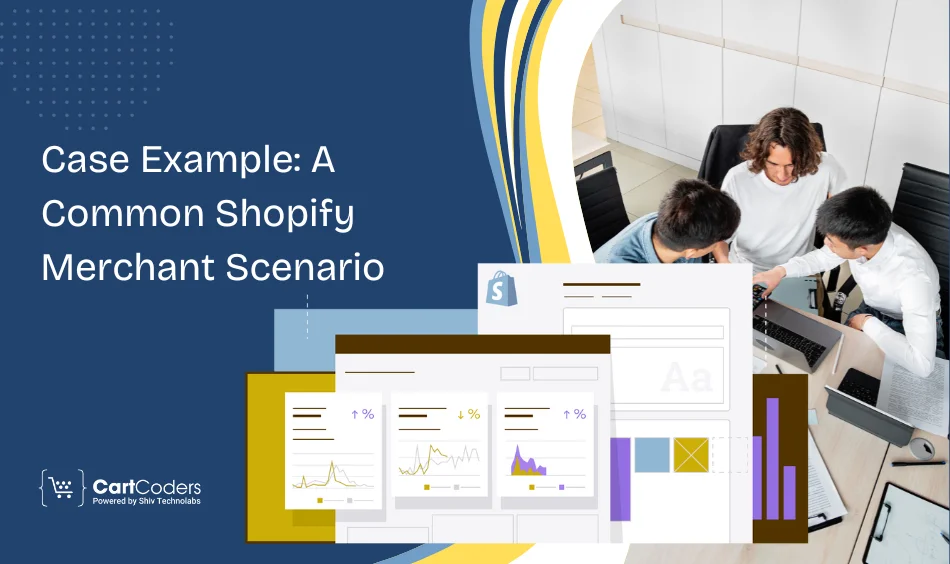
Case Example: A Common Shopify Merchant Scenario
To understand why traffic does not necessarily translate into sales, we could look at a real-life example from Shopify that represents thousands of merchants every month.
Store Situation: High Traffic, No Revenue.
Google Ads and Instagram campaigns bring 1,000 to 1,200 people to a Shopify store in the lifestyle segment in a day. Traffic is good, the session duration seems high enough, yet sales are nearly zero. The store receives 0-2 orders per week, even as impressions increase and ad spending does not decrease. The initial impression of the store owner suggests the price is high or the demand is low.
Initial Assumption
The merchant believes:
The product is too expensive
The market is saturated
Sales have to be evoked by discounts.
This makes them begin giving 10 to 20% discounts and the conversion rate hardly changes. Traffic does not go down, revenue does.
Data Review Using GA4
An adequate examination of GA4 tells a much different tale.
Key observations:
Product page bounce rate over 75%.
Mean product page time is less than 18 seconds.
Scroll depth indicates that most users do not visit product descriptions.
The add-to-cart rates are very low.
This information clearly indicates an issue that occurs before check-out, not pricing.
Root Cause: Expectation Mismatch
The advertisements market the product as being of high quality and premium; however, the product page tells otherwise:
Generic product images
None of the contexts of lifestyle and use.
A description based on features rather than benefits.
No social evidence or customer testimonials.
The visitors arrive with high expectations and leave when the page fails to deliver on the promise in the advertisements.
Fix Applied: Alignment, Not Discounts
The store instead concentrates on alignment, rather than continuing to lower prices:
Substituted stock photography with natural lifestyle photography.
Restated product descriptions to take care of buyer issues.
Included a strong value proposition above the fold.
Added elements of trust, such as guarantees and FAQ. There were no changes in traffic sources or ad spend.
Outcome: Conversion Begins
After 14 days of changes in the following:
Bounce rate dropped by 38%
There was a 2.4x increase in add-to-cart rate.
Initial daily sales were obtained.
The cost per acquisition was brought to a standstill.
It was not a volume of traffic at all. It was transparency, belief and congruency.
Conclusion
Traffic is not success but progress. Sales occur when the visitors are knowledgeable, confident and secure enough to pay. When you are getting traffic in Shopify but no sales, it is not that you need more advertising, but rather to eliminate friction.
Determine the precise drop-off point using data. Organize the actual issue rather than pursue more visitors. Be it UX, trust, checkout, or traffic intent, there is a solution for every problem.
CartCoders is the leading Shopify development company focused on diagnosing and resolving conversion issues. Our team helps stores convert traffic into revenue through UX audits, checkout optimisation and professional Shopify design services.
When your Shopify store isn’t registering any sales despite substantial traffic, it is time to stop guessing and start fixing it.
Frequently Asked Questions (FAQs)
Why traffic and no sales in Shopify?
This most commonly occurs because of incompatible traffic intent, inadequate UX and a lack of trust cues or checkout friction, not traffic volume problems.
How good is a Shopify conversion rate?
The majority of Shopify shops make a turnover between 1.5 and 2%. A value below this indicates issues with optimisation.
Does it mean that the wrong traffic does not lead to sales in Shopify?
Yes, opportunity or discovery traffic is hardly ever converted into purchases.
What is the reason why visitors carry a cart and fail to purchase?
Checkout friction, unexpected costs, or lack of trust commonly cause abandonment.
Does store design influence Shopify sales?
Absolutely, the layout is weak and the poor navigation and visuals lower confidence in buyers.
What is the benefit of GA4 to resolve Shopify conversion problems?
GA4 will indicate a conversion blocker because it is where visitors get lost.
Would I put more advertisements when there is low sales?
No, correct any conversion problems and then scale traffic.
Can Shopify sales be optimized using mobile?
Yes, Shopify is visited by more than 70% of people using mobile devices.
What is the turnaround time for conversion problems?
After appropriate repairs, most stores improve within 2-4 weeks.
Does CartCoders optimize Shopify conversions?
Yes, CartCoders is a Shopify developmentcompany that focuses on troubleshooting and repairing Shopify stores that are not generating sales but still have traffic.
As the CTO at Shiv Technolabs & CartCoders, I am liable for instigating, planning, integrating, and implementing the organization's strategic orientation.
I gather the most significant tech news in addition to sharing the information I gained while serving as the CTO of Shiv Technolabs, a renowned web and mobile app development company. I am pleased to answer questions as a most valuable expert for Shiv Technolabs Private Limited and to share my experience. I offer a keen insider's perspective on technical advancements.
 eCommerce
Solution
eCommerce
Solution








 INDIA
INDIA


 USA
USA
 CANADA
 AUSTRALIA