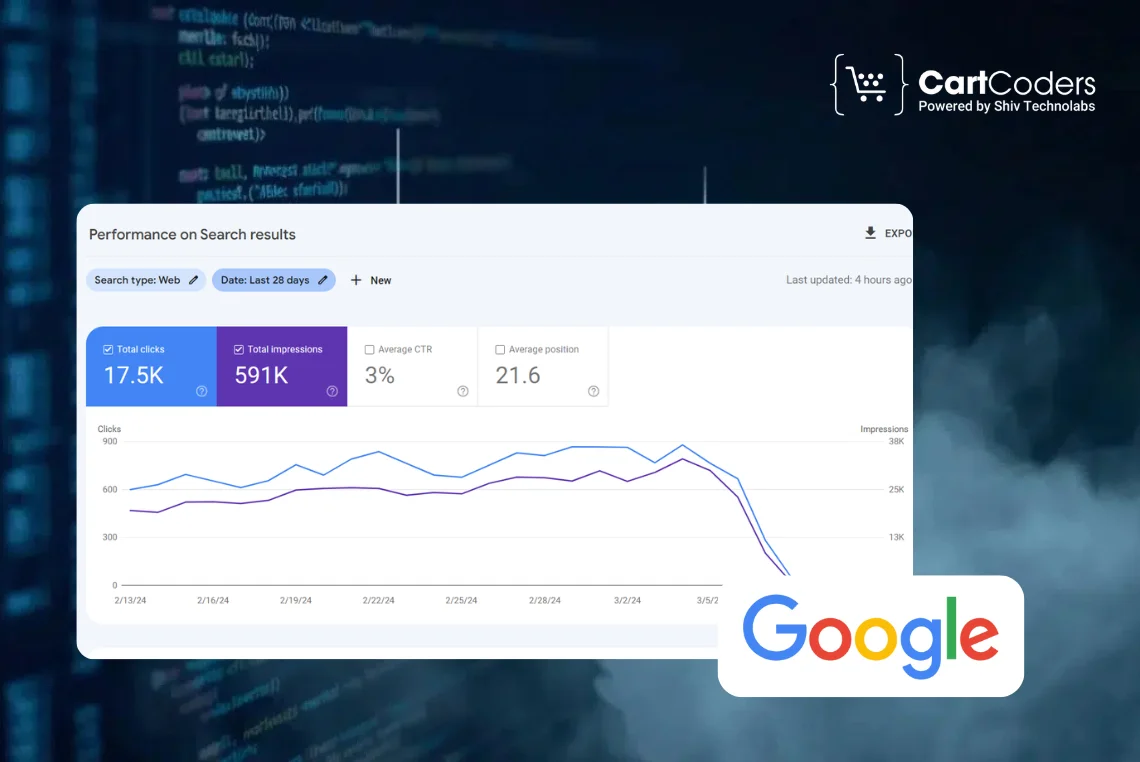
A complete redesign seems the natural fix for high-traffic Shopify stores. The sales drop, the pages are slow, the apps are competing, and redesigning the Shopify store is the automatic response. However, statistics speak otherwise. Google claims that conversion may decrease by 20% with a one-second increase in the site load time. According to Shopify Plus, more than 65% of high-revenue stores are experiencing performance problems rather than design issues, which are hindering scalability.
Shopify stores with high traffic are under pressure at all times. There are heightened expectations of speed, checkout stability is paramount, and any change is risky to revenue. A complete redesign is reasonable, but it will cause downtime, search engine instability, and tracking setbacks. The smart move is to repair what actually is a performance-killer instead of dismantling it.
Upgrade Your Shopify Store Design Without Rebuilding
Clean UI updates that keep your data intact.
This article explores more suitable alternatives to a complete Shopify redesign, tailored for stores that process thousands of sessions, orders and SKUs every day.
Why High Traffic Shopify Stores Consider Redesigns?
The high-volume stores do not wake up needing redesign. They do it because they are under accumulating technical and operational pressure.
Slow Product Pages
The more traffic, the heavier the product pages are. Scripts are stacked, pictures are not optimized and applications are adding unnecessary logic. Load time increases to 5s or higher, damaging rankings and conversion percent. Merchants treat the problem as the theme, yet the majority of slowdowns are caused by the logic behind the scenes and by asset overload, rather than the visual design.
App Overload
For high-revenue stores, 25+ apps may be used. Upprocess, loyalty, personalization, reviews, subscriptions, upsells, analytics. Every application includes scripts, API calls and render blocking. Over time, conflicts appear. Merchants believe that redesign = cleanup, but unless they restructure the app’s logic, performance problems return within weeks.
Design Limits During Growth
Themes that perform in the five-digit-per-month bracket find it hard in the five-digit-per-month bracket. Dealer struck layout limits, gathering complexity and sales limits. This gives the impression that design is hindering growth, yet in reality, it is structural flexibility and data-flow processing that are hindering growth.
Checkout or Tracking Breaking
Businesses with high traffic depend on accurate tracking, conversion attribution and a stable checkout process. Minor theme changes may interfere with GA4, Meta pixels, or checkout code. Teams consider it safer to start afresh after several attempts at breakage, although redesign exponentially increases this risk.
Why a Full Shopify Redesign Can Create New Problems?
Redesigns also make them feel productive, but in high-traffic stores, they pose serious operational threats.
Downtime Risk
Though staged, extensive Shopify redesigns require DNS changes, theme publishing and app reconfiguration. Errors are high during launches. Failure to check out during rush hour may cost a mature store tens of thousands of dollars in an hour.
SEO Impact
Rankings can be tanked due to URL changes, changes in internal linking, a lack of schema and changes in the content hierarchy. Recovery can take 3 to 6 months. For stores reliant on organic traffic, a loss in redesign SEO directly affects revenue.
Checkout and Payment Issues
Payment gateways, shipping logic, tax codes and checkout scripting are brittle. These flows are frequently interrupted by redesigns. A 1% checkout decline at scale equates to colossal monthly losses.
Tracking and Analytics Resets
Recurring events such as GA4, Meta Capi, TikTok pixels and server-side tracking configurations are often reset during redesigns. Lacses disrupt ROAS analysis and optimization of paid media.
Rework Costs of Large Catalogs
Big box stores (5,000 SKUs and above) have to do rework. Metafields, templates, collections and filtering logic has to be re-created. Expenses are growing faster than the redesign estimate.
When a Full Redesign Actually Makes Sense?
Redesign is not necessarily bad. It is just often misused.
Brand Repositioning
If the brand image, messages and visual language are undergoing a paradigm shift, a redesign should be implemented. This is long-term and not short-term.
Platform Change
Re-designing in conjunction with structural upgrades goes hand in hand when relocating the legacy system or old Shopify structures to the current Shopify Plus configuration.
Major UX Shift for a New Audience
If the business changes to an alternative to a DTC, B2B, wholesale, or heavy model of subscription, UX architecture might need to be restructured.
Better Alternatives to a Full Shopify Redesign
High traffic stores are more scaled up where the structure is enhanced in pre of the visuals.
Improving Performance Without Changing the Theme
Clearly, it is possible to do this without altering the theme and still improve performance. Script control decreases render blocking. Remover Redundant logic is eliminated with app cleanup.
Page-level fixes are template optimization. Mobile-first performance tuning addresses 70%+ of traffic. These alone can soon increase speed by 30-50% with no design modifications.
Fixing Store Logic Instead of Rebuilding Design
Cart rules define the behavior of orders. Pricing logic influences promotions and packages. Handling inventory can lead to overstocking and fulfilment delays. Order flow stabilizations stabilize post-purchase activities. None of this needs redesign, but it all enhances performance and reliability.
Separating Storefront Changes From Backend Risk
Checkout remains untouched. Front-end updates are separated. Backend logic stays stable. This partitioning minimizes breakage during updates and protects revenue flow even during high-traffic spikes.
Handling High Traffic Without Theme Limitations
UI flexibility is not decoupled, enabling faster updates. Reduced dependency translates to fewer conflicts. Live traffic is secured through safer iteration. Big-box stores prefer modular changes over complete resets.
How High Traffic Stores Decide Which Path to Take?
Large-scale decision-making should not be hasty.
Redesign vs Targeted Fixes
Redesigns reset everything. Fixes are solution-oriented to a particular bottleneck. Huge traffic stores prefer accuracy to inconvenience.
Short-term vs Long-term Impact
Redesigns are experienced as meaningful in the short run. Structural fixes enhance the long-term advantages of speed, stability and scalability.
Risk vs Control
Redesign enhances risk exposure. Specific enhancements enhance control of operations. Established brands are controlled.
What to Review Before Choosing Any Redesign Alternative?
High-traffic stores have to stop and reconsider the basics before deciding whether a complete Shopify redesign is needed or whether more innovative solutions can resolve the issue.
This review stage safeguards income, avoids unnecessary risk and prevents modifications motivated by frustration. For stores with 10k+ monthly sessions or 100k+ in revenue, this step can be disastrous.
Traffic Characteristics & Load Characteristics.
Begin with reality and not assumptions about traffic. Check the source of traffic, the peak and the load behavior of the users. The behaviour of organic, paid, email and direct traffic differs.
The store experiencing 60% mobile traffic with peak loads during campaigns is another issue compared to the store that is driven by constant organic visits.
Talk To Experts About Shopify Store Redesign
Discuss layout issues, goals, and redesign scope.
Examine bounce rate percentage, interactive time, checkout drop-offs and server response during the peak period. The numerous performance complaints are linked to traffic spikes, not design issues.
App Usage & Script Weight
Busy shops tend to collect apps quickly. This is an addition of scripts and API calls, along with dependencies for each app. Examine which applications actively earn a profit and which do not just add functionality.
Determine redundant functionality, non-utilized tools, and applications that inject scripts across the entire site. Even dropping 3 to 5 low-value apps can save 20+% of load time. Without altering the design, speed improvements are likely; hence, redesign may be unnecessary.
Count of Products and Complexity of Catalogs
A small store with 50 products does not exhibit the same behavior as a store with 5,000 SKUs. Big catalogs place emphasis on collection logic, filtering, search and metafields. Test the grouping of products, collections and whether templates are used effectively.
Most redesigns fail due to their lack of attention to catalog scale and recreation of layouts that cannot accommodate long-term growth.
System Dependencies and Depth of Integration
Contemporary Shopify stores can hardly survive on their own. ERP, CRM, WMS, subscription systems, loyalty systems and analytics systems are closely intertwined. Check the extent of integration of your store.
The more integrations, the greater the risk of redesign. Disruption of fulfilment, reporting or communication with a customer can occur by interfering with a single webhook or API flow. High dependency depth supports specific resolves instead of resets.
Payments, Checkout and Compliance Logic
There is no compromise on checkout stability. Review custom scripts, payment gateways, tax settings, shipping logic and regional compliance settings. Even simple modifications can disrupt the scalability of the checkout process.
Checkout works and converts well, but redesigning around it brings unwarranted risk. Smart options preserve the checkout intact while enhancing everything else.
Strategy Plans and Map Alignment
Lastly, revisit the direction that the business is taking. Do you intend to go international, B2B, subscription, or marketplace integrations? Long-term growth plans are usually in conflict with short-term redesigns. Otherwise, better alternatives that enhance the structure, flexibility and performance scale better after 6 to 24 months. The decisions must be made in favour of future earnings, not only current issues.
How Growing Shopify Stores Make Changes Without Starting Over?
High-growth teams are not notorious for any changes.
Phased Changes: Releases are done in staged periods. Revenue risk stays minimal.
Safer Rollouts: Feature lists and testing systems prevent live failures.
Testing Without Disruption: Other teams address this by separating the storefront from Shopify product administration and checkout. This will enable stabilized innovation.
Conclusion
Redesign cannot always be the solution for a high-traffic Shopify store. Speed concerns, instability and developmental friction can hardly be attributed solely to visuals. They are due to overworked logic, uncontrolled applications and structural inefficiencies. Smart changes minimize risks, defend revenue and sustain momentum.
It is at this point where CartCoders will differ. CartCoders is a certified Shopify development company that helps high-traffic Shopify and Shopify Plus stores scale without destructive redesigns. Our team focuses on performance engineering, structural optimization, backend logic refinement and safe storefront evolution.
CartCoders fortifies stores, rather than resetting them. Stability is growth for brands that handle thousands of orders and millions in revenue. CartCoders develops precisely that.
If your Shopify store is under pressure from traffic growth, speed issues, or operational complexity, do not default to redesign. Let CartCoders audit your store, identify real bottlenecks and implement safer high-impact improvements.
Frequently Asked Questions
What are the options for a complete redesign of Shopify in large stores?
Yes, performance optimization, app cleanup, backend restructuring and a modular UI upgrade are more likely to help high-traffic stores than complete redesigns, which are risky.
Is it possible to run high traffic in Shopify without a redesign?
With adequate optimization, Shopify can support enormous traffic. The performance problems encountered are typically due to poor architecture, heavy applications and inefficient logic, rather than the platform.
To what extent should a Shopify store be redesigned?
Reworking is rational in cases of brand repositioning, significant UX changes, or platform changes. It ought not to be reactive to performance problems.
What is the solution to Shopify’s slowness?
Increased speed can be achieved by controlling the script, audit of apps, optimized templates, caching policy and correcting the backend logic without altering the theme.
Who is to deal with optimizing the performance of Shopify?
Established Shopify development agencies, such as CartCoders, are experts in upgrading high-traffic stores to safely grow without affecting the revenue stream during redesigns.
As the CTO at Shiv Technolabs & CartCoders, I am liable for instigating, planning, integrating, and implementing the organization's strategic orientation.
I gather the most significant tech news in addition to sharing the information I gained while serving as the CTO of Shiv Technolabs, a renowned web and mobile app development company. I am pleased to answer questions as a most valuable expert for Shiv Technolabs Private Limited and to share my experience. I offer a keen insider's perspective on technical advancements.
 eCommerce
Solution
eCommerce
Solution









 INDIA
INDIA


 USA
USA
 CANADA
 AUSTRALIA