eMAG is one of Eastern Europe’s largest online marketplaces. It connects thousands of sellers with buyers across Romania, Hungary, and Bulgaria. The platform grew fast because it supports local deliveries, multiple languages, and simple checkout.
Many startups and retailers want to follow this model. They aim to build a marketplace where sellers can list, sell, and ship products using one system. An eMAG-style site gives flexibility to both merchants and customers.
Build Your Own eMAG-Like Store in Romania
Product feeds, multi-vendor, shipping—all handled
If you plan to build a website like eMAG, you need modules for seller onboarding, product control, order tracking, and payouts. This blog explains how those parts work together — including the main modules, admin panels, and seller flows that power a scalable marketplace.
What Makes eMAG a Successful Multi-Vendor Marketplace
eMAG stands out for its practical design and clear process.
Key features include:
Multi-seller setup with verified merchants
Category-based commissions
Detailed product filters and fast search
Easybox locker delivery for faster shipping
Discount vouchers and campaign tools
These features help buyers compare offers quickly. They also let sellers manage stores with minimal manual work.
The business model is simple. Sellers register, upload products, and pay a small fee per sale. Revenue comes from commissions, campaigns, and ad placements.
Every new seller passes KYC verification before joining. Once approved, they can manage listings, handle orders, and process returns. Buyers use cards or cash on delivery, which builds trust in regions where COD is common.
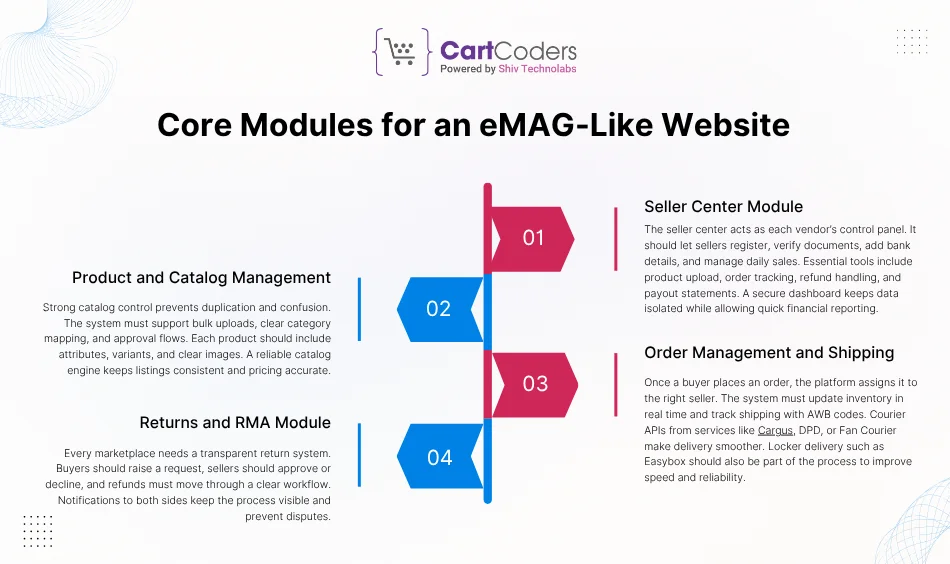
Core Modules for an eMAG-Like Website
Seller Center Module
The seller center acts as each vendor’s control panel. It should let sellers register, verify documents, add bank details, and manage daily sales. Essential tools include product upload, order tracking, refund handling, and payout statements. A secure dashboard keeps data isolated while allowing quick financial reporting.
Product and Catalog Management
Strong catalog control prevents duplication and confusion. The system must support bulk uploads, clear category mapping, and approval flows. Each product should include attributes, variants, and clear images. A reliable catalog engine keeps listings consistent and pricing accurate.
Order Management and Shipping
Once a buyer places an order, the platform assigns it to the right seller. The system must update inventory in real time and track shipping with AWB codes. Courier APIs from services like Cargus, DPD, or Fan Courier make delivery smoother. Locker delivery such as Easybox should also be part of the process to improve speed and reliability.
Returns and RMA Module
Every marketplace needs a transparent return system. Buyers should raise a request, sellers should approve or decline, and refunds must move through a clear workflow. Notifications to both sides keep the process visible and prevent disputes.
Your eMAG Clone, Built With Ownership
No templates—custom UI, logic, and flow
Payments and Settlement
Money flow defines marketplace trust. The platform should support cards, wallets, COD, and pay-later options. It should calculate commissions automatically and create payout statements for each seller. A consistent commission engine keeps financial records clear and avoids calculation errors.
Admin Panel Architecture for an eMAG-Clone Website
Admin Dashboard
The admin area should display real-time metrics such as total sales, active sellers, and category performance. Access control is vital — finance, logistics, and support teams need different permissions. Integrated ticketing helps handle disputes and refund cases quickly.
Campaign and Voucher Management
Campaigns attract buyers and help sellers increase sales. Admins should create category-specific campaigns, apply discount codes, and track voucher usage. A built-in report helps measure the impact of each campaign and improves planning for future events.
Audit Logs and Compliance
Security and compliance must stay at the core. Every login, payout, and data update should be logged automatically. The system should support GDPR requests, store consent records, and use two-factor authentication for sensitive actions. Detailed logs help detect fraud and maintain trust between sellers and administrators.
Technical Foundation and API Design
Building an eMAG-style marketplace requires a stable and modular technical base. The platform must handle thousands of daily transactions while keeping performance steady. A flexible backend and modern frontend framework make that possible.
Marketplace API Structure
APIs connect every part of your marketplace. They sync sellers, buyers, couriers, and payment providers.
Core endpoints should cover:
Products: create, update, and fetch details
Orders: process, cancel, and track deliveries
Invoices: generate and store fiscal data
Shipping: create labels and fetch courier statuses
Users: manage roles and permissions
A versioned API (for example, v1, v2) prevents system breaks when new modules launch. Documented endpoints also help third-party partners such as couriers or accounting tools connect easily. When built well, the API behaves like the one eMAG offers to its sellers — simple, reliable, and secure.
Security and Reliability
Security cannot be an afterthought. Use token-based authentication, HTTPS, and encrypted storage for sensitive data.
Add rate limits to stop API abuse.
Schedule database backups and health checks daily.
If your platform handles personal data from Romania, Hungary, or Bulgaria, make GDPR compliance part of your development checklist.
Mobile App Like eMAG – Features and Cost
Most buyers shop on phones. A mobile app brings speed, convenience, and push notifications that keep users engaged. An eMAG-style app should work smoothly on both Android and iOS.
User App Features
The buyer app should include:
Product catalog and search
Advanced filters and category view
Cart and checkout flow
Real-time delivery tracking
Account management and order history
Push alerts can inform users about sales, Easybox deliveries, or refund updates. Offline caching helps when network speed is low.
Seller App Features
Sellers also need a mobile dashboard. They can view new orders, confirm shipments, track payments, and manage customer questions. Quick access through a secure login saves time and builds efficiency.
Development Cost for Web and App
Creating a full-scale marketplace with mobile support requires planning and budget.
A basic MVP web marketplace with limited modules may cost around $10,000 – $20,000.
A full system with seller center, courier integrations, and marketing tools may reach $25,000 – $50,000.
Building both Android and iOS apps adds another $15,000 – $30,000, depending on design complexity and features.
Timelines vary between 10 – 14 weeks for an MVP and 20 – 28 weeks for a complete rollout. Choosing reusable code frameworks and a shared API layer cuts total time by up to 30%.
Cost and Timeline Breakdown
Phase
Scope
Estimated Cost (USD)
Duration
MVP Website
Core marketplace modules
10,000 – 20,000
10 – 14 weeks
Full Marketplace
Seller center, courier, payments
25,000 – 50,000
20 – 24 weeks
Mobile Apps
Buyer + Seller apps, API layer
15,000 – 30,000
6 – 10 weeks
Costs depend on design, integrations, and country-specific logistics APIs. Including a cloud infrastructure plan early prevents surprises later. Hosting on AWS, Google Cloud, or Azure keeps performance consistent even under traffic spikes.
Maintenance and Future Growth
After launch, set aside a small budget for ongoing updates. New courier APIs, payment options, or legal rules appear often. Updating modules regularly keeps the system secure and compliant. Many marketplaces plan quarterly upgrades to add campaigns, loyalty points, or analytics dashboards.
Localization and Cross-Border Setup
eMAG expanded fast because it localized every element — language, currency, and delivery. You can do the same with translation modules and tax settings for each region.
Your platform should:
Support multiple currencies (RON, HUF, BGN, EUR)
Display prices and tax details per country
Include VAT, invoice formats, and e-invoicing where required
Connect with regional couriers for domestic and cross-border delivery
Multi-language support helps sellers target customers in their native language. It also improves search results because users often look for products in local terms.
A consistent cross-border setup opens new revenue streams without creating separate stores for each country. With one admin panel and shared catalog, you can manage sales in several regions just like eMAG does.
SEO and Growth Strategy for an eMAG-Style Marketplace
Building the platform is only half the job. The next step is attracting sellers and buyers. SEO and structured content help your site rank high and drive organic traffic.
On-Page SEO Setup
Every product page should include a clear title, unique description, and high-quality image. Use schema markup for product, review, and offer data. This helps search engines display rich snippets.
Add canonical URLs for categories and filters to prevent duplicate indexing. Use short, keyword-focused URLs like “/electronics/phones” instead of long query strings.
Internal links between related products keep visitors engaged and lower bounce rates.
Technical SEO
Fast loading speed builds trust and improves conversion. Use lazy loading for product images and store assets on a CDN.
Compress images, minify scripts, and test performance using tools like PageSpeed Insights. Mobile responsiveness is essential since most shoppers visit from phones. Include structured breadcrumb trails so users can jump between categories easily.
Voice Search and AEO Optimization
Voice search queries are rising. Buyers often ask full questions such as “Where can I buy phones online in Romania?” To capture these searches, add conversational questions in your FAQ and blog sections.
Use direct answers below each question in plain language.
This approach helps your content appear in AI overviews and voice assistant results.
Security and Compliance for a Large Marketplace
Security builds trust for both sellers and customers. Each action on the platform should be traceable and encrypted.
User and Seller Verification
Start with verified sign-ups. Ask sellers to upload identity and business documents before approval. Use two-factor authentication for login and financial updates. Limit failed login attempts to prevent brute-force attacks. Keep all data encrypted in transit and at rest.
Payment Security
Work with certified gateways that follow PCI DSS rules. Avoid storing card information directly on your servers. Enable refund traceability so every return or cancellation can be tracked from the admin panel.
Data Protection and Legal Compliance
Follow GDPR rules when collecting and storing personal data. Let users download or delete their information when requested. Store access logs to monitor any misuse. Regular audits and vulnerability scans reduce security risks.
Fraud Detection
Set alerts for suspicious seller activity. Track sudden price drops, multiple failed payments, or identical product images from different sellers. Automated checks can flag high-risk accounts for review.
Strong security reduces support load and increases buyer confidence. Once users trust the platform, they return more often.
Growth Channels Beyond SEO
Paid ads and partnerships help expand faster. Work with courier and payment partners to promote your marketplace jointly. Encourage sellers to run discount campaigns during key seasons. Offer loyalty credits or reward points to repeat customers. Email and push notifications can remind users about abandoned carts or pending returns.
You can also build a referral program for both sellers and buyers. Happy users often invite others when they earn small rewards or discounts. Such word-of-mouth campaigns work better than paid promotions in the long run.
Conclusion
An eMAG-style website needs strong planning, modular architecture, and a reliable tech team. Each part—from product uploads to Easybox deliveries—should work smoothly through secure APIs.
When built right, such a marketplace can handle thousands of orders per day and attract verified sellers from different regions.
At CartCoders, we build custom multi-vendor marketplaces inspired by successful platforms like eMAG. As a leading Shopify development company in Romania, Our develops secure seller centers, admin panels, and mobile apps tailored to your business goals.
A well-designed marketplace doesn’t just connect sellers and buyers—it builds long-term trust, repeat purchases, and regional growth opportunities.
FAQs
How much does it cost to build a website like eMAG?
It depends on features, app support, and integrations. On average, development costs range between $25,000 and $50,000 for a full marketplace.
Which modules are most important for an eMAG-style marketplace?
Seller onboarding, catalog management, order tracking, payments, and admin reports are essential for daily operations.
How long does development take?
An MVP can launch within 10 to 14 weeks. A complete platform with mobile apps may take up to 28 weeks.
Can I include my own courier or payment system?
Yes. The API-based design lets you connect any regional courier or gateway, including local options in Romania, Hungary, or Bulgaria.
How can I make my marketplace stand out from eMAG?
Add faster support, better loyalty programs, or unique niche categories. Focus on user experience and clear pricing for sellers.
As the CTO at Shiv Technolabs & CartCoders, I am liable for instigating, planning, integrating, and implementing the organization's strategic orientation.
I gather the most significant tech news in addition to sharing the information I gained while serving as the CTO of Shiv Technolabs, a renowned web and mobile app development company. I am pleased to answer questions as a most valuable expert for Shiv Technolabs Private Limited and to share my experience. I offer a keen insider's perspective on technical advancements.
 eCommerce
Solution
eCommerce
Solution








 INDIA
INDIA


 USA
USA
 CANADA
 AUSTRALIA