Print-on-demand (POD) stores work under a totally different system than regular online shops. Standard retailers keep stock ready and ship items right away, but POD businesses create each item only when someone buys it. According to reports, the global print-on-demand market is projected to grow at 26.1% by 2033.
Since POD items are made just for you, print-on-demand shipping, returns and customer support require more time, better planning, and lots of back-and-forth.
People buying custom stuff need to know that nothing starts printing until they pay, that waiting times stretch longer and that sending things back isn’t always an option. POD shipping delays, requests for new items and help desk questions happen all the time in this type of business.
Launch Your Print On Demand Store Faster
Clean setup for designs, pricing, and order routing.
This guide breaks down exactly how POD stores manage shipping, returns, refunds and customer support.
How Long Does Print-on-Demand Shipping Take?
Print-on-demand order completion involves several steps that affect when your package arrives. Getting familiar with this schedule helps stores tell buyers what to expect and reduces arguments.
Production Time Before Shipping
In POD shops, your item is made only after you buy it. There’s nothing already made sitting in storage. Most POD products take 2–7 business days to print, depending on what you ordered, the design’s complexity and the supplier’s workload. Items with photos, special text, or detailed artwork usually take even longer. When shopping gets crazy during Q4, placing your order can take 30%–40% longer.
Shipping Time After Production
After your item finishes printing, it heads into the delivery phase. Packages travelling across the country usually arrive in 3–7 business days, depending on the carrier and destination. Orders crossing borders can take 7–20 business days, especially during border checks. Things like where you live, how you chose to ship and how much the delivery company can handle all change when your package shows up.
Total POD Order Timeline
The full POD order journey looks like this:
Order placed, printing, quality check, packing, shipping, delivery
Buyers need to expect longer wait times than stores that keep everything ready. Being upfront cuts down cart abandonment by up to 18%, according to Baymard Institute data.
Why POD Orders Take Time?
Lots of shoppers wonder why POD orders take longer. The answer comes down to how custom manufacturing works and can’t really be avoided.
Made-to-Order Printing Process
POD items get created only after someone pays. Nothing sits waiting on warehouse shelves. Every sale starts a new print job, which includes setting up the design, preparing materials and adjusting the machines. This create-as-you-go system reduces waste but adds steps that regular online stores don’t handle.
Manual Quality Checks
Unlike factory-made products, POD items undergo hands-on inspection. Print companies check if colors look right, everything lines up correctly, images are sharp and designs sit where they should on the fabric. When problems pop up, items get printed again without asking. These quality steps cut return rates by up to 25%, but they push back when shipping starts.
Provider and Carrier Dependencies
POD stores lean on outside print companies and delivery partners. Shop owners can’t control when couriers run late, bad weather slows things down, or border checks take forever. Orders going overseas especially feel the impact of delivery rules and local regulations.
Can Print on Demand Items Be Returned?
Returns at POD shops are subject to strict rules because items are made specifically for each buyer.
Standard Return Rules for POD Products
Most POD items can’t be sent back by default. Since they’re made just for you, nobody else can buy them. Unlike normal online shopping returns, POD sellers can’t put custom items back on the shelf. This rule helps businesses avoid losing money, but it needs to be clearly spelled out before checkout.
When Returns May Be Accepted
Sending things back usually works only in certain situations:
Damaged items during transit
Printing defects or misalignment
Wrong product or incorrect size sent
In these scenarios, the problem needs to be confirmed with pictures before anything gets approved.
What Customers Should Know Before Ordering
Shoppers need to double-check size guides, preview how designs look and review order information carefully. POD stores clearly spell out personalised product return policies to reduce confusion. Honest warnings cut down disputes by 35%+.
What Happens If a POD Order Is Wrong?
Mistakes are uncommon but can happen in POD operations.
Common POD Order Issues
Typical POD problems include:
Wrong size or colour
Print placement errors
Damaged items during delivery
Most problems occur during the making or delivery stages, not when ordering.
How Stores Handle Wrong Orders
When someone reports a problem, stores ask for pictures as proof. The order is reviewed internally and shared with the print company. Depending on what the supplier says, either a new item is sent, or money is returned.
Replacement vs Refund
Sending out a new item works better for POD shops since it keeps money coming in. Giving money back happens only when sending a replacement doesn’t make sense or supplier rules allow it. POD refund policy approval often depends on supplier agreements.
Who Handles POD Returns?
Knowing who does what stops confusion.
Role of the Store Owner
The shop owner is who buyers talk to first. Everything happens through email, help desks, or support pages. Shop owners work with customers and print partners to resolve issues quickly.
Role of the Print Provider
Print companies deal with manufacturing mistakes and decide whether to offer reprints or a refund. They don’t talk straight to buyers. Their job stops at making things and making sure quality stays high.
Why Customers Should Not Contact the Printer
Print companies only work on business-to-business contracts. Buyers who reach out to printers directly won’t hear anything back. Stores handle all customer conversations to keep the brand voice consistent.
How POD Refunds Work
Refunds follow set procedures in POD shops.
When Refunds Are Approved – How POD Refunds Work
Money gets returned for:
Verified printing defects
Lost shipments
Incorrect products delivered
Changing your mind or picking the wrong size usually doesn’t count.
How Refunds Are Processed
Money goes back to however you originally paid. How long it takes depends on the payment system, usually somewhere between 5–10 business days. Transaction fees might not come back.
Partial Refunds and Store Credit
Some POD shops give store credit instead of cash back. Shipping costs often stay gone. Store credit stops money from leaving while keeping shoppers happy.
Professional POD stores follow a defined workflow:
Acknowledge the issue
Request order details and images
Provide a resolution timeline
Update the customer regularly
This structured approach increases resolution satisfaction by 40%.
Keeping Customer Trust
Honest timelines, transparent policies and proactive updates help maintain trust. Customers value clarity more than speed when buying personalized items.
How POD Customer Support Works
Customer support is the backbone of POD success.
Support Channels Used by POD Stores
Most POD stores use:
Email support
Contact forms
Helpdesk platforms like Zendesk or Freshdesk
Multi-channel support improves response efficiency.
Response Time Expectations
Standard response times range between 24–48 hours. Complex cases involving providers may take longer. Automated replies help manage expectations during peak periods.
Post-Purchase Support Flow
Support does not end at checkout:
Order confirmation emails
Shipping updates
Delivery follow-ups
Issue resolution if needed
This flow reduces chargebacks by 20%+.
Talk To Experts About Print On Demand Website Setup
Discuss products, suppliers, and the fulfillment process.
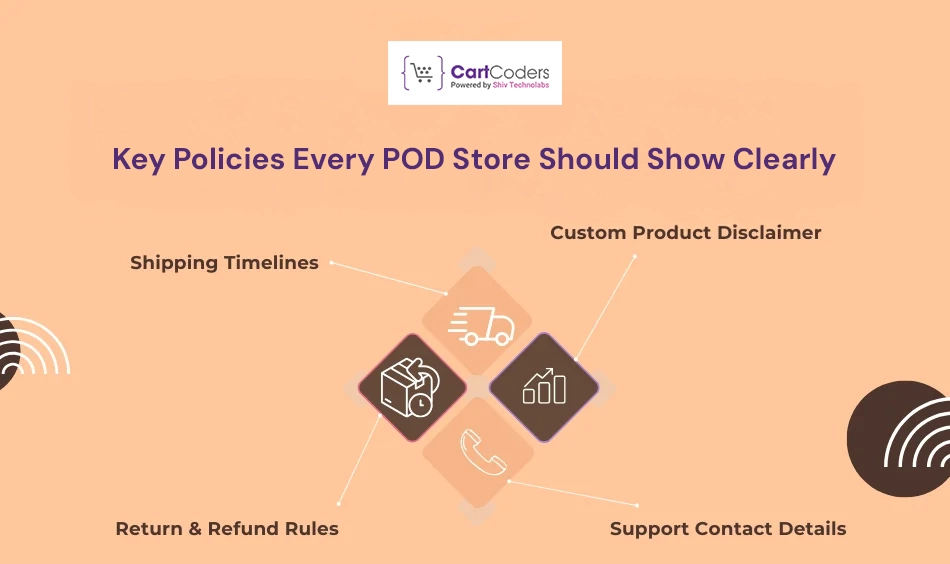
Key Policies Every POD Store Should Show Clearly
Clear policies prevent disputes and refunds.
Shipping Timelines
Stores must display realistic production and shipping timelines prominently. Transparency reduces support tickets significantly.
Return and Refund Rules
Return and refund policies must explain eligible scenarios clearly. Ambiguity leads to dissatisfaction and negative reviews.
Custom Product Disclaimer
Personalized product disclaimers protect businesses legally and operationally. Customers must acknowledge customization terms before checkout.
Support Contact Details
Visible support contact information builds trust and improves conversion rates by up to 12%.
Conclusion
Print-on-demand shipping, returns and customer support work very differently from traditional online shopping models. Longer wait times, tight rules on sending things back and organized complaint handling are just part of how POD businesses run. Clear policies reduce fights, while solid support systems build lasting buyer trust. A well-organized POD setup allows brands to scale without chaos, even during high-volume periods.
This is where CartCoders becomes a strategic advantage. As a specialized eCommerce and POD store setup services provider, CartCoders helps brands design scalable POD infrastructures, integrate reliable print providers, automate order flows and build customer support systems that actually work. Whether you are launching a new POD brand or struggling with pod shipping delays, pod refund policy issues, or pod order issue management, CartCoders delivers solutions that drive growth, not headaches.
If you want to build a profitable, scalable print-on-demand business without operational bottlenecks, now is the time to act. Partner with CartCoders to implement optimized POD workflows, clear policies, and customer support systems that protect your brand and revenue.
Frequently Asked Questions (FAQs)
How long does print-on-demand shipping take?
Print on demand shipping typically takes between 7–20 business days, including production and delivery. Timelines vary based on product type, location and carrier availability.
Can print on demand items be returned?
Most print-on-demand items are non-returnable due to customization. Returns are accepted only for defects, damage, or incorrect products.
How do POD stores handle refunds?
POD refunds are approved only for verified issues and processed to the original payment method. Processing times depend on payment gateways.
Why do POD orders take time?
POD orders take time because products are printed only after purchase, followed by quality checks and third-party shipping processes.
As the CTO at Shiv Technolabs & CartCoders, I am liable for instigating, planning, integrating, and implementing the organization's strategic orientation.
I gather the most significant tech news in addition to sharing the information I gained while serving as the CTO of Shiv Technolabs, a renowned web and mobile app development company. I am pleased to answer questions as a most valuable expert for Shiv Technolabs Private Limited and to share my experience. I offer a keen insider's perspective on technical advancements.
 eCommerce
Solution
eCommerce
Solution







 INDIA
INDIA


 USA
USA
 CANADA
 AUSTRALIA