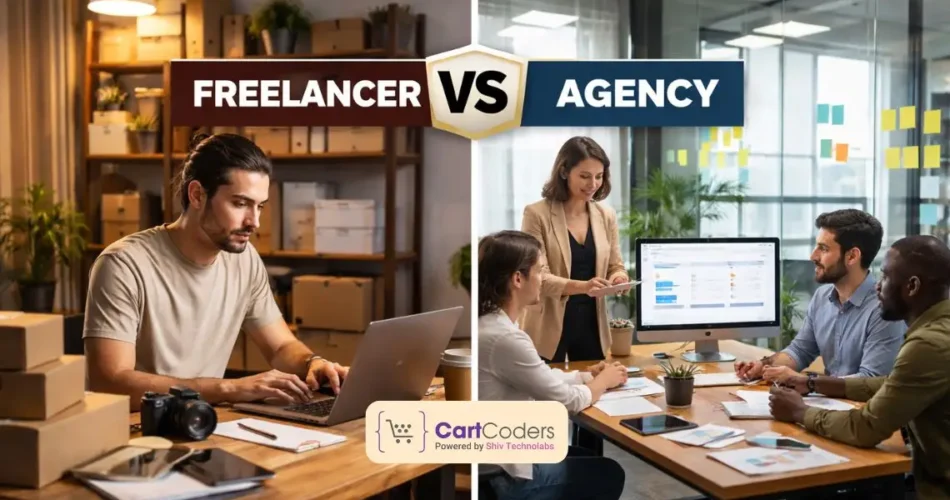
When planning an eCommerce website, one of the first decisions you face is whether to work with a freelance eCommerce developer or an eCommerce development agency. Both options can deliver results, but the outcome depends on project size, technical depth, budget control, and long-term expectations.
Many businesses start this search after facing delays, poor communication, or technical limits in earlier projects. Others want clarity before investing money into a new build or redesign. This comparison helps you decide who fits your project, not who sounds better on paper.
Work With Experienced Ecommerce Developers You Can Trust
CartCoders supports startups and enterprises worldwide.
This guide focuses on real-world project needs, cost responsibility, delivery structure, and risk handling so you can make a clear decision.
What’s the Real Difference Between an eCommerce Freelancer and an Agency?
An eCommerce freelancer usually works alone and handles limited parts of a project. An eCommerce agency works as a team and manages the full development lifecycle.
The difference is not just about team size. It affects planning, quality checks, response time, and ownership of outcomes.
Core responsibility difference
Area
eCommerce Freelancer
eCommerce Development Agency
Team structure
Single person
Developers, QA, PM, support
Project ownership
Individual
Shared across roles
Availability
Limited hours
Structured working hours
Testing responsibility
Often manual
Dedicated QA process
Backup support
Not available
Built-in team coverage
This difference matters more as projects grow in complexity.
When Hiring an eCommerce Freelancer Makes Sense
A freelancer works well when the project stays small, focused, and low-risk.
You can consider a freelancer if:
The website has a small product catalog
The project needs limited custom work
No heavy integrations exist
You already have clear documentation
Short-term development is enough
Freelancers suit simple eCommerce builds where speed matters more than structure. Many small businesses choose freelancers to fix layout issues, handle basic theme work, or manage short updates.
Typical freelancer use cases
Shopify theme adjustments
WooCommerce plugin setup
Simple checkout changes
Content and layout fixes
Small redesign tasks
However, freelancers often juggle multiple clients. This can affect response time during urgent issues.
When an eCommerce Development Agency Is the Better Choice
An agency fits projects where scale, stability, and long-term planning matter.
You should consider an agency if:
The website includes complex product rules
Payment, ERP, or CRM systems connect to the site
Traffic volume is high
The project needs ongoing updates
Security and data handling matter
Agencies work best when the project requires clear workflows, multiple checkpoints, and long-term responsibility.
Agency-led project strengths
Structured planning before development starts
Separate roles for coding, testing, and review
Faster issue resolution through shared workload
Support beyond launch
Documented processes
Businesses planning long-term eCommerce growth often choose agencies for reliability rather than short-term savings.
Cost Structure: Freelancer vs Agency
Cost often drives this decision, but pricing alone can mislead.
Cost Factor
Freelancer
Agency
Hourly rates
Lower
Higher
Fixed project pricing
Rare
Common
Maintenance costs
Separate
Often included
Risk coverage
Client-managed
Agency-managed
Revision handling
Limited
Structured
Freelancers may appear affordable upfront. Agencies usually cost more but include planning, testing, and support within the price.
Project Management and Communication
Freelancers handle communication directly. This works well for small scopes but becomes difficult as requirements change.
This structure reduces confusion during long projects and helps avoid missed requirements.
Cost Comparison — Freelancer vs Agency for eCommerce Development
Cost remains one of the biggest decision points when choosing between a freelancer and an agency. The difference does not come from coding alone. It comes from who takes responsibility when things change, break, or grow.
Freelancers usually charge lower hourly rates. Agencies charge more because they include planning, testing, coordination, and long-term accountability.
How pricing usually works
Cost Area
Freelancer
eCommerce Agency
Hourly rate
Lower
Higher
Fixed project pricing
Uncommon
Standard
Change requests
Extra charges
Managed scope
Testing cost
Often skipped
Included
Post-launch support
Separate
Planned
Freelancer pricing fits small tasks. Agency pricing fits projects where changes and growth remain likely.
A common mistake
Many businesses compare only hourly rates. They forget to count:
Rework time
Missed requirements
Downtime fixes
Coordination overhead
These hidden costs often push total spend higher than expected.
Plan Ecommerce Developer Hiring With Skilled Specialists
CartCoders helps select the right developer mix.
Project Management, QA, and Delivery Responsibility
Project delivery rarely fails due to coding alone. Most failures happen due to poor planning, missing checks, or unclear ownership.
Freelancer-led projects
A freelancer manages:
Coding
Updates
Basic testing
Client communication
This works when requirements stay fixed. Problems arise when features change or timelines stretch.
This structure helps large or evolving projects stay stable.
Quality Testing and Issue Handling
Testing plays a major role in eCommerce success. Checkout errors, payment failures, or stock issues directly affect revenue.
Testing Area
Freelancer
Agency
Manual testing
Basic
Detailed
Device checks
Limited
Structured
Payment flow testing
Partial
Full scenarios
Regression testing
Rare
Regular
Issue tracking
Informal
Logged and tracked
Agencies follow repeatable testing routines. Freelancers often test manually based on experience and time limits.
Risk, Security, and Long-Term Stability
Every eCommerce project carries risk. The question is who handles it when it shows up.
Risks with freelancers
Single point of dependency
No backup during illness or unavailability
Limited security monitoring
Delayed fixes during high-traffic periods
Risk handling with agencies
Shared responsibility across teams
Defined response times
Ongoing security updates
Clear escalation paths
Security updates, payment compliance, and data handling demand regular attention. Agencies plan for this. Freelancers usually react when issues appear.
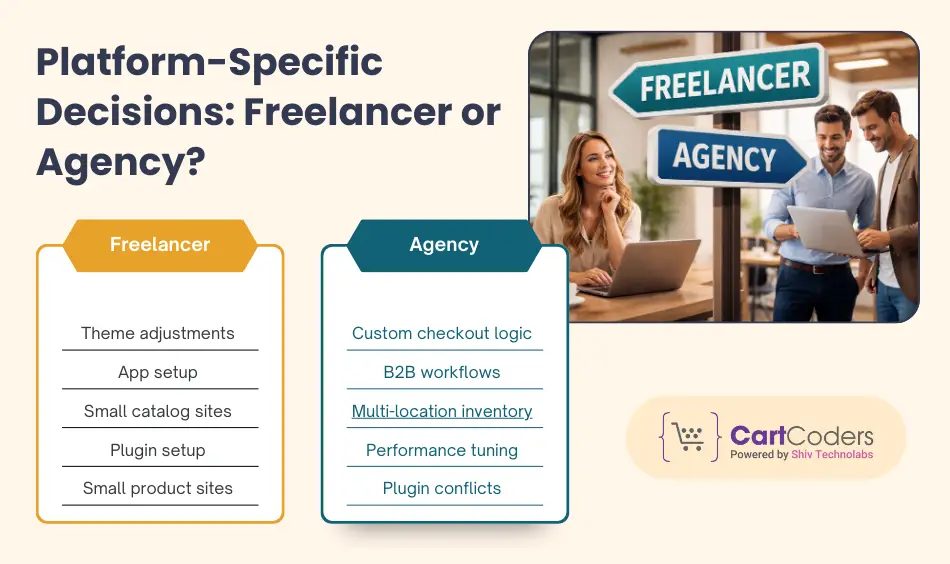
Platform-Specific Decisions: Freelancer or Agency?
Different platforms demand different levels of support.
Freelancers may manage parts of this setup, but agencies usually handle full systems better.
Area
Freelancer
Agency
API handling
Limited
Structured
Frontend-backend sync
Risky
Managed
Ongoing changes
Slower
Planned
Team coordination
Not available
Built-in
Headless projects demand coordination across tools and teams. Agencies reduce risk by distributing responsibility.
Choosing Based on Project Type
You should base your decision on project behavior, not just budget.
Choose a freelancer if:
The scope stays small
Features remain fixed
Short-term delivery is enough
Choose an agency if:
The project will grow
Integrations exist or will expand
Support matters after launch
Business risk needs control
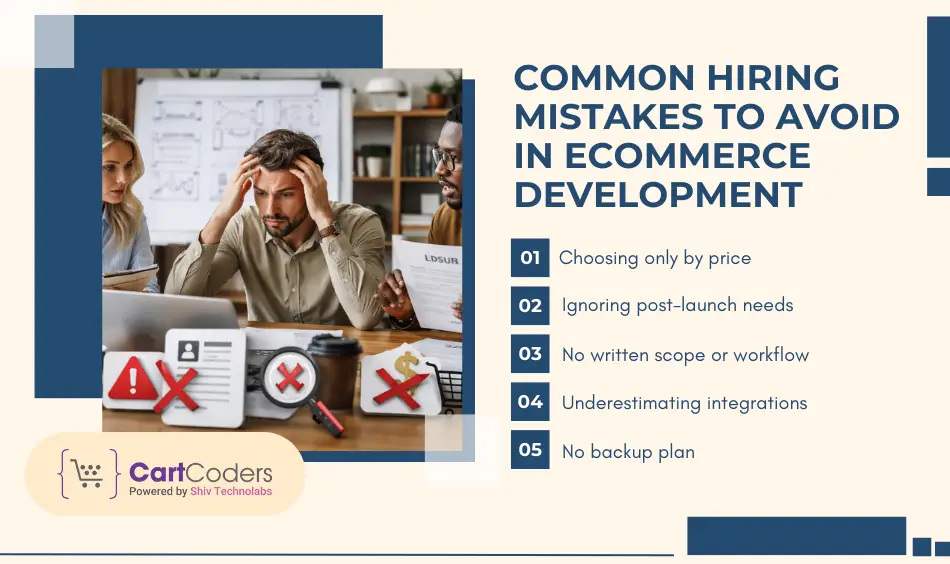
Common Hiring Mistakes to Avoid in eCommerce Development
Many eCommerce projects fail not because of technology, but because of early hiring decisions. Businesses often rush this step and face issues later.
Mistake 1: Choosing only by price
Lower cost often looks attractive, but it may hide future risk. Missed testing, unclear scope, and delayed fixes increase total spend over time.
Mistake 2: Ignoring post-launch needs
An eCommerce website does not stop at launch. Updates, security checks, and feature changes continue. Many freelancers do not commit to long-term support.
Mistake 3: No written scope or workflow
Projects without clear documentation face delays and disagreements. Agencies usually define scope, timelines, and responsibilities early. Freelancers may rely on informal communication.
Mistake 4: Underestimating integrations
Payment systems, shipping rules, tax logic, and inventory tools add complexity. Hiring without integration experience often leads to rework.
Mistake 5: No backup plan
If a freelancer becomes unavailable, the project stalls. Agencies reduce this risk through shared ownership.
Freelancer or Agency — How to Decide Based on Your Project Type
The right choice depends on how your project behaves over time.
Decision framework
Project Factor
Freelancer Fits
Agency Fits
Project size
Small
Medium to large
Custom features
Limited
Advanced
Integrations
Few or none
Multiple
Growth plans
Short-term
Long-term
Support needs
Minimal
Ongoing
Risk tolerance
Higher
Lower
Use this table as a quick reference before committing.
Real-World Scenarios
Scenario 1: Small business launch
A small catalog, standard checkout, and fixed scope often work well with a freelancer.
Scenario 2: Growing brand
If traffic, products, or locations will increase, an agency offers better stability.
Scenario 3: Custom workflows
Projects involving ERP, CRM, custom pricing rules, or headless builds benefit from agency teams.
Final Verdict — Which One Fits Your eCommerce Goals?
There is no universal winner in the freelancer vs agency debate. Each option serves a different type of project.
Freelancers suit:
Clearly defined tasks
Limited customization
Short delivery cycles
Agencies suit:
Complex builds
Long-term development
Ongoing maintenance
Risk-managed delivery
Your decision should reflect project responsibility, not just development speed.
Frequently Asked Questions
Is it better to hire an agency or freelancer for eCommerce development?
It depends on project size, technical depth, and support needs. Small projects often work with freelancers. Complex or long-term projects usually fit agencies better.
What are the risks of hiring a freelancer for eCommerce projects?
Common risks include limited availability, lack of backup support, and minimal testing. These risks increase as project complexity grows.
Why do eCommerce agencies charge more than freelancers?
Agencies include planning, quality checks, coordination, and support in their pricing. This structure reduces long-term risk and rework.
Can a freelancer handle eCommerce maintenance and support?
Some freelancers offer maintenance, but availability may vary. Agencies usually provide structured support plans with defined response times.
When should I move from a freelancer to an agency?
You should consider this move when your website grows, integrations increase, or support demands become consistent.
As the CTO at Shiv Technolabs & CartCoders, I am liable for instigating, planning, integrating, and implementing the organization's strategic orientation.
I gather the most significant tech news in addition to sharing the information I gained while serving as the CTO of Shiv Technolabs, a renowned web and mobile app development company. I am pleased to answer questions as a most valuable expert for Shiv Technolabs Private Limited and to share my experience. I offer a keen insider's perspective on technical advancements.
 eCommerce
Solution
eCommerce
Solution










 INDIA
INDIA


 USA
USA
 CANADA
 AUSTRALIA