

One of the most frequently asked questions among store owners and one of the most misinterpreted is the cost of building a Shopify mobile app in 2026. When it comes to pricing, some brands are quoted as low as $5,000 and others are mentioned as high as $100,000+, which causes extreme confusion. This variation is made because mobile applications have varying prices depending on the region, technology stack, feature depth, and the scope of long-term maintenance.
Reports further predict that mobile commerce will account for upwards of 60% of all ecommerce sales by 2026, underscoring mobile apps as a strategic investment rather than a luxury feature.

This blog breaks down the cost of Shopify mobile app development in 2026 with clarity.
Why Shopify Store Owners Are Asking About Mobile App Cost in 2026?
Shopify merchants no longer need to ask whether they require a mobile application. The actual issue is the extent to which it will cost and whether it is worth the investment to their stage of growth.
Increase in App First Buying Habits
Customers are more inclined to use apps than mobile websites. Apps load faster and feel more intimate, with smoother navigation. With app-based checkout completion rates almost three times higher than on the mobile web, Shopify brands consider apps a revenue driver rather than a branding tool.
Focus on Retention and Faster Checkout
Push notifications drive repeat purchases, saved payment methods and custom product feeds. Store owners now regard mobile apps as retention engines that minimise cart abandonment and shorten the buying cycle.
Cost Depends on Goals and Technology
A basic catalog application is much cheaper than a subscription-driven or B2B-specific application. Technical decisions, such as React Native, Flutter, or fully native builds, also significantly affect overall development costs.
Quick Cost Summary for Shopify Mobile Apps in 2026
Here is a quick cost overview of Shopify Mobile App development in 2026.
Average Cost Ranges at a Glance
The total cost depends on features, integrations and scalability requirements.
| App Stage | Key Features | Estimated Cost (USD) | Ideal For |
| Basic or MVP | Catalog, cart, login, profile | $6,500 to $15,000 | Small Shopify stores |
| Growth Stage | Wishlists, coupons, push alerts | $15,000 to $35,000 | Scaling DTC brands |
| Enterprise Build | AI features, headless setup, B2B, ERP CRM sync | $35,000 to $100,000+ | Mid to large stores |
These numbers reflect realistic market pricing in 2026, not marketing promises.
Shopify Mobile App Cost by Experience Level and Region
Team experience and location are the two direct influences on your budget on the app.
| Region | Hourly Rate Range | Typical Budget Mid Level App | Notes |
| USA and Canada | $80 to $150 per hour | $40,000 to $120,000 | Strong engineering depth |
| UK and Europe | $70 to $130 per hour | $35,000 to $100,000 | Balanced cost and quality |
| UAE and GCC | $60 to $120 per hour | $30,000 to $90,000 | Compliance driven builds |
| India and South Asia | $25 to $60 per hour | $15,000 to $60,000 | Best value for long term projects |
Many global brands choose hybrid teams to balance cost efficiency and quality control.
Key Factors That Shape Shopify Mobile App Development Cost
Several technical and business factors determine final pricing.
App Type and Technology Stack
Native apps have to be built separately on iOS and Android, which is more expensive. React Native and Flutter share a codebase, reducing development time without sacrificing performance. Progressive Web Apps are the cheapest browser-based app experience with few device-level capabilities.
Features and User Journeys
More complex user flows increase both development and testing time.
| Feature Category | Examples | Cost Impact |
| Basic | Login, product list, cart | Low |
| Growth | Wishlists, coupons, rewards | Medium |
| Advanced | AI search, subscriptions, B2B flows | High |
Integrations and Backend Requirements
All external systems are costly. The complexity of development and testing is intensified by Shopify APIs, payment gateways, inventory sync and third-party solutions [Recharge, Klaviyo, Zoho, or Odoo].
Design and Branding Needs
UI costs the least with a template-based based. Full custom UI kits, animations and branded interactions dramatically increase design and front-end development time.
Shopify Mobile App Cost by App Type
Different build approaches serve different budgets and growth stages.
Using Shopify App Builders
The monthly subscription prices for app builders range from $200 to $800. They can be launched fast and are restricted in customization, scalability, and maximum performance. Most appropriate for early-stage stores trying to meet mobile demand.
Custom Shopify Mobile App
Custom builds range from $25,000 to $100,000+. They endorse subscriptions, sophisticated personalization, headless business, and business processes. Best in cases where there are repeat buyers and long-term growth plans for the brand.
Hybrid Approach
Many brands begin with builders and eventually transition to custom apps. Migration is usually priced at $8,000-$20,000, depending on the complexity of the data and the scope of feature expansion.
Country-Wise Shopify Mobile App Price Breakdown
| Country or Region | Best For | Cost Benefit | Cost Range |
| USA | DTC growth brands | Faster delivery | High |
| UK and EU | Retail and fashion | Balanced pricing | Mid High |
| UAE and GCC | Enterprise groups | Local compliance | Mid |
| India and South Asia | Global Shopify brands | Best value | Low to Mid |
Hidden Costs Most Shopify Owners Do Not Plan For
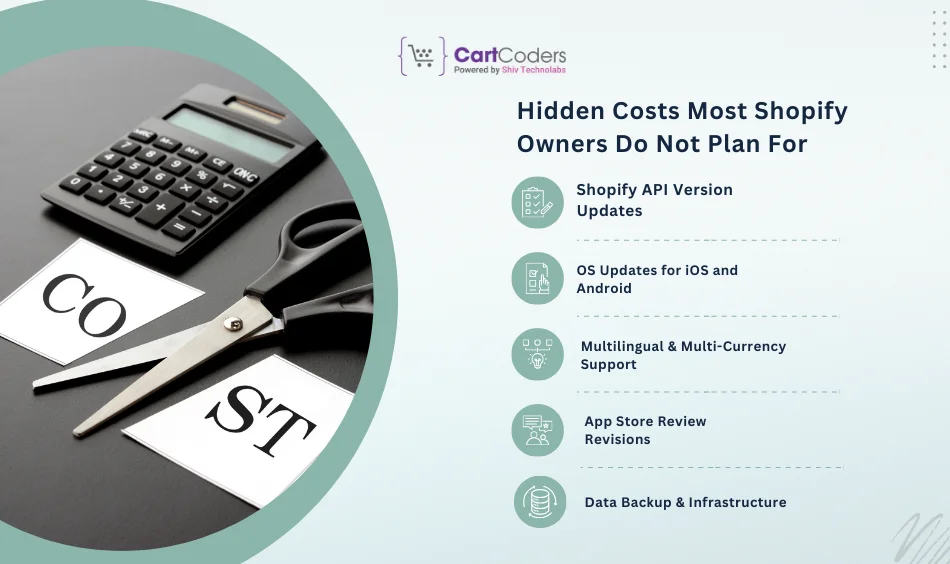
Many app budgets fail because hidden costs are ignored.
Shopify API Version Updates
Shopify’s API versions are updated frequently. Applications have to be maintained to keep up, which incurs continuous development cost.
OS Updates for iOS and Android
New OS versions tend to disrupt the behavior of pre-existing apps and need to be fixed and retested.
Multilingual and Multi-Currency Support
Selling internationally complicates product information, checkout process and test cycles.
App Store Review Revisions
Unaccepted submissions need repairs, recompilation and more time to be reviewed.
Data Backup and Infrastructure
Recurrent charges are added as secure backups, server monitoring and crash reporting.
Get Expert Guidance For Shopify Mobile App Development
Talk through scope, cost, and delivery approach.


Yearly Design Refreshes
UI is typically updated annually to align with evolving UX standards and branding.
React Native vs Flutter vs Native Cost Impact
Here is an end-to-end comparison of React Native vs Flutter vs Native Cost:
| Tech Stack | Pros | Best Use Case | Budget Level |
| Flutter | Fast multi platform builds | New brands | Mid |
| React Native | Large plugin ecosystem | Scaling stores | Mid |
| Native iOS and Android | Maximum performance | Enterprise builds | High |
Ongoing Maintenance and Support Cost
The development of a Shopify mobile application is not the end. Maintenance and support of the long-term performance, stability and compliance with the app stores. The absence of this stage results in feature breakage, poor performance and negative user reviews. An honest budget will always include planning for continuous support.
Monthly Update Cycles Recommended
Regularly updating your Shopify mobile app monthly keeps it stable, secure and compatible with evolving platforms. Constant updates are used to fix bugs, enhance performance, and meet changes in the Shopify API. They also ensure an easy upgrade to new models of devices and operating systems. Brands with monthly update schedules will not crash out of the blue and will also maintain a stable user experience across devices.
Average Yearly Spend: 15% to 25% of the Build Cost
According to industry standards, it generally costs between 15% and 25% of the initial cost of developing the mobile app each year. This includes bug fixes, performance enhancements, security patches and minor feature enhancements. Indicatively, a typical $40,000 application will need a minimum of $6,000-10,000 per year to remain viable and competitive.
Hosting and Push Notification Services
Mobile applications rely on hosting and push notification systems to work effectively. Server hosting is provided to ensure quick API response times and data security, and services are offered to update orders and send marketing notifications. Such services are charged regularly and increase with user traffic. If you have active users of your app, the costs of hosting and notifications are rising.
App Store Updates When Policies Change
The policies of Apple App Store and Google Play are frequently changed. As guidelines are updated, apps also need to be updated to comply. These are privacy disclosures, use of permission and security standards. Failure to update may result in the app being rejected or removed. Regular policy oversight and updates ensure the accessibility of your app and its long-term revenue stream.
How to Plan a Practical Budget for Your Shopify Mobile App

To plan the Shopify mobile app budget, there must be order, clarity and perspective. An effective budget is not made on assumptions. It is constructed by subdividing the project into distinct decision points that manage scope, cost and long-term sustainability. Shooting bullets at the correct times simplifies the planning process, makes it more open and makes it more precise.
Define Core Feature Set (MVP First)
Begin by establishing your Minimum Viable Product. An MVP is about focus and not compromise. In your initial version of the app, include only the features that directly influence user experience and revenue.
Core MVP features usually include:
- Product catalog and collections
- Search and basic filtering
- Cart and checkout
- User login and profile management
- Order history and tracking
Features to avoid in phase one
- AI-based recommendations
- Loyalty and rewards engines
- Complex subscription logic
- Advanced analytics dashboards
Each additional feature has the potential to add cost by 15%-30%. By locking the MVP early, your original budget is also controlled and predictable.
Fix Required Integrations Early
One of the most significant cost drivers of the Shopify mobile app is integrations. Every external system requires time and effort to develop and maintain.
Standard integrations to identify upfront
- Shopify Admin and Storefront APIs
- Payment gateways like Stripe, PayPal, Razorpay
- Subscription tools such as Recharge
- Marketing platforms like Klaviyo
- ERP or CRM systems, including Zoho or Odoo
Why early integration planning matters
- Prevents mid-project scope expansion
- Avoids backend rework
- Reduces unexpected budget jumps
The quickest way for budgets to go out of control is to miss integrations in early planning.
Confirm Regions and Payment Logic
In region-based selling, the requirements are changed by both the technical complexity and compliance. Regional budget planning is half-baked.
Key region-related decisions to lock:
- Countries the app will support
- Single currency vs multi-currency setup
- Local tax and VAT handling
- Region-specific payment methods
- Language and localization requirements
Cost impact considerations
- Multi-region apps can increase cost by 20% to 40%
- Additional testing cycles are required per region
- Compliance requirements vary by country
Early confirmation of regions ensures proper timelines and accurate cost estimates.
Pick Stack: Native vs React Native vs Flutter
The build cost, the speed and the long-term maintenance directly affect technology choice.
Native iOS and Android
- Separate codebases
- Highest performance and control
- Higher initial and maintenance costs
React Native
- Shared codebase for iOS and Android
- Strong ecosystem for Shopify and third-party tools
- Balanced cost and performance
Flutter
- Fast UI development
- Single codebase
- Slightly limited plugin ecosystem compared to React Native
By selecting the correct stack, rebuild costs can be avoided in the future and help with long-term scalability.
Add Build Cost + 12 Month Support Cost.
A mobile app is not a one-time cost issue. It also requires ongoing maintenance to remain operational and compliant.
Development costs are not the only expenses to consider.
- App store submission and policy compliance
- Bug fixes and stability improvements
- iOS and Android OS updates
- Shopify API version changes
- Hosting and push notification services
- Performance monitoring and backups
Annual maintenance cost ranges from 15% to 25% of the initial build price
Example
- App build cost $30,000
- Estimated yearly support costs $4,500 to $7,500
Ignoring support costs leads to broken features, poor reviews and revenue loss.
Custom Shopify Mobile App Development for Your Store
There is no coding required when building a Shopify mobile app. It is concerned with planning, scalability and long-term performance. CartCoders is the best Shopify Development company and it approaches mobile app development with structured discovery, clear tech decisions and lifecycle support.
With expertise in React Native, Flutter, native iOS and Android applications, headless Shopify applications, B2B workflows and integrative API applications. From project planning and UI design to app store launches and update cycles, the emphasis remains on the stability, speed and ROI.
CartCoders provides solutions that deliver real business results, whether you need Shopify mobile app development, a personalized mobile app for Shopify stores, or a stable Shopify app development firm.
Conclusion
In 2026, building a Shopify mobile application will cost between $6,500 to build a basic MVP application and $100,000 or more to build an enterprise-grade application. The final price varies based on scope, features, region and technology selection. The owners of the stores that set the requirements and maintain the plan for their establishments prevent budget overruns.
If you are keen on creating a scalable, high-performance Shopify mobile app, it is vital to work with a team with experience. CartCoders combines technical skills and knowledge, ecommerce expertise, and long-term support to enable brands to build apps that convert, retain and scale.
Thinking of a Shopify mobile application in 2026? Get a real price estimate, technological advice, and a build plan to match your growth objectives with CartCoders today.
Frequently Asked Questions
In 2026, the average cost of most Shopify mobile applications will range from $15 to $35k to use growth-oriented features. Complex integrations and AI-generated experiences with advanced enterprise applications may cost more than $75,000.
Mobile applications require backend APIs, authentication, push notifications and compliance with app store requirements. Apps have to be cross-platform, device, OS and security-version-compatible, which means more development and testing work.
App builders are less expensive at the start-up and have monthly charges. They, however, restrict scalability and customization. Bespoke applications are expensive but perform better, are owned and deliver a high ROI over the long run.
Maintenance normally costs 15-25% of the initial construction cost per annum. This involves OS updates, API modifications, hosting, bugs and performance tracking.
An average Shopify application requires 6 to 8 weeks. Apps in the growth stage require 10-14 weeks. Enterprise constructions can take 4 to 6 months, depending on features and integrations.


