

Most eCommerce owners reach the Shopify vs Magento question at a specific moment: the current platform is either holding them back, costing more than it should, or simply not keeping up with where the business is going. Both platforms have long track records, large developer communities, and the ability to power serious online stores, but they are built around fundamentally different assumptions about who runs them and how.
Shopify was designed for merchants who want to focus on selling rather than managing infrastructure. Magento, now operating as Adobe Commerce in its enterprise form, was built for organizations that want complete control over their platform businesses with dedicated development teams who need the flexibility to build custom functionality that no out-of-the-box solution can provide.
This guide covers the differences between Shopify and Magento features, pricing, scalability, B2B capability, and the cases where migrating from Shopify to Magento or vice versa benefits the business.
Quick Answer
Shopify is a fully hosted platform that handles setup, security, and updates automatically the right fit for most small to large businesses that want to move fast without managing infrastructure. Magento (Adobe Commerce) is an open-source platform built for enterprises that need full code-level customization and have a development team in place to manage ongoing maintenance.
What is the Difference Between Shopify and Magento?
The core distinction comes down to who owns the infrastructure and who is responsible for it. With Shopify, you are operating on a managed platform. Shopify handles the hosting, security patches, PCI compliance, and software updates, and your team focuses entirely on running and growing the store. With Magento, you own and operate the full stack: you choose your server, configure your environment, apply security updates, and manage performance, either with an internal team or through an agency.
This difference shapes everything else in the comparison: total cost of ownership, level of customization available, how quickly you can launch or make changes, and what happens when something goes wrong. It is not a matter of one platform being technically superior to the other; it is a philosophical difference about where responsibility sits and how much control your business actually needs.
Shopify vs Magento: Side-by-Side Comparison
The table below compares both platforms across the features that matter most to eCommerce operators making this decision.
| Feature | Shopify | Magento (Adobe Commerce) |
| Setup & Hosting | Fully hosted, no server setup needed | Self-hosted, requires server configuration |
| Ease of Use | Beginner-friendly, drag-and-drop editor | Steep learning curve, developer-dependent |
| Customization | Theme-based with app extensions | Full source code access, unlimited flexibility |
| Pricing (entry) | From $39/month (Basic) | Free open source + hosting/dev costs ($500-$2,000+/mo) |
| Enterprise Plan | Shopify Plus from ~$2,500/month | Adobe Commerce from ~$22,000/year |
| App/Plugin Ecosystem | 10,000+ apps in Shopify App Store | 5,000+ extensions on Magento Marketplace |
| Multi-store Management | Available on Shopify Plus | Built-in for all editions |
| SEO Capabilities | Strong built-in SEO tools | Advanced SEO with full URL/metadata control |
| Security & Updates | Handled automatically by Shopify | Your team manages patches and updates |
| B2B Features | Native B2B on Shopify Plus | Strong B2B capabilities on Adobe Commerce |
| Best For | Small to large businesses want speed | Large enterprises needing deep customization |
How Do Shopify and Magento Compare on Features?
Both platforms offer the core tools you need to run an online store. Where they differ is in how you access those tools, how much control you have over them, and how much technical knowledge you need to use them effectively.
Key Shopify Features are as Follows:
1. Hosted infrastructure: Shopify runs entirely in the cloud. You never configure a server, manage SSL certificates, or worry about a traffic spike taking your store down. This matters most during peak sales periods like BFCM.
Shopify automatically handles server scaling, which means your store stays live when traffic surges. For most eCommerce businesses, this removes one of the biggest operational risks.
2. Shopify App store with 10,000+ integrations: Shopify has one of the largest eCommerce app ecosystems available. You can add subscription billing, product reviews, loyalty programs, upsells, shipping rules, and more without custom development.
Most apps connect in minutes and work without touching code. When store needs go beyond ready-made apps, custom Shopify app development helps build custom features, integrations, and workflows without limiting business growth.
3. Shopify Payments and checkout: Shopify’s native checkout is conversion-optimized and supports Shop Pay, which processes returning customers faster. Shopify Plus unlocks checkout extensibility for custom logic and UI changes.
In third-party testing, Shop Pay consistently shows higher conversion rates than standard guest checkouts. For high-volume merchants, that difference compounds significantly.
4. Built-in analytics and reporting: All plans include sales reports, customer data, and traffic metrics. Advanced and Plus plans give you custom report builders and real-time dashboards.
You can see which products are underperforming, which channels are driving revenue, and where customers drop off, all without a separate analytics tool.
Key Magento Features are as Follows:
1. Full source code access: With Magento Open Source, you own the codebase. Developers can build any custom feature, create bespoke integrations, and change how any part of the platform behaves.
This is the primary reason enterprises with unusual workflows choose Magento. When your business process does not fit a standard template, Magento lets you build around it rather than work around it.
2. Multi-store management from one admin: Magento lets you run multiple stores with different domains, currencies, languages, and product catalogs from a single backend. This is available on all Magento editions, not just enterprise.
For businesses operating across multiple countries or managing separate B2C and B2B storefronts, this is a significant structural advantage over basic Shopify plans.
3. Advanced SEO controls: Magento gives developers granular control over URL structure, canonical tags, metadata, rich snippets, and XML sitemaps. Every element is configurable at the code level.
This matters most for large catalogs where SEO is a primary traffic channel. The control Magento offers lets technical SEO teams implement complex strategies without platform limitations.
4. Deep ERP and CRM integrations: Magento has mature integration pathways for SAP, Oracle, Microsoft Dynamics, and other enterprise systems. These connections can be built with custom code or through extension providers.
For businesses running large-scale backend operations, the ability to connect Magento directly to ERP and warehouse management systems can significantly reduce manual data handling.
Shopify Plus vs Magento Enterprise: Which Scales Better?
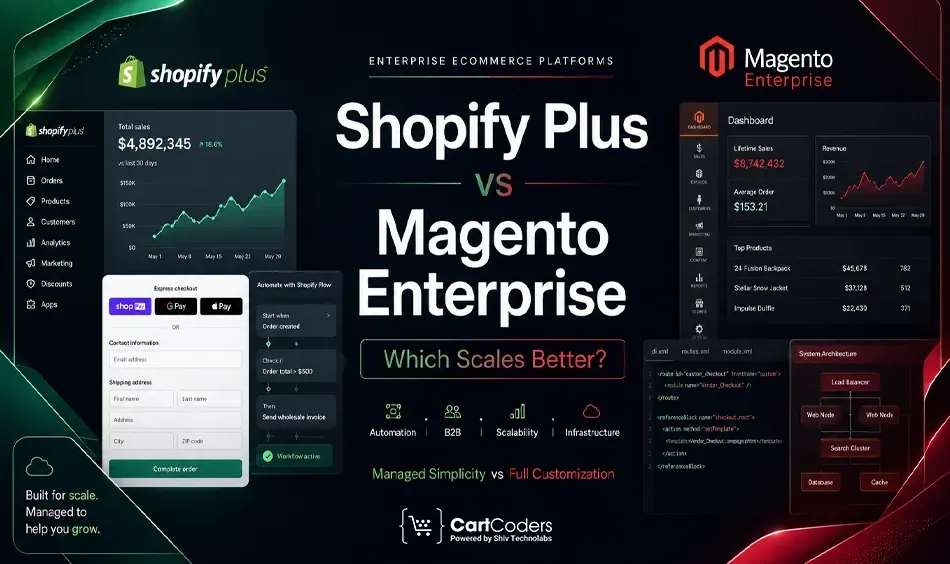
This is the comparison that matters most for growing businesses. Both Shopify Plus and Adobe Commerce (Magento Enterprise) target high-volume merchants and enterprise clients. But they take very different approaches to getting there.
What Shopify Plus Is Capable Of:
Shopify Plus is a managed enterprise tier. You get everything in Shopify Advanced plus unlimited staff accounts, custom checkout via Checkout Extensibility, Shopify Flow automation, B2B functionality, multi-currency and multi-language selling, and dedicated merchant success support. The platform handles all infrastructure.
- Starts at approximately $2,500 per month (scales with revenue)
- No additional hosting or server management costs
- Custom checkout logic without developer maintenance overhead
- Native B2B portal for wholesale and trade customers
- API rate limits that support high-volume integrations
Shopify Plus development is the right choice when you want enterprise capability without building an internal platform team. Most merchants on Plus can launch new markets, automate workflows, and customize checkout without a permanent Shopify developer on staff.
What Adobe Commerce Is Capable Of:
Adobe Commerce is Magento’s enterprise product. It adds customer segmentation, advanced B2B features, AI-powered product recommendations through Adobe Sensei, a headless PWA Studio framework, and SLA-backed managed cloud hosting.
- License starts at approximately $22,000 per year (hosted infrastructure billed separately)
- Full code customization at every layer of the platform
- Advanced customer segmentation for personalized pricing and promotions
- Built-in B2B features, including company accounts, requisition lists, and quote management
- Requires a Magento development agency for setup and ongoing maintenance
Adobe Commerce is the right choice when your business has genuinely unique requirements that no standard platform can meet, and when you have the budget for a developer team and hosting infrastructure.
Which is Better for B2B eCommerce?
Both platforms have invested heavily in B2B features. Shopify Plus includes a native B2B portal that handles company accounts, custom pricing, payment terms, and order management. Adobe Commerce offers quote requests, requisition lists, and shared catalogs with advanced segmentation.
For most B2B merchants, Shopify Plus B2B covers the majority of requirements with less setup time. For businesses with highly complex B2B workflows, Adobe Commerce gives more customization control.
Get More Info: Migrate from Magento to Shopify Plus
How Much Does Shopify vs Magento Cost in 2026?
Pricing is where the comparison becomes most complex. Shopify’s cost is predictable. Magento’s true cost depends heavily on your team, your hosting, and your development needs.
Shopify & Shopify Plus Pricings
| Plan | Monthly Cost | Best For |
| Shopify Basic | ~$39/month | Solo merchants, new stores, simple product catalogs |
| Shopify (Standard) | ~$105/month | Growing stores need professional reports and more staff accounts |
| Shopify Advanced | ~$399/month | Scaling stores needing custom reports and lower transaction fees |
| Shopify Plus | From ~$2,500/month | High-volume enterprise stores, B2B, complex automation |
Magento / Adobe Commerce Pricing
| Plan | Monthly Cost | Best For |
| Magento Open Source | Free license (hosting: $100-$500+/month) | Developers and technical teams with a budget for setup and maintenance |
| Adobe Commerce (Cloud) | From ~$22,000/year | Large enterprises needing SLA-backed managed infrastructure |
| Adobe Commerce (On-Premise) | From ~$22,000/year + server costs | Enterprises with dedicated IT teams managing their own infrastructure |
The Hidden Cost of Magento
Magento Open Source carries no license fee, but the operational costs add up quickly. Managed cloud hosting for a production Magento store typically runs $200-$1,000 per month, depending on traffic. Developer costs for ongoing maintenance, security patches, and feature work vary by region. A dedicated Magento developer in the US can cost $8,000-$15,000 per month. Agencies charge $100-$250/hour for Magento work.
When you add hosting, development, extensions, and security monitoring, a Magento Open Source store often costs more to run annually than a comparable Shopify plan. This does not mean Magento is the wrong choice. It means the cost comparison needs to account for total operational cost, not just license fees.
When Does Migrating From Magento to Shopify Make Sense?
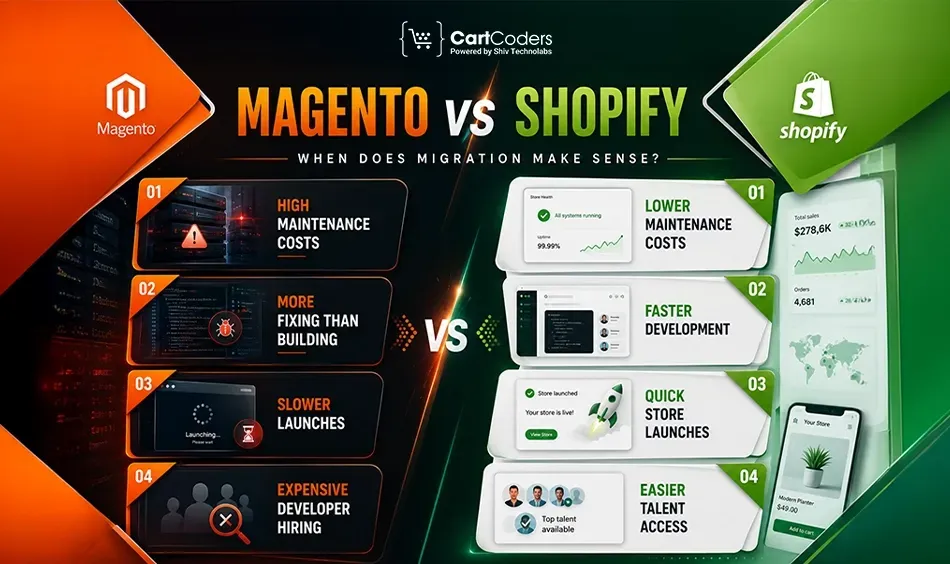
A growing number of businesses that started on Magento are now migrating to Shopify. The most common triggers are rising maintenance costs, difficulty finding Magento developers, and a desire to move faster without platform limitations.
- Magento maintenance costs: Magento requires regular security patches, extension updates, and PHP version compatibility work. When this overhead becomes a significant monthly cost without adding business value, the economics of switching shift substantially.
- Team spends more time fixing than building: This is one of the clearest signs that a platform is working against your business rather than for it. Developer time spent on infrastructure is time not spent on customer experience, new features, or revenue-driving work.
- Need faster launches: Shopify’s multi-currency, multi-language, and multi-channel capabilities are faster to set up and easier to manage than equivalent Magento configurations. For businesses expanding internationally, Shopify Plus can compress a months-long project into weeks.
- Cannot find or afford qualified Magento developers: The pool of experienced Magento developers has shrunk relative to Shopify developers. In many markets, finding a senior Magento developer at a reasonable rate is genuinely difficult. Shopify’s larger community makes hiring and support more accessible.
Dig Deeper: How to Migrate from Magento to Shopify
What Does a Magento to Shopify Migration Cost?
Migration costs vary by catalog size, custom feature complexity, and data volume. A straightforward migration with a standard Shopify theme typically runs $3,000-$8,000. A complex migration involving custom Magento features, large catalogs, and bespoke design work typically runs $10,000-$25,000+. Timeline ranges from 4 weeks for simple migrations to 3-4 months for complex enterprise projects.

CartCoders has completed Magento to Shopify migrations across retail, B2B, and multi-brand businesses. Our migration process covers product and customer data transfer, URL redirect mapping, theme setup or custom design, third-party integration reconnection, and post-launch testing. Visit cartcoders.com/magento-to-shopify to learn more.
How to Choose Between Shopify and Magento?
Use this as a decision framework based on your situation.
Choose Shopify when
- You want to launch fast: Shopify stores can go live within days. Magento deployments typically take 2-6 months from start to production.
- Your team is not technical: Shopify’s admin is designed for non-developers. Adding products, running promotions, managing shipping, and updating pages all work without touching code.
- You want predictable costs: Shopify’s monthly plans include hosting, security, support, and software updates. The total cost is visible upfront.
- You need enterprise capability without enterprise complexity: Shopify Plus gives high-volume merchants advanced automation, B2B, and checkout customization without building a platform team.
Choose Magento when
- Your business has genuinely unique workflows: If your operations require custom catalog logic, unusual pricing structures, or integrations that no app or Shopify API can support, Magento gives you the code access to build it.
- You need to run multiple independent stores with one admin: Magento’s multi-store functionality is native and supports different domains, currencies, and languages from a single installation. Shopify’s equivalent requires Plus and separate store setups.
- You have a dedicated development team: Magento rewards investment in technical resources. If you have a skilled development team and the budget for ongoing platform management, Magento gives that team maximum control.
Ready to Make the Switch?
Get a free migration consultation from CartCoders!


Conclusion
Shopify and Magento are both serious eCommerce platforms with long track records. The decision between them comes down to your business structure, technical resources, and growth goals.
Shopify works for businesses that want speed, predictability, and a platform that handles infrastructure so the team can focus on selling. Shopify Plus extends this to enterprise scale with B2B, advanced checkout, and automation, without the overhead of managing a platform.
Magento works for enterprises with complex requirements, dedicated developer teams, and the budget for full platform ownership. It offers capabilities that no managed platform can fully match. But those capabilities come with significant responsibility.
If you are evaluating a Magento to Shopify migration, or starting fresh and weighing both platforms, contact CartCoders today. Our team has worked across both platforms and knows where each one fits.
Frequently Asked Questions
Yes, for most small businesses. Shopify handles hosting, security, and updates automatically. You can launch a store without a developer and scale without needing a platform team. Magento requires ongoing developer involvement, which adds cost and complexity that most small businesses cannot justify.
Shopify Plus is a managed enterprise plan starting around $2,500/month. Adobe Commerce (Magento Enterprise) starts at around $22,000/year plus separate hosting and developer costs. Shopify Plus includes all infrastructure. Adobe Commerce gives full code access but requires your team to manage hosting, security, and ongoing maintenance.
Both platforms support large product catalogs. With proper server configuration, Magento can handle hundreds of thousands of SKUs. Shopify Plus also handles large catalogs reliably without requiring server management. For most merchants, the limiting factor is not the platform’s capacity but how well the catalog is structured.
Migration costs typically range from $3,000 for simple stores to $25,000+ for complex enterprise migrations with custom features and large catalogs. Timeline ranges from 4 weeks to 3-4 months. The main cost drivers are catalog size, custom Magento features that need to be rebuilt, and design requirements.
Magento Open Source has no license fee, but running it is not free. You pay for hosting (typically $200-$1,000/month for a production store), developer time for setup and maintenance, security monitoring, and premium extensions. Total operational costs often exceed a Shopify plan.
Both are capable SEO platforms. Shopify has strong built-in SEO tools and handles technical SEO requirements automatically. Magento gives developers more granular control over URL structure, metadata, and schema markup. For most merchants, Shopify’s built-in SEO capabilities are sufficient. Magento’s advantage is mainly relevant for very large catalogs with complex technical SEO strategies.
The clearest signals are rising maintenance costs, difficulty finding or affording qualified Magento developers, and development time dominated by platform upkeep rather than business growth. If your Magento store costs more than $2,000/month in maintenance alone, the economics of switching often favor Shopify within the first year.
CartCoders specialises in Magento to Shopify migrations. Our team handles the full migration, including product and customer data, URL redirects, theme setup, and integration reconnection, with zero downtime and a defined scope.


