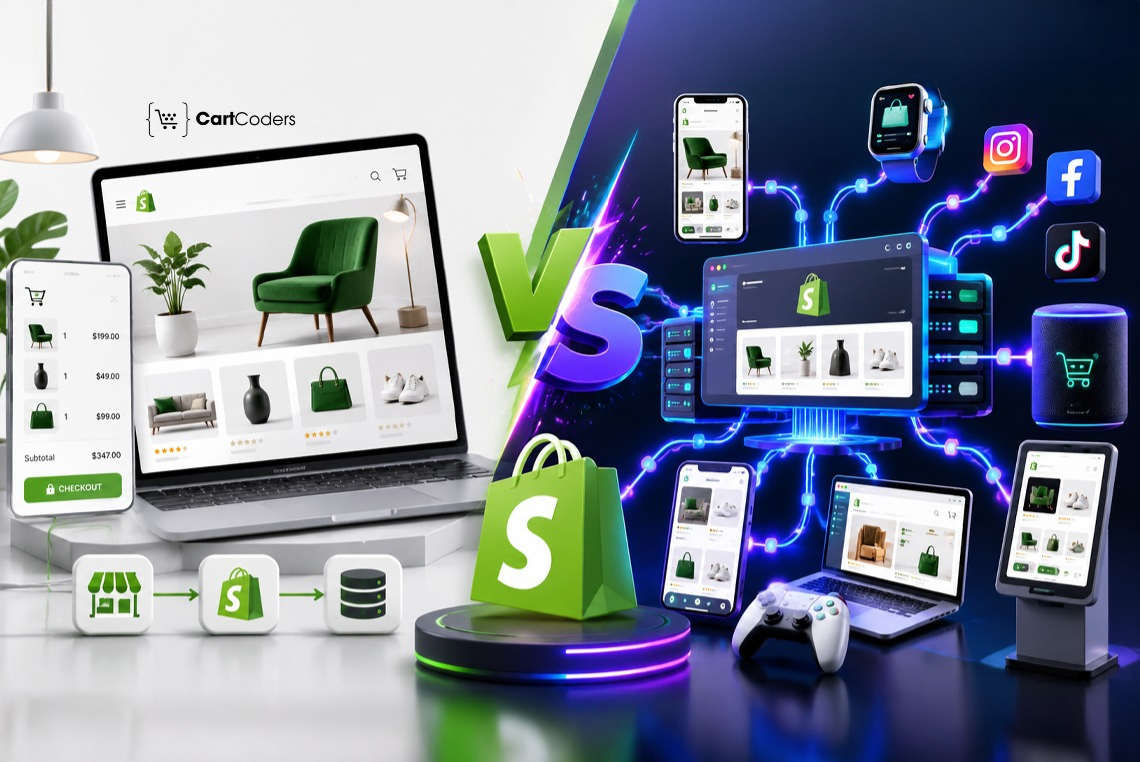

You built your Shopify store on a traditional setup and it worked well for years. Orders came in, the theme handled the storefront, and the backend managed everything else in one place. But as your product range grew, your sales channels expanded, and your team started requesting deeper customization, the cracks began to show.
That is the exact moment when the headless commerce vs traditional commerce debate becomes real for most Shopify brands. It is not a conversation about which option is newer or more technically impressive. It is a practical question: which architecture gives your store the right foundation for where it needs to go?
This guide breaks down both approaches with clear comparisons, real cost context, and a decision framework you can apply directly to your store today.
Quick Answer
Headless commerce separates the frontend from the backend and connects them through APIs, giving development teams complete control over the user experience across multiple channels. Traditional commerce keeps both layers together on one platform, making it faster to set up and easier to manage. Headless suits complex, high-growth brands with dedicated development resources. Traditional commerce works well for stores that need speed, simplicity, and lower operational costs.
What is Headless Commerce and How Does it Work?
In a headless setup, the frontend layer – the part your customer sees and interacts with – is completely separated from the backend, where inventory, orders, and payments are processed. These two layers communicate through APIs, which means developers can build any kind of storefront without being locked into a platform’s default theme system.
The Decoupled Architecture Explained
When a shopper visits a headless Shopify store, the frontend – typically built in React, Next.js, or a similar framework sends an API request to Shopify’s backend. Shopify returns the relevant product data, cart state, and pricing, and the frontend renders it in whatever way the development team has designed.
This structure gives brands the freedom to build entirely different experiences for different channels. A brand could display one version of its storefront on the desktop website, a different interface on its mobile app, and a simplified version on an in-store kiosk – all pulling from the same Shopify backend handling every transaction.
What Shopify Provides for Headless Builds
Shopify supports headless builds through its Storefront API and Hydrogen, its React-based framework built specifically for headless commerce. Oxygen, Shopify’s hosting solution, pairs with Hydrogen to give brands a complete deployment path within the Shopify infrastructure.
Shopify Plus merchants get additional flexibility around custom checkout flows, which matters significantly for brands with complex pricing rules, B2B order logic, or high average order values. For most headless builds targeting serious customization, Shopify Plus solutions are the practical starting point.
What is Traditional Commerce and Where Does it Still Hold Value?
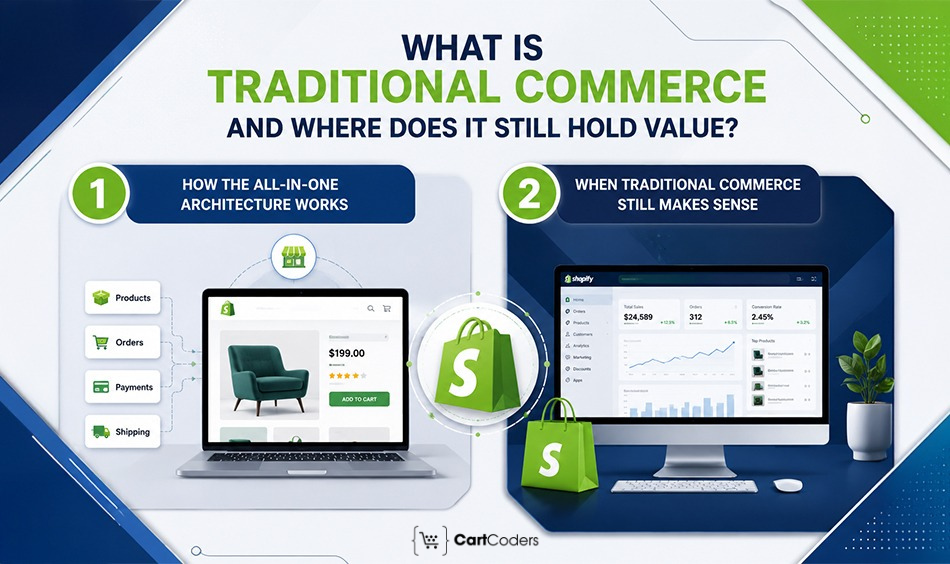
Traditional commerce – sometimes called monolithic commerce – bundles the frontend and backend into a single platform. In Shopify’s case, this means using themes built on Liquid to control the storefront while the same Shopify system manages products, orders, payments, and shipping.
How the All-in-One Architecture Works
With a traditional setup, all layers of the store run inside one system. When a shopper loads a product page, Shopify renders the template, pulls the product data, and serves the completed page in a single process. Merchants manage their entire store through the Shopify admin without needing a separate frontend infrastructure or development pipeline.
This is not a limitation for most businesses. For brands selling through one or two channels and not requiring store customization beyond Shopify’s theme editor and app ecosystem, the traditional setup is reliable, cost-efficient, and more than adequate.
When Traditional Commerce Still Makes Sense
Traditional commerce works well for brands in the launch or early growth stage, for teams without dedicated frontend developers, and for businesses whose customization needs fall within what themes and apps can cover. It also suits stores with standard product catalogs, no complex integration requirements, and a team that manages the site in-house.
For most Shopify merchants, traditional is the right long-term setup unless specific business requirements push them toward headless. The mistake many brands make is switching to headless before they have the volume, team, or genuine need to justify it.
Headless Commerce vs Traditional Commerce: Side-by-Side Comparison
The right way to compare these two architectures is not by asking which one is better in general, but by asking which one fits your store’s current stage, team capacity, and growth direction. Here is how the two approaches compare across the factors that matter most.
| Feature | Headless Commerce | Traditional Commerce |
| Frontend control | Full custom control via API | Limited to theme templates |
| Development speed | Slower initial build | Faster to launch |
| Page performance | Very high with CDN + SSR | Good, depends on the theme quality |
| Omnichannel reach | Yes – web, app, kiosk, voice | Primarily web-focused |
| Team requirement | Needs frontend developers | Non-technical teams can manage |
| Upfront cost | $20,000 – $100,000+ | $0 – $10,000 |
| Ongoing complexity | Higher – API + frontend upkeep | Lower – one platform to manage |
| Best for | High-growth, multi-channel brands | Small to mid-size Shopify stores |
When Does Headless Commerce Make the Most Sense for Shopify Brands?
Headless is not the right choice for every merchant. It makes sense in specific situations where the business has genuinely outgrown what a traditional setup can handle. Here are the four clearest signals that a headless move is justified.
You Sell Across Multiple Channels at the Same Time
Headless lets a single Shopify backend serve your website, mobile app, and in-store kiosk with different frontend experiences for each. Each channel can be fully customized without rebuilding backend logic. This is particularly valuable for brands managing DTC, retail, and wholesale simultaneously from one product catalog.
Your Current Theme is Blocking Conversion Improvements
If your development team has hit a ceiling with what Liquid templates allow, and CRO work is blocked by theme constraints, headless removes those limits entirely. You control the component structure, the page rendering logic, and every interaction element – things no Shopify theme gives you by default.
You Need Significantly Faster Page Load Times
Headless frontends built on frameworks like Next.js can pre-render pages and serve them through a CDN, cutting load times in ways traditional Shopify themes cannot match at scale. For high-traffic stores where milliseconds affect both conversion rates and Google rankings, this performance gap is material.
You Have a Dedicated Frontend Development Team or the Budget for One
Headless developers needs to understand both the chosen framework and Shopify’s APIs. Without this capability in-house or through a trusted agency partner, the cost of building and maintaining a headless store becomes unpredictable and expensive. This is not a one-time build – it requires ongoing technical ownership.
When Should You Stay With a Traditional Shopify Setup?
Traditional commerce is not the outdated option. For most Shopify stores operating today, it remains the right infrastructure choice. Moving to headless prematurely often creates more complexity, cost, and maintenance burden than the business is ready to absorb.
You Are in the Launch or Early Growth Stage
A traditional Shopify setup gets you selling faster. Themes handle the storefront, Shopify manages the backend, and your team can focus entirely on products, marketing, and customer acquisition instead of infrastructure decisions. Speed to launch matters far more at this stage than maximum customization flexibility.
Your Team Does Not Include Frontend Developers
Headless requires developers who can build and maintain a custom frontend application. Without this, even minor updates to the storefront become costly and slow. Traditional Shopify setups allow non-technical teams to manage design, content, and layout changes through the theme editor and admin panel without any developer involvement.
Your Budget is Growth-stage, Not Enterprise
A proper headless build typically costs between $20,000 and $100,000 or more, depending on complexity. Ongoing maintenance adds to that figure every year. Traditional Shopify themes, including premium customized options, cost a fraction of that and still support meaningful personalization through the theme editor, metafields, and app integrations.
You Operate Primarily Through One or Two Sales Channels
If your store is web-based and you are not running a separate mobile app or in-store experience alongside it, the flexibility of headless does not justify its complexity. Traditional commerce handles single-channel and dual-channel setups extremely well without the overhead of managing a decoupled architecture.
What Does Going Headless on Shopify Actually Cost?
Cost is one of the most important practical factors in this decision, and it is often underestimated by brands that are excited by the capabilities of headless promises.
Initial Build Cost
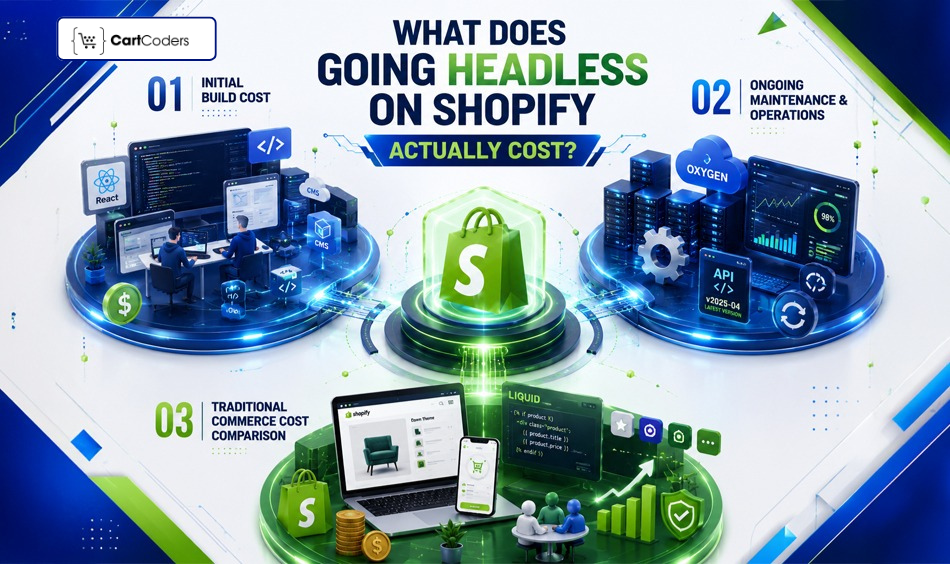
A Shopify headless detypically costs between $20,000 and $100,000+, depending on the scope of the frontend, the number of third-party integrations, the CMS choice, and the team you work with. Enterprise-level builds with complex API configurations, custom checkout flows, and multi-channel deployments often exceed that range.
Ongoing Maintenance and Operations
Ongoing costs include frontend developer time for updates, bug fixes, and new feature additions. Hosting scales with traffic even on Oxygen. API version updates from Shopify require regular attention to avoid deprecation issues. For Shopify Plus brands, the platform cost is higher from the start, and the headless layer adds technical overhead that traditional setups simply do not carry.
Traditional Commerce Cost Comparison
Traditional Shopify setups cost significantly less to run at any scale. A high-quality premium theme costs between $150 and $500. Custom development, app integrations, and ongoing CRO work typically add a few hundred to a few thousand dollars per year for most mid-size stores. The total cost of ownership is far lower, and it requires a smaller team to maintain.
How CartCoders Helps Shopify Brands Make This Decision Correctly?
Deciding between headless and traditional is not a question you should answer based on a blog comparison alone. The right answer depends on your traffic volume, team composition, budget range, product complexity, and growth timeline – factors that vary for every brand.
CartCoders has worked with Shopify and Shopify Plus brands across both paths. The team helps merchants evaluate whether headless is actually the right move for their stage, plan and build headless migrations that do not disrupt live sales, and implement CRO-focused improvements to traditional Shopify setups that close the performance gap significantly for stores that are not ready for headless.
For brands using Hydrogen, CartCoders provides end-to-end builds covering architecture planning, frontend development, API integration, and post-launch performance monitoring. For brands staying on traditional Shopify, CartCoders delivers store audits, checkout optimization, and conversion rate improvements grounded in real GSC and analytics data.
Ready to make the right call for your Shopify store? Talk to a CartCoders Shopify expert today. Get a clear recommendation for your store’s architecture – headless or traditional – based on your actual business stage, team size, and growth plan.
The Bottom Line
The headless commerce vs traditional commerce decision is not about which technology is more advanced or which one your competitors are using. It is about what your store needs right now and what it will need in the next two to three years.
Traditional commerce is reliable, cost-efficient, and the right choice for the majority of Shopify stores operating today. Headless commerce removes real limitations for brands that have genuinely outgrown the traditional setup and have the team and budget to manage a decoupled architecture properly.
Make the decision based on your team, your budget, and your actual growth path. If you are not certain which fits your situation, a quick call with the CartCoders team will give you a clear and honest answer.
Frequently Asked Questions
Headless commerce separates the frontend from the backend using APIs. Traditional commerce keeps both layers in one connected platform. Headless gives development teams more control over the user experience. Traditional is simpler to manage and faster to launch.
Not automatically. Headless suits brands with complex customization needs, multiple sales channels, and dedicated development teams. Traditional commerce works better for most Shopify stores that need simplicity, cost efficiency, and a manageable tech stack.
Yes. Shopify supports headless builds through its Storefront API, Hydrogen framework, and Oxygen hosting. Shopify Plus gives additional flexibility for custom checkout flows, which are often required for enterprise headless builds.
A headless Shopify build typically costs between $20,000 and $100,000 or more, depending on scope, integrations, and the agency or team you work with. Ongoing maintenance adds to that figure annually. Traditional Shopify setups cost significantly less.
It is technically possible but rarely practical. The cost, team requirements, and maintenance overhead make headless a poor fit for small stores. A well-optimized traditional Shopify setup will deliver better results at that stage.
Shopify’s Hydrogen framework, built on React, is the most common choice for headless builds within the Shopify ecosystem. Brands also use Next.js or Vue.js with Shopify’s Storefront API for custom frontend builds outside the Hydrogen framework.
A standard headless Shopify build takes three to six months depending on the frontend scope, number of integrations, and testing requirements. Complex enterprise builds with multi-channel deployments or custom checkout logic typically take longer.
Shopify Plus gives access to the Checkout Extensibility API, which allows custom checkout experiences that standard Shopify plans cannot support. For headless builds where checkout customization is a core requirement, Shopify Plus is usually the right starting plan.


