
Custom Shopify app development helps brands build features that standard apps cannot handle. As stores grow, ready-made apps often fail to support complex workflows, integrations, and operational logic. This creates gaps that directly affect performance and efficiency.
Think of a brand managing wholesale pricing, custom checkout rules, or ERP sync. Off-the-shelf apps struggle in such cases and force businesses to adjust their processes. Instead of relying only on pre-built tools, many brands start investing in custom app solutions for Shopify to solve these limitations.
That is when a custom solution becomes a practical choice. It works around your processes, connects systems, and supports scale without adding unnecessary complexity. For growing Shopify stores, this approach brings better control, smoother operations, and fewer limitations in daily workflows.


Key Questions to Ask Before You Build a Custom Shopify App
Before starting development, it is important to evaluate your needs clearly.
- What problem am I trying to solve?
- Can this be solved with existing apps?
- How many tools am I currently using?
- Do I need integration with external systems?
- Will this feature scale with my business?
Answering these questions helps in planning the right solution.
It also avoids unnecessary development and keeps the focus on real business impact.
Why Are Growing Shopify Stores Moving Toward Custom Features?
As Shopify stores scale, many brands start moving beyond pre-built apps to gain better control over operations.
- Around 63% of mid to large Shopify stores rely on custom-built features for specific workflows
- Stores using tailored apps report 30% faster backend operations
- Brands with custom checkout logic see 15-25% higher conversion rates
- Businesses integrating ERP or CRM systems reduce manual work by 40%+
- Custom apps help reduce dependency on multiple third-party tools
These numbers show a clear shift. Growth brings complexity, and standard tools cannot handle every requirement.
Shopify app development services help brands simplify operations, reduce tool dependency, and create a smoother experience for both teams and customers.
What is Custom Shopify App Development?
Shopify app development means creating applications specifically for your store’s needs. These apps are not listed on the Shopify App Store. They are created to solve exact business challenges.
A custom app can work in many ways depending on your requirements:
- Connect Shopify with ERP, CRM, or inventory systems
- Create custom pricing logic for B2B or wholesale buyers
- Build tailored checkout flows with conditions and rules
- Manage subscriptions, bundles, or product configurations
- Automate backend tasks like order processing or reporting
These apps run in the background and support your store without affecting the customer experience negatively.
For brands handling complex operations, custom apps remove manual work and reduce operational friction.
Types of Custom Shopify Apps You Should Know
All custom apps serve different purposes. The type of app depends on how your business operates.
Private Apps for Internal Operations
Private app development is created specifically for a particular business and supports backend tasks. It helps teams manage orders, inventory, and workflows. Customers do not interact with them directly.
They are useful for brands that need automation across departments. For example, syncing orders with warehouse systems or generating custom reports.
Custom Public Apps for Scalable Use
Public app development works across multiple stores but is still tailored for specific needs. Agencies sometimes build these for repeated use across clients.
They allow flexibility while maintaining a controlled feature set.
Custom Checkout and Function-Based Apps
These apps modify how checkout behaves. They help brands apply rules like discounts, payment methods, or shipping logic based on conditions.
For Shopify Plus stores, this becomes important when handling bulk buyers or region-based pricing.
Integration Apps
These apps connect Shopify with external systems like ERP, CRM, or logistics platforms. They reduce manual data entry and keep systems in sync, which improves accuracy and speed.
Each type plays a role depending on your business model and growth stage.
Custom Shopify Apps for Real Business Needs
Handle complex operations, integrations, and growth without limits


When Do You Need Custom Shopify App Development?
Many store owners delay this decision. They try to manage with existing apps until operations become difficult to handle.
Here are clear signs that indicate the need for custom Shopify app development:
You Use Too Many Third-Party Apps
Managing multiple apps increases cost and slows down your store. It also creates dependency on external tools.
A custom app can replace several tools with one focused solution.
Your Business Has Unique Workflows
If your operations do not match standard app features, you will face limitations.
Custom apps allow you to align technology with your business logic instead of adjusting your process.
You Need Advanced Checkout Control
Standard Shopify checkout has limitations. If you need custom rules for pricing, discounts, or approvals, a custom solution becomes necessary.
You Want to Integrate Shopify with Other Systems
Manual data transfer between systems leads to errors and delays. Custom apps help connect Shopify with ERP, CRM, or accounting tools for real-time data flow.
Performance Issues Due to App Overload
Too many apps can slow down your store. This affects user experience and conversion rates. Replacing them with a single custom solution improves performance and stability.
You Are Scaling to B2B or Wholesale
Wholesale operations require different pricing, bulk orders, and account management. Custom apps support these requirements without affecting your main store flow. These situations clearly show when moving to a custom solution makes sense.
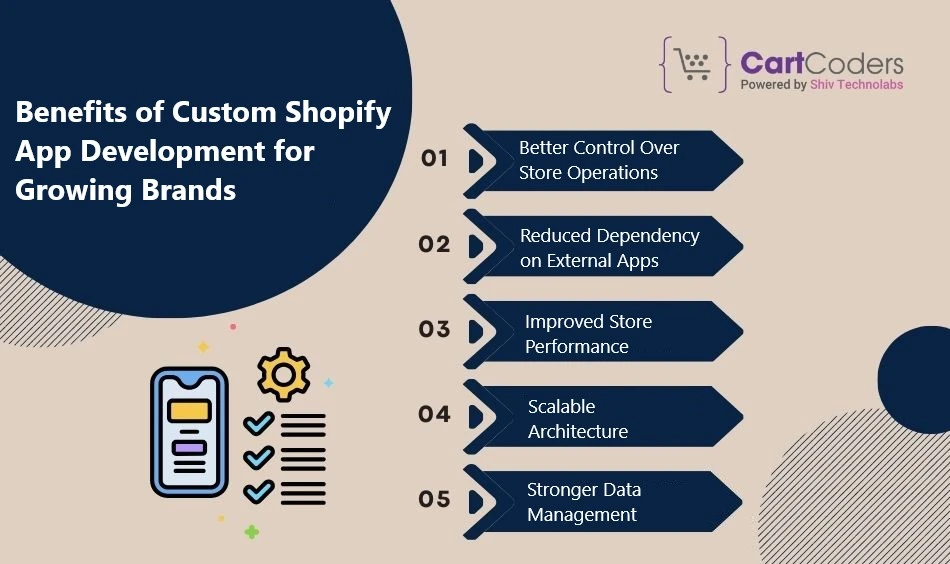
Benefits of Custom Shopify App Development for Growing Brands
Custom Shopify app development is not just about adding features. It changes how your store operates at scale.
Better Control Over Store Operations
Custom apps allow you to define how your store operates instead of adjusting to third-party limitations. You can build workflows that match your exact business logic, whether it is pricing rules, order handling, or backend processes.
This level of control helps maintain consistency across teams and reduces operational confusion as your store scales.
Reduced Dependency on External Apps
Relying on multiple apps often leads to higher costs and conflicts between tools. A custom solution replaces several subscriptions with one focused system built around your needs.
This makes your tech stack simpler and easier to manage while reducing long-term operational costs.
Improved Store Performance
Too many apps add extra scripts that slow down your store. A custom app reduces this load by handling multiple functions within a single system.
This results in faster load times, smoother navigation, and a better experience for users, which directly impacts conversions.
Scalable Architecture
As your business grows, your requirements change. Custom apps allow you to add new features without rebuilding your entire setup.
This flexibility supports long-term growth and helps your store adapt to new business models like B2B or multi-channel selling.
Stronger Data Management
Custom apps give you better control over how data flows between systems. You can manage storage, reporting, and integrations in a structured way.
This improves accuracy, supports better decision-making, and helps teams work with reliable real-time data.
These benefits make custom development a long-term investment for serious Shopify brands.
Challenges You Should Consider Before Building a Custom App
While custom apps offer many advantages, it is important to understand the challenges involved.
Initial Development Cost
Custom apps require an upfront investment since they are built specifically for your business needs. Unlike monthly subscriptions, this is a one-time build cost based on features and integrations.
Over time, this approach can reduce recurring expenses by replacing multiple third-party tools and improving operational efficiency.
Must Read: Shopify App Development Cost Guide
Development Time
Building a custom app takes time because it involves planning, development, testing, and refinement. Each feature must be designed to match your workflows and business logic.
Brands should plan timelines realistically and align internal teams instead of expecting immediate deployment.
Ongoing Maintenance
Custom apps require regular updates and monitoring to stay aligned with Shopify updates and changing business needs. Performance checks and improvements are also part of this process.
Working with an experienced development team helps maintain stability and keeps the app running without disruptions.
Clear Requirement Planning
A custom app performs well only when requirements are clearly defined from the start. Without proper planning, the final solution may not meet business expectations.
It is important to outline workflows, use cases, and goals in detail before development begins to avoid rework and delays.
Understanding these challenges and preparing well helps in making the right decision.
How Custom Shopify Apps Work Behind the Scenes
Custom Shopify apps connect with your store using Shopify APIs. They interact with products, orders, customers, and checkout processes.
Here is a simple breakdown:
- The app connects securely to your Shopify store
- It reads and writes data based on permissions
- It runs logic based on triggers like orders or customer actions
- It sends data to external systems if needed
This setup allows real-time operations without manual intervention.
For example, when an order is placed, the app can automatically update inventory, notify the warehouse, and sync data with ERP.
This level of automation improves efficiency across the business.
Why Brands Choose CartCoders for Custom Shopify App Development?
Building a custom Shopify app requires both technical knowledge and business understanding.
CartCoders focuses on creating solutions that match real business needs, not just features.
- Experience with Shopify and Shopify Plus projects
- Strong understanding of B2B, D2C, and hybrid models
- Expertise in integrations with ERP, CRM, and third-party systems
- Focus on performance and clean architecture
- Support for scaling stores with complex requirements
The approach stays practical. The goal is to build apps that simplify operations and support growth without adding complexity.
Conclusion
Custom Shopify app development becomes relevant when your store moves beyond standard operations. It helps you manage complexity, reduce dependency on multiple tools, and build systems that align with your business.
As your store grows, flexibility and control become more important than convenience. Custom apps provide that flexibility while keeping operations efficient and scalable.
For brands aiming to build strong Shopify systems, this approach supports long-term growth without operational bottlenecks.
FAQs
Custom Shopify app development means building apps specifically for your store’s needs. These apps solve unique problems that standard apps cannot handle.
You should consider it when your store has complex workflows, uses too many apps, or needs integration with external systems like ERP or CRM.
Custom Shopify app development typically costs:
– Basic app: $5,000 to $12,000
– Mid-level app: $12,000 to $30,000
– Advanced app: $30,000 to $80,000+
– Shopify Plus solutions: $50,000 to $100,000+
The cost depends on features, integrations, and the complexity of your requirements.
Development time depends on requirements. Basic apps may take a few weeks, while complex systems can take a few months.
Yes. Replacing multiple third-party apps with one custom solution can reduce load time and improve overall performance.
A custom Shopify app is built specifically for your store’s needs, while a public app is designed for general use across many stores. Custom apps focus on your workflows, integrations, and business logic without extra features. Public apps offer ready-made solutions but may not fully match your requirements.
Custom Shopify apps are not limited to large businesses. Small and mid-sized stores also use them when they need specific features or want to reduce dependency on multiple apps. If your store has unique workflows or scaling challenges, a custom app can be a practical solution regardless of size.
Yes, custom Shopify apps can connect with tools like ERP, CRM, payment systems, and logistics platforms. These integrations help automate data flow between systems and reduce manual work.
A well-built custom app can improve store performance. It replaces multiple third-party apps, which reduces extra scripts and load time. However, poor development can cause issues, so it is important to build the app with clean architecture and proper performance checks.


