
AI shopping is changing how people find and buy products online. Instead of moving between several stores, shoppers can use AI assistants to compare options, check availability, and move closer to purchase in one conversation.
For Shopify merchants, this makes UCP vs ACP worth understanding. Both protocols support agentic shopping, but they connect merchants with different AI ecosystems. The broader shift toward Shopify Agentic Storefronts also shows how product discovery is moving beyond the traditional storefront.
The practical question is not simply which protocol is better. Shopify supports both through its agentic commerce infrastructure, so merchants should focus on keeping product data, availability, policies, checkout, and reporting accurate across these channels.
Shopify’s Agentic Storefronts announcement provides more context on how these AI shopping channels connect with Shopify. This guide compares UCP and ACP and explains what merchants should prepare for next.
Quick answer: UCP is an open commerce standard co-developed by Google and Shopify. ACP is an open specification created by OpenAI and Stripe. Shopify merchants usually do not build separate integrations for both. Their priority is preparing accurate product data and reliable shopping journeys for each supported AI channel.
What Are UCP and ACP in Agentic Commerce?
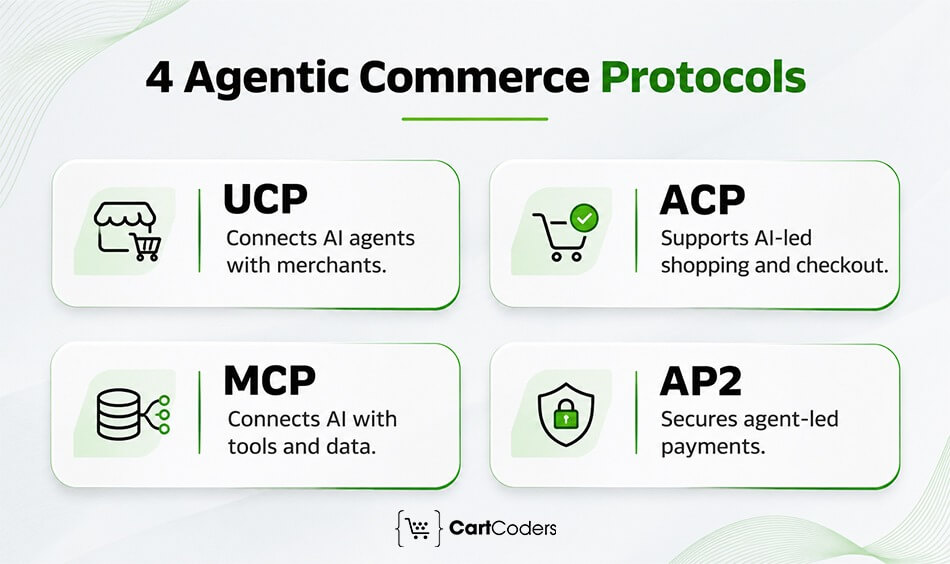
UCP and ACP give AI systems structured ways to communicate with merchants. They reduce the need for every AI platform and commerce business to create a completely separate connection.
Both protocols can support parts of the shopping journey, including product discovery, carts, checkout, payments, and order processing. However, their associated platforms, technical structures, and merchant onboarding paths differ.
Universal Commerce Protocol
Universal Commerce Protocol is an open standard co-developed by Google and Shopify. It gives AI agents and merchants a shared structure for product discovery, checkout, fulfilment, orders, and post-purchase activity.
UCP uses a modular model. Merchants and agents can declare the capabilities they support, including discounts, subscriptions, loyalty benefits, delivery choices, and payment handlers. The official Universal Commerce Protocol documentation describes its use across Google AI Mode, Gemini, and connected commerce experiences.
Agentic Commerce Protocol
Agentic Commerce Protocol is an open specification created by OpenAI and Stripe. It gives AI agents a standard method for exchanging product, checkout, payment, and order information with sellers.
ACP first supported Instant Checkout in ChatGPT. OpenAI expanded its role in March 2026, allowing merchants and commerce platforms to provide richer product feeds and promotions for ChatGPT discovery. OpenAI’s announcement on product discovery in ChatGPT explains how ACP receives structured catalog information from participating merchants.
Model Context Protocol and AP2 Fit
MCP is different from both commerce protocols. It helps AI systems connect with tools, services, and data sources, but it is not a dedicated checkout standard.
UCP can use an MCP binding, while Shopify makes commerce tools available to agents through supported endpoints. MCP handles connections to tools and data, whereas UCP defines the broader commerce interactions, including checkout and order processing. These roles are part of the wider shift toward agentic commerce and AI shopping agents
Where MCP and AP2 Fit
MCP and AP2 sit alongside UCP and ACP, but they solve different parts of agent-led commerce. UCP and ACP focus on commerce interactions, while MCP helps AI systems connect with external tools and data, and AP2 focuses on payment authorization.
- MCP provides a connection layer between AI applications, tools, services, and external data.
- AP2 supports secure authorization when an AI agent is involved in a payment.
- UCP defines broader commerce operations between AI agents and merchants.
- ACP supports product discovery and purchasing interactions associated with ChatGPT.
These technologies can work together rather than compete directly. For example, UCP can work through REST, MCP, A2A, and other supported transport methods. MCP may manage the connection, while UCP defines the commerce action.
As AI continues to shape online shopping, agentic commerce and AI shopping agents offer a closer look at how these systems are moving beyond product research to support purchasing decisions and transactions.
UCP vs ACP: What Are the Main Differences?
The main difference lies in the ecosystems and implementation models associated with each protocol. UCP plays a central role in Google and Shopify’s agentic commerce infrastructure. ACP supports product discovery and purchasing experiences associated with ChatGPT.
Both standards continue to develop as more commerce platforms, payment providers, and AI channels participate. Their presence does not guarantee access to every feature or checkout option.
| Comparison Factor | UCP: Universal Commerce Protocol | ACP: Agentic Commerce Protocol |
| Main developers | Google and Shopify, with other partners | OpenAI and Stripe |
| Initial launch | January 2026 | September 2025 |
| Main purpose | Interoperable agentic commerce operations | Product discovery and purchasing integrations |
| Associated AI channels | Google AI Mode and Gemini; related ecosystem integrations | ChatGPT shopping |
| Architecture | Modular commerce capabilities | Structured merchant-to-AI integration |
| Merchant discovery | Merchant capabilities and supported integrations | Product feeds and approved partner integrations |
| Product information | Merchant Center feeds and connected systems | Structured product feeds |
| Checkout | Native, cart handoff, and supported embedded approaches | Merchant checkout, browser flows, and supported integrations |
| Payments | Payment handlers and compatible payment protocols | Merchant payment systems and supported delegated payment approaches |
| Merchant approval | Depends on platform and integration | Partner approval for direct ACP onboarding |
| Shopify support | Through Shopify’s agentic commerce infrastructure | Through Shopify Catalog and supported integrations |
| Custom development | Depends on the commerce platform and implementation | Depends on the integration path |
The comparison describes protocol capabilities, not guaranteed access. Available features depend on the channel, merchant eligibility, customer location, product type, and rollout status.
How Their Integration Models Differ
UCP allows agents and merchants to publish supported capabilities. A direct implementation may include a merchant profile covering checkout, fulfilment, payment handlers, discounts, and supported protocol versions.
ACP uses structured product feeds for discovery and merchant endpoints for supported checkout journeys. Its checkout API can create, update, and complete checkout sessions while the merchant controls pricing, inventory, taxes, and payment processing.
Shopify handles much of this infrastructure for eligible stores. Direct protocol work becomes more relevant for custom commerce platforms, shopping-agent developers, and unusual purchasing workflows.
How Do UCP and ACP Handle Checkout?
UCP can support native checkout, embedded experiences, and cart handoffs. The available approach depends on the AI platform, merchant connection, and supported commerce capabilities.
ACP can support agent-led checkout, but product discovery does not automatically provide in-chat purchasing. A customer may find a product through ChatGPT and still complete checkout on merchant’s Shopify store.
The ACP checkout specification describes structured sessions for cart management, fulfilment, payment, and order completion.
Expert insight: Product visibility and checkout availability are separate. A product can appear inside an AI response without being eligible for direct purchasing within that interface.

Does Shopify Work With Both UCP and ACP?
Shopify works across both protocol ecosystems, but its role differs between them. Shopify directly co-developed UCP, while Shopify Catalog supplies product information to ChatGPT’s ACP-based discovery infrastructure.
Eligible merchants manage supported AI channels through Agentic Storefronts in Shopify Admin. These channels may include ChatGPT, Google AI Mode, Gemini, Microsoft Copilot, and Meta.
Shopify merchants do not need to choose between protocols or set up separate connections for each one. Instead, Shopify prepares eligible store data for supported AI channels, a direction reflected in its agentic commerce announcement.
How Shopify Connects AI Shopping Channels
| AI Channel | Shopify’s Current Role | What Merchants Should Review |
| ChatGPT | Shopify Catalog supplies product data | Catalog accuracy, eligibility, and store checkout |
| Google AI Mode | UCP-based commerce connection | Channel eligibility and checkout availability |
| Gemini | Connected through Google’s commerce infrastructure | Product data and regional access |
| Microsoft Copilot | Shopify-supported shopping experience | Channel access, order flow, and attribution |
| Meta | Supported experiences where available | Eligibility and current rollout status |
| Other supported channels | Shopify-managed integrations where available | Supported features and merchant settings |
A merchant may therefore have products available for AI discovery without every AI channel offering the same purchasing experience. For businesses with advanced B2B requirements, Shopify Plus development may still be necessary when agent-assisted purchasing involves customer-specific catalogs, custom pricing, or external systems. These needs should be assessed within the broader Shopify Plus development architecture rather than treated as a separate protocol-selection problem.
What Happens When a Shopper Uses an AI Assistant?
Consider a shopper looking for a waterproof travel bag under $150.The customer specifies a budget, preferred color, and delivery destination.
A supported shopping experience may follow these steps:
- Request interpretation: The assistant identifies the budget, use case, delivery need, and preferred features.
- Product discovery: The AI channel searches eligible catalog information for suitable options.
- Comparison: The assistant reviews price, material, size, availability, shipping, and return conditions.
- Selection: The customer chooses a product and confirms the required variant.
- Checkout: The platform opens an embedded experience, supported checkout, or merchant website.
- Payment approval: The customer approves the transaction through an available payment method.
- Order processing: Shopify receives the order and passes it into the merchant’s existing operations.
The exact experience varies by platform. A successful checkout through one AI channel does not confirm that every other channel works identically.
Expert insight: Merchants should test each supported shopping channel separately. A successful purchase through one AI platform does not prove that product discovery, payment, and fulfillment work identically elsewhere.
How Shopify Checkout Remains Involved
Shopify remains the merchant’s commerce system. Orders, inventory changes, customer details, fulfilment steps, taxes, and policy obligations still return to the merchant’s Shopify setup.
For Shopify products found through ChatGPT, shoppers generally complete checkout through the merchant’s online store. Other eligible channels may support embedded or direct purchasing experiences.
Stores with custom checkout logic should test every supported journey. This becomes important when discounts, subscriptions, bundles, delivery rules, or customer-specific pricing affect the final order.
What Determines Whether AI Agents Find Your Products?
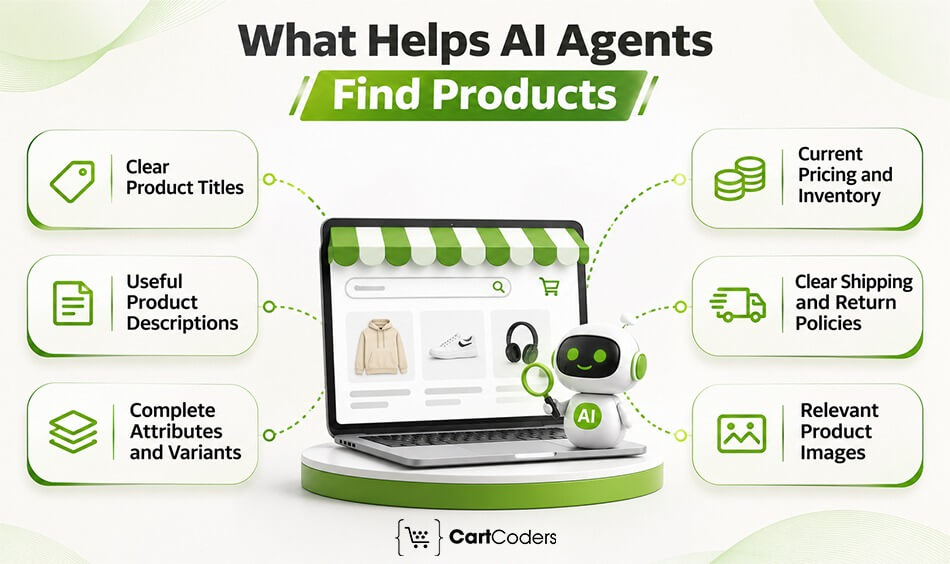
Protocol support creates a connection, but product data determines what an AI assistant can interpret. Both UCP and ACP depend on reliable merchant data to support relevant product discovery and purchasing decisions. Incomplete information can cause a relevant product to be overlooked or represented inaccurately.
However, complete information does not guarantee that an AI assistant will recommend a particular store. It is totally depending upon the store structure. AI agents need more than titles and prices. They may compare size, material, compatibility, delivery, availability, warranty, return conditions, and intended use before suggesting a product.
Clear Product Titles
A title should identify the product without relying on vague promotional language. Include the product type, core feature, model, material, or other meaningful detail where relevant. For example, “Waterproof Women’s Hiking Shoes” gives an agent more context than “Adventure Pro.” Brand names can remain, but they should not replace useful product information.
Useful Product Descriptions
Descriptions should answer the questions customers ask before buying. Include materials, dimensions, intended use, compatibility, care instructions, limitations, and suitable customer types. Avoid repeating the same keyword throughout the description. Specific facts give AI systems stronger information for comparisons and recommendations.
Complete Attributes and Variants
Size, colour, capacity, age group, gender, material, and compatibility should use consistent values. Important attributes should not appear only inside images. Each variant needs the correct SKU, image, price, inventory status, and option name. Complex variant structures may require a closer review of Shopify Catalog mapping.
Current Pricing and Inventory
AI shopping systems need current price and availability information. An outdated promotion or delayed inventory update can create a poor experience during checkout.
Stores connected with an ERP, warehouse, supplier, or inventory platform should check update frequency. Businesses with complex systems may need Shopify integration support to correct delays or conflicting records.
Clear Shipping and Return Policies
AI assistants may answer questions about shipping costs, delivery dates, return windows, final-sale items, warranties, and subscriptions. These answers depend on the information supplied by the store.
Shopify requires eligible stores to complete terms, privacy, and return policies. Its Agentic Storefronts requirements also explain that each AI channel can apply separate conditions.
Relevant Product Images
Images should show the complete product, important details, scale, colour, and intended use. Variant images should match the option selected by the customer. AI shopping systems increasingly interpret text and visual information together. Conflicting images can make product matching less reliable.
Product Data Readiness Checklist
| Data Area | What to Review | Priority |
| Product titles | Clear identity and product type | High |
| Descriptions | Features, specifications, and use cases | High |
| Categories | Correct product classification | High |
| Variants | Sizes, colours, images, and SKUs | High |
| Pricing | Current price and valid promotions | Critical |
| Inventory | Live variant availability | Critical |
| Shipping | Destinations, costs, and delivery estimates | High |
| Returns | Conditions, exclusions, and timeframes | High |
| Images | Accurate product representation | Medium |
| Business details | Consistent policies and contact information | High |
Consider: Begin with high-revenue products and items with complex variants. These products are more likely to reveal data, pricing, or inventory conflicts.
How Can Shopify Merchants Prepare for UCP and ACP?
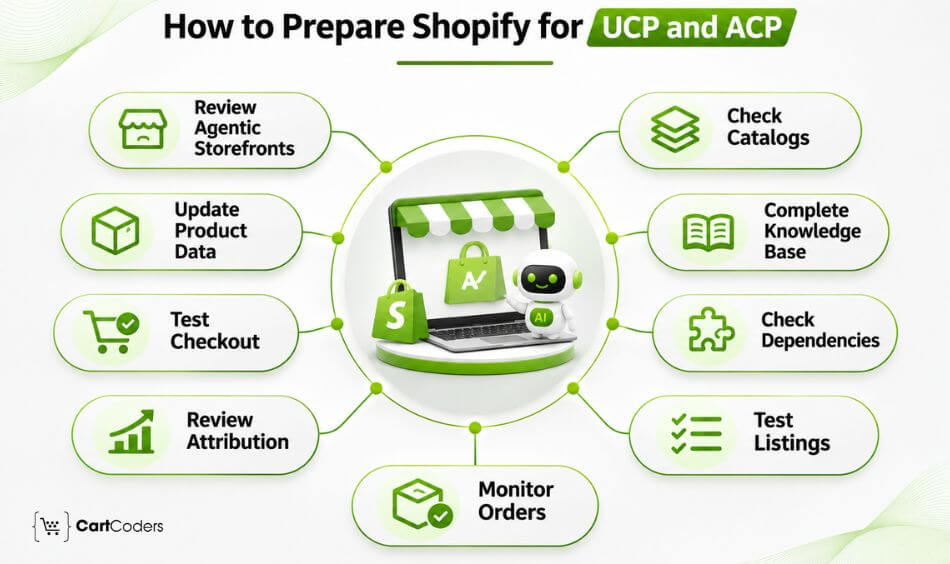
Most merchants should focus on store readiness instead of building separate UCP and ACP connections. Start with Shopify’s existing capabilities, then consider custom work only when a confirmed requirement remains unsupported.
The preparation process should cover eligibility, product information, policies, checkout, connected systems, and measurement.
1. Review Agentic Storefronts
Check the Agentic Storefronts area inside Shopify Admin. Confirm which AI shopping channels are available and whether each connection is active. Eligible stores may receive Agentic Storefronts by default. However, channel access still depends on regional, product, policy, and store requirements.
2. Check Shopify Catalog Eligibility
Review store-level and product-level eligibility. Look for restricted categories, incomplete information, unsupported sales conditions, or catalog errors. Correct the reported cause instead of creating duplicate product feeds. Multiple feeds may introduce conflicting prices, products, and availability.
3. Review Product Information
Audit titles, descriptions, categories, variants, images, prices, and inventory. Begin with products receiving the most orders, traffic, or support questions. Shopify’s Fall ’26 updates also introduce changes to Catalog eligibility and the Knowledge Base, which affect how merchants prepare their stores for AI-driven commerce.
4. Complete the Knowledge Base
Add accurate answers about shipping, returns, warranties, subscriptions, payment methods, product care, and common purchase concerns. Each answer should match the information shown on the storefront. Conflicting answers can confuse both customers and AI shopping systems.
5. Verify Checkout Experiences
Test the customer journey available through each supported AI channel. Include product selection, variants, discounts, shipping, taxes, payment, confirmation, and fulfilment. Stores using subscriptions, bundles, pre-orders, or custom delivery rules need additional test cases. Standard product testing may not reveal problems affecting these orders.
6. Review Technical Dependencies
Map the systems involved after an AI channel sends a customer or order to Shopify. This may include inventory, ERP, CRM, accounting, shipping, support, and warehouse platforms. A successful front-end checkout is not enough if the order fails inside fulfilment or inventory operations.
7. Check Attribution and Reporting
Confirm how AI referral sessions and orders appear in Shopify Analytics. Compare this information with GA4, server-side tracking, and other reporting platforms. Some embedded journeys may not trigger every browser-based script. Reporting should not depend entirely on client-side tracking.
8. Test Product Representation
Use realistic customer prompts across the supported platforms. Search by need, budget, material, compatibility, delivery time, and other buying criteria. Review how the AI assistant presents titles, descriptions, prices, images, variants, and policy details. Trace incorrect information back to its source.
9. Monitor Orders and Customer Questions
Track which products receive AI referrals, completed orders, cancellations, and support questions. These signals show where product information or checkout steps remain unclear. Review trends over time instead of judging performance from a small number of visits. AI shopping availability and customer behavior can vary between channels.
Expert consideration: Start with Shopify’s current tools before commissioning custom development. A separate protocol connection may duplicate capabilities already available through Shopify.
What Mistakes Should Shopify Merchants Avoid?
Agentic commerce announcements can make protocol work appear more urgent than store preparation. Merchants often create unnecessary costs by starting technical projects before reviewing their existing Shopify capabilities. The following mistakes affect product accuracy, implementation costs, checkout reliability, and performance reporting.
Treating UCP and ACP as Competing Shopify Platforms
UCP and ACP connect with different AI ecosystems, but most Shopify merchants do not select one as an exclusive channel. Confirm what Agentic Storefronts already supports before planning separate integrations. A custom project should address a defined limitation.
Ignoring Product Data Quality
A connected store can still provide incomplete or conflicting information. Missing attributes, incorrect variants, delayed inventory, and outdated prices can weaken product representation. Review catalog accuracy before investing in further technical work. Better source data supports every connected shopping channel.
Creating Duplicate Product Feeds
Shopify Catalog already supplies information to supported AI platforms. Adding another feed without a defined need can create duplicate listings or conflicting prices. Map the existing data flow before adding a new connection. One reliable source is easier to maintain than several overlapping feeds.
Measuring Only AI Referral Traffic
Referral sessions do not show whether agent-led discovery produces profitable orders. Some purchases may also be recorded differently across Shopify and analytics tools. Track orders, revenue, checkout failures, unavailable products, cancellations, and repeat purchases alongside referral traffic.
Assuming Every Channel Works the Same Way
Product discovery, checkout, payment, attribution, and regional support can differ between ChatGPT, Google, Gemini, Copilot, and Meta. Test each channel separately. One successful journey does not confirm that every other connection is ready.
When Does Agentic Commerce Require Custom Shopify Development?
Many Shopify stores can begin with Agentic Storefronts and Shopify Catalog. Custom work becomes relevant when the standard setup cannot support specific catalog, checkout, integration, or reporting requirements. The development scope should follow the business process. A store does not need custom UCP or ACP work simply because these protocols exist.
| Business Requirement | Possible Technical Work |
| Customer-specific B2B prices | Catalog access and pricing controls |
| Complex product configurations | Selection and validation logic |
| External inventory systems | Real-time inventory synchronization |
| ERP-based order processing | Order, fulfilment, and status connections |
| Special checkout requirements | Supported checkout extensions |
| Custom shopping agents | MCP, UCP, API, and permission planning |
| Advanced attribution | Server-side reporting and channel tracking |
| Regional selling | Currency, tax, inventory, and policy rules |
B2B and Wholesale Stores
B2B stores may use private catalogs, customer-specific prices, payment terms, quantity rules, or company accounts. These details should not appear in public AI shopping results. Blended B2B and D2C stores need careful catalog separation. Shopify Plus development may be relevant when AI shopping must work alongside private wholesale logic.
Stores With Complex Products
Configurable products may require compatibility checks, measurements, uploaded files, personalisation, or dependent options. An AI assistant cannot create a valid order without the correct validation rules. These stores may need custom product logic before agent-led checkout becomes reliable.
Stores Using External Business Systems
ERP, warehouse, supplier, or fulfilment platforms may control prices and inventory. Slow or conflicting updates can affect every AI shopping channel connected through Shopify. The priority is correcting the source data path. A separate AI integration will not solve inaccurate information entering Shopify.
Businesses Building Their Own Shopping Agent
A business developing its own shopping assistant may need direct access to UCP, MCP tools, Catalog API, or custom checkout endpoints. This work requires authentication, permissions, inventory validation, payment security, order state management, customer consent, and error handling. Shopify AI development can support these requirements when an existing sales channel does not cover the intended experience.
How CartCoders Helps Shopify Merchants Prepare for AI Shopping
CartCoders helps merchants identify the store-level issues that affect AI product discovery and agent-led purchasing. The review begins with Shopify’s existing capabilities before recommending custom development.
Our team can assess Agentic Storefronts, Shopify Catalog, product attributes, policies, checkout behaviour, connected systems, and order reporting. This gives merchants a clear view of what already works and what requires attention.
Support may include:
- Agentic Storefronts eligibility review
- Shopify Catalog and product-data checks
- Variant, attribute, and category mapping
- Knowledge Base and policy review
- Checkout and order-flow testing
- ERP, inventory, and fulfilment checks
- AI referral and order-attribution review
- Custom agent and commerce integration planning
CartCoders’ Shopify development services can address confirmed gaps involving product data, integrations, checkout logic, and custom AI shopping requirements.
Final Verdict: Readiness Matters More Than Protocol Selection
UCP and ACP provide two structured approaches to agentic commerce. UCP supports broad commerce operations across Google and participating platforms, while ACP supports product discovery and purchasing interactions associated with ChatGPT.
For most Shopify merchants, the practical task is not choosing one protocol. Shopify handles much of the connection through Agentic Storefronts, UCP, Shopify Catalog, and supported AI channel integrations.
The stronger preparation plan focuses on complete product information, current inventory, clear policies, reliable checkout, connected operations, and measurable sales. Custom development should address confirmed business requirements rather than duplicate platform capabilities.
Frequently Asked Questions
UCP is an open commerce standard co-developed by Google and Shopify. It supports commerce operations such as checkout, fulfilment, orders, and post-purchase activity. ACP was created by OpenAI and Stripe. It supports structured product discovery and approved checkout interactions associated with ChatGPT.
Shopify co-developed UCP and uses it within supported agentic commerce experiences. Shopify Catalog also provides product information to ChatGPT, where ACP supports product discovery. Shopify merchants generally access these connections through Agentic Storefronts instead of implementing both protocols separately.
Most Shopify merchants do not need to choose. Each AI channel uses its own supported commerce infrastructure, while Shopify manages the available connection. Merchants should focus on eligibility, catalog accuracy, policies, checkout behaviour, connected systems, and order attribution.
UCP is an open standard for communication between merchants, AI agents, payment providers, and commerce platforms. It supports capabilities such as product discovery, checkout, payments, fulfilment, orders, discounts, loyalty benefits, and post-purchase services.
ACP is an open specification that connects sellers with AI agents such as ChatGPT. It supports structured product feeds and approved checkout endpoints. Merchants remain responsible for pricing, inventory, taxes, fulfilment, returns, support, and other business operations.
MCP connects AI applications with external tools and data sources. UCP and ACP address commerce-specific interactions involving products and purchasing. UCP can use an MCP binding, but MCP alone does not define the complete checkout, payment, and order lifecycle.
The store must meet Shopify Catalog and channel requirements. Products also need complete titles, attributes, prices, variants, images, inventory, and policies. Eligibility allows participation, but each AI platform decides which products best match the customer’s request.
Shopify products can appear in ChatGPT through Shopify Catalog. Customers generally complete checkout through the merchant’s online store. The store may open inside an in-app browser or a separate tab. Other approved merchants may receive different checkout options.
UCP does not replace Shopify Checkout. It provides a structured method for an AI system to communicate with the merchant’s commerce infrastructure. Shopify still processes supported checkout activity, order data, inventory changes, and merchant operations.
Neither protocol guarantees sales or product recommendations. Their value depends on channel access, product relevance, catalog quality, customer demand, and purchasing reliability. Merchants should measure completed orders, revenue, cancellations, and repeat purchases rather than protocol access alone.


