

Running an eCommerce store means making dozens of decisions every day. Which products should show first? Why do visitors leave without buying? Why does the stock sell out faster than planned? AI tools help answer these questions using data instead of guesswork. They do not replace people. They support better decisions.
This guide explains how AI tools fit into real eCommerce workflows. The focus stays on tools that store owners, managers, and tech teams already use.


What Makes a Tool AI-based in eCommerce?
Many eCommerce tools claim to use AI, but not all of them do meaningful work.
An AI-driven eCommerce tool usually does one or more of the following:
- Studies shopper behavior
- Adjusts results based on patterns
- Predicts future outcomes from past data
- Reacts without fixed rules
Traditional tools follow instructions written by humans. AI tools adapt over time based on data. Both matter, but AI becomes more useful as stores grow and catalogs expand.
AI works best when:
- Product data is structured
- Customer activity is tracked correctly
- Teams review results regularly
Poor data leads to poor output. This matters more than the brand name of any tool.
AI Tools for Product Discovery and Onsite Search
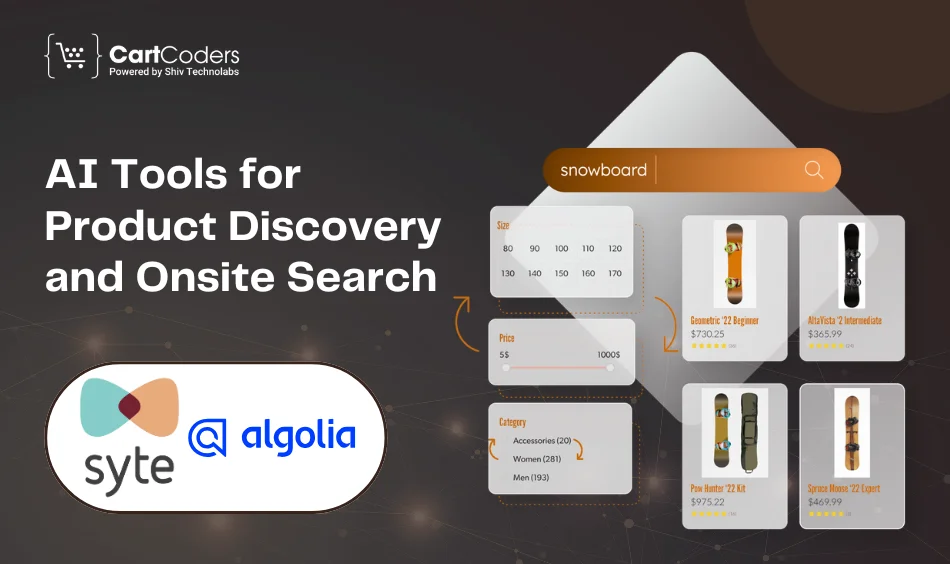
Search is often the first interaction a shopper has with a store. If results feel slow or irrelevant, visitors leave.
1. Algolia
Algolia supports fast onsite search with typo handling and smart ranking. It studies clicks, searches, and purchases to adjust product order over time.
Best suited for:
- Large catalogs
- Electronics and accessories
- Multi-category stores
It helps shoppers find what they want without scrolling through long lists.
2. Syte
Syte focuses on visual search. Shoppers can upload images or click visuals to find similar products. This works well when customers cannot describe what they want in words.
Best suited for:
- Fashion and lifestyle stores
- Furniture catalogs
- Mobile-first users
Visual matching shortens the path from interest to product view.
AI Tools for Personalization and Recommendations
Personalization helps shoppers see relevant items earlier. This reduces decision fatigue and improves product discovery.
3. Nosto
Nosto supports product recommendations across home pages, collections, and emails. It learns from browsing behavior, cart actions, and purchase history.
Best suited for:
- Mid-size Shopify stores
- Cross-sell and upsell goals
- Returning customers
It works well with minimal setup and clear reporting.
Also Read: Nosto App Shopify – Complete Review, Cost, and Features Guide
Make Your Store Ready for AI Tools
Clean structure, strong performance, and future-ready setup.


4. Dynamic Yield
Dynamic Yield supports deeper personalization. It adjusts content blocks, banners, and recommendations based on user behavior and segments.
Best suited for:
- High-traffic stores
- Enterprise teams
- Stores operating across regions
It fits teams that review data often and run structured tests.
5. AI Fit Finder
AI Fit Finder tools help shoppers choose the right size, fit, or product variation based on their inputs and past behavior. This is especially helpful in categories where returns are high due to sizing issues.
AI Fit Finder tools work by:
- Asking simple questions about body type, usage, or preferences
- Comparing responses with past purchase and return data
- Suggesting the most suitable size or product option
These tools reduce guesswork for shoppers and lower return rates for store owners.
Best suited for:
- Fashion and apparel stores
- Footwear brands
- Fitness, wearables, and uniform-based products
The AI Fit Finder tool is most effective when product data is detailed and consistent. Poor size charts or missing attributes reduce accuracy, so data cleanup is an important step before setup.
AI Tools for Pricing and Inventory Decisions
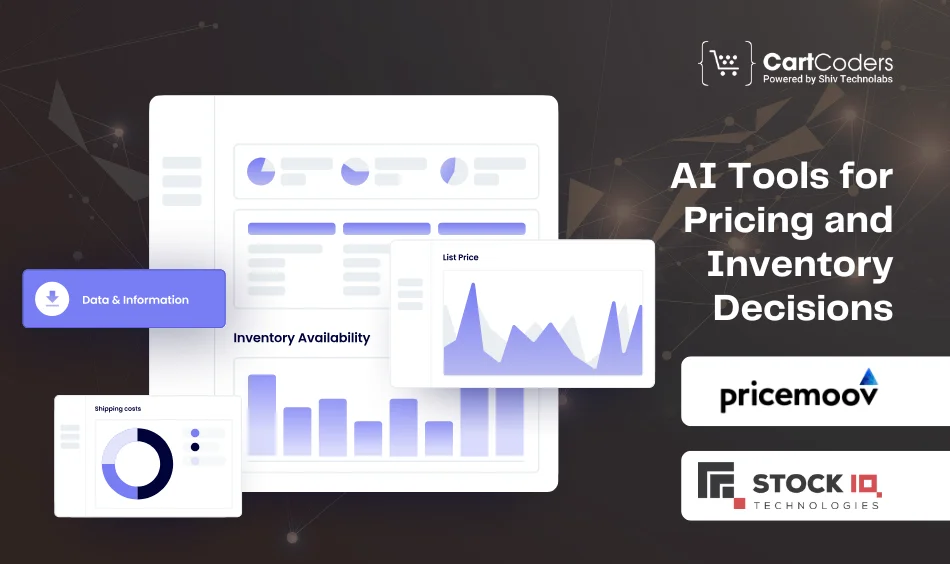
Pricing and stock mistakes impact profit directly. AI helps teams spot patterns that are hard to see manually.
6. Pricemoov
Pricemoov provides pricing suggestions based on demand, competitor data, and sales trends. It does not change prices without approval.
Best suited for:
- Competitive catalogs
- Fast-moving products
- Seasonal campaigns
Teams stay in control while gaining data-driven insight.
7. StockIQ (by ChannelAdvisor)
StockIQ focuses on demand forecasting and inventory planning. It predicts future stock needs using sales history and trends.
Best suited for:
- Multi-channel sellers
- Regional warehouses
- Large SKU counts
It reduces overstock and late restocking issues.
AI Tools for Customer Support and Retention
Customer support teams often answer the same questions again and again. Order status, shipping timelines, return rules, and basic product details make up a large share of tickets. AI helps reduce this load.
8. Gorgias AI
Gorgias AI handles routine support requests by studying past tickets and storing data. It suggests replies for order tracking, delivery updates, and common questions.
It works well for:
- Shopify-based stores
- Small to mid-size support teams
- Stores with high repeat questions
Human review still matters for refunds, complaints, and edge cases.
9. Zendesk AI
Zendesk AI focuses on sorting and routing tickets. It detects intent, suggests responses, and helps teams manage large volumes across channels.
It fits well for:
- Multi-brand eCommerce teams
- Email, chat, and social support
- Structured support workflows
AI speeds up response handling, but decision-making stays with the team.
AI Tools for eCommerce Marketing and Content
Content creation scales slowly when done fully by hand. AI helps with drafts and structure, but not final judgment.
10. Jasper
Jasper supports product descriptions, email drafts, and ad copy. Teams should treat output as a starting point, not finished content.
It works best for:
- Large catalogs
- Content refresh projects
- Draft-level copy creation
Every output should pass through human review before publishing.
11. Klaviyo AI
Klaviyo AI supports email and SMS campaigns by studying engagement patterns. It helps decide when messages should be sent and which users should receive them.
It supports:
- Send-time predictions
- Audience grouping
- Retention-focused messaging
It improves timing and targeting rather than content quality.
AI-assisted Shopify Migration Tools
12. Matrixify
Matrixify supports bulk imports and exports for products, customers, and orders. It allows teams to review structured data before and after transfer.
It helps with:
- Large data sets
- Controlled import workflows
- Validation during migration
However, tools have limits.
They do not handle:
- SEO planning
- Redirect strategy
- Custom pricing rules
- B2B logic
- Complex integrations
This is where managed Shopify migration services become necessary, especially for stores that rely on organic traffic, custom workflows, or multi-system connections.
AI Tools for Analytics and Decision Support
Traditional reports show what has already happened. AI-driven analytics focus on what is likely to happen next and where teams should pay attention.
13. Pecan AI
Pecan AI supports predictive analysis. It studies customer behavior and sales data to identify trends such as churn risk and repeat purchase likelihood.
It is useful for:
- Subscription-based stores
- Retention-focused teams
- Long-term revenue planning
Rather than reading dozens of charts, teams get clear signals on where to act.
14. Google Analytics 4 (AI features)
Google Analytics 4 includes built-in AI signals such as anomaly detection and predictive metrics. These features highlight sudden changes in traffic, conversions, or engagement.
It supports:
- Early issue detection
- Traffic pattern analysis
- Conversion trend tracking
GA4 works best when events are set up correctly and reviewed on a regular basis.
How to Choose the Right AI Tools for Your eCommerce Store?
Not every store needs every tool. Tool selection should match store size, data volume, and team capacity.
Before adding any AI tool, teams should ask:
- What problem are we trying to solve?
- Do we have clean data for this tool?
- Who will review the output?
- How will success be measured?
A simple way to think about tool selection:
Small stores
- One search or recommendation tool
- One support automation tool
- Manual review for most decisions
Growing stores
- Search plus personalization
- Email or SMS intelligence
- Inventory forecasting
Large or enterprise stores
- Multiple AI layers across search, pricing, and analytics
- Dedicated teams reviewing results
- Clear ownership for each system
Adding tools without ownership often creates more work instead of clarity.
Common Mistakes Teams Make with AI Tools
AI tools fail most often due to process issues, not technology limits.
Common mistakes include:
- Adding too many tools at the same time
- Trusting AI output without review
- Ignoring data cleanup
- Skipping testing before live use
- Expecting instant results
AI improves outcomes over time. Early results often need adjustment.
What AI Tools Cannot Replace in eCommerce?
AI supports decisions, but it does not replace responsibility.
AI cannot replace:
- Platform architecture planning
- UX and customer journey design
- Brand voice decisions
- Complex migrations
- Long-term business strategy
Human judgment still defines direction. AI helps teams move faster in that direction.
How AI Supports Global and Regional eCommerce Growth?
For stores selling across regions, AI helps manage scale without chaos.
AI supports:
- Regional demand patterns
- Language-based behavior signals
- Location-specific stock planning
- Time-based engagement patterns
This helps eCommerce teams operate across the US, UK, EU, and other regions without rebuilding processes for each location.
How CartCoders Helps Teams Apply AI the Right Way?
AI tools work best when they are connected to the right platform setup, clean data, and clear business goals. This is where many eCommerce teams need experienced support.
CartCoders works with growing and enterprise-level eCommerce brands to plan, build, and manage Shopify-based systems that support AI-driven workflows. The focus stays on stability, performance, and long-term growth rather than quick fixes.
Teams work with CartCoders for:
- Shopify store setup and redesign
- Shopify migration with data checks and SEO safety
- App selection and custom feature development
- B2B, multi-store, and regional setups
- Ongoing technical support after launch
Instead of adding tools blindly, CartCoders helps teams decide what fits their store size, data structure, and internal resources. This approach reduces risk during platform changes and supports smoother adoption of AI tools across search, content, analytics, and operations.
For stores planning a platform change or needing structured Shopify migration support, contact CartCoders because we provide hands-on guidance from planning through post-launch review.
Bringing It All Together!
AI tools work best when treated as helpers, not shortcuts. Each tool should solve one clear problem. Teams should start small, review results often, and expand with purpose.
Search and discovery help users find products. Personalization guides choices. Pricing and inventory protect margins. Support automation reduces load. Analytics guide decisions. Migration tools reduce risk during platform changes.
The strongest eCommerce teams combine:
- Clean data
- Focused tools
- Human oversight
- Clear goals
AI does not run an eCommerce business. People do. AI simply helps them see more clearly and act with confidence.
Frequently Asked Questions (FAQs)
AI tools help eCommerce teams handle tasks like product search, recommendations, pricing decisions, inventory planning, customer support, and performance analysis. They reduce manual work and help teams act faster using data patterns.
Yes. Small stores can start with one or two AI tools, such as onsite search or email timing tools. The key is choosing tools that solve a real problem and reviewing results regularly instead of adding many tools at once.
Many AI tools support Shopify, but they also work with other platforms. Shopify stores often see faster adoption because of app support, data access, and flexible integrations.
No. AI supports decisions and execution, but people still manage strategy, product planning, customer experience, and technical direction. AI works best as support, not control.
AI helps during migrations by checking data accuracy, matching products and variants, detecting duplicates, and validating imports. These checks reduce errors before launch, but human review is still required for SEO, redirects, and custom logic.
For small and simple stores, tools may handle most data transfer. For larger stores with SEO traffic, B2B pricing, or custom features, it is strongly recommended to avail the best Shopify migration services.
AI tools can support SEO when used correctly, such as improving search experience, content drafts, and internal linking. Poor data or unchecked automation can harm rankings, so review remains important.
Costs vary by tool and store size. Some tools charge monthly fees, others scale by usage or order volume. Teams should compare pricing against the problem being solved rather than feature lists.
Some tools, like search and support automation, show results within weeks. Others, such as personalization and analytics, need more data and time before patterns become reliable.
No. Developers and agencies handle platform structure, integrations, migrations, and long-term planning. AI tools support daily operations but do not replace technical ownership.


