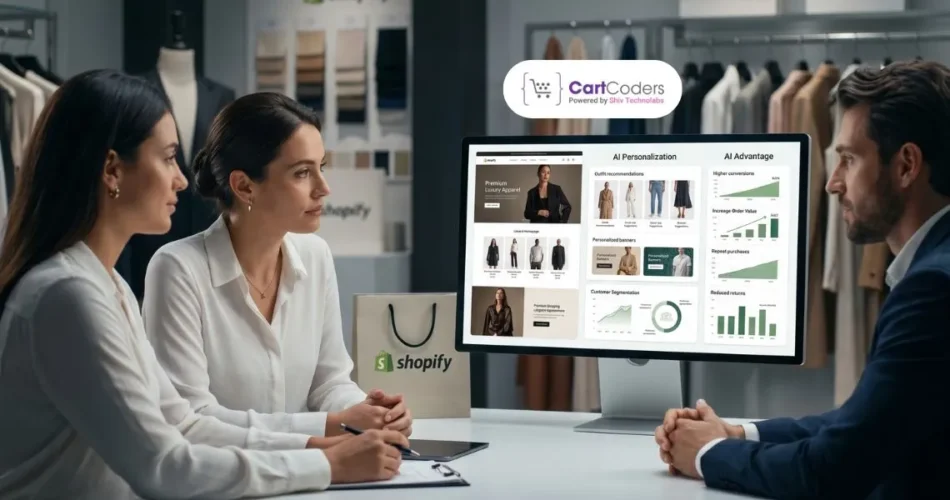

A customer visits your fashion store, browses for 40 seconds, finds nothing that feels relevant, and leaves, costing you a reduced sale and a potential buyer.
This happens thousands of times a day across fashion eCommerce. Not because the products are wrong, but because the experience feels built for nobody in particular.
eCommerce personalization for fashion brands is changing that. AI-powered Shopify development solutions can now serve each visitor a curated, relevant experience, from the first product they see to the final upsell at checkout. For global fashion labels, this is no longer a competitive edge; it is the new standard customers expect.
What Is eCommerce Personalization for Fashion Brands?
eCommerce personalization for fashion brands means using AI to tailor every aspect of the shopping experience, including product recommendations, content, pricing offers, and marketing, to each shopper’s behavior, style preferences, and purchase history. On Shopify, this translates to real-time product feeds, dynamic collections, and smart re-engagement campaigns that turn browsers into buyers.
Why Fashion Brands Can No Longer Ignore AI Personalization?
The global fashion eCommerce sector is projected to reach $1.22 trillion by 2027, growing at a CAGR of 10.5% (ResearchandMarkets). With that scale comes fierce competition. Brands that deliver generic browsing experiences are already losing ground to those offering curated, intuitive storefronts.
Here is what the data consistently shows across leading fashion platforms:
- Conversion rates rise: Shoppers who interact with personalized product recommendations convert at significantly higher rates than those who browse generic category pages.
- Cart abandonment drops: Personalized recovery flows, combining dynamic reminders with tailored offers, recover a measurable share of otherwise lost revenue.
- Average order values increase: AI-driven upsell and cross-sell suggestions, timed at the right moment in the buying journey, consistently lift basket sizes.
- Customer retention improves: Shoppers who feel a store understands their taste return more often and spend more per visit.
For fashion brands operating at scale, these gains are not marginal. They compound across millions of sessions.
How AI Builds a Personalized Experience on Shopify Fashion Stores?
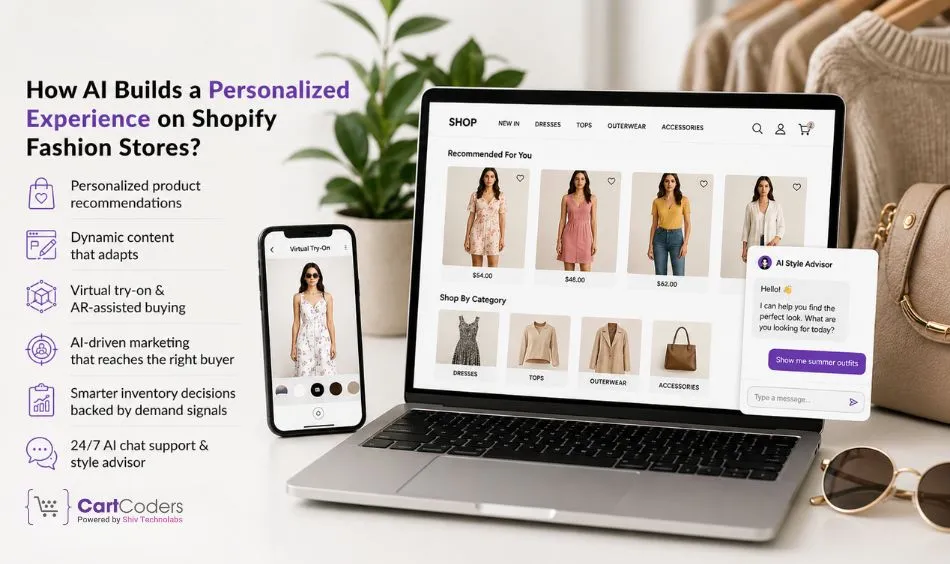
AI personalization is not a single feature. It is a connected system of tools that learns from shopper behavior and adapts the store experience in real time. Here is how each layer works for fashion brands.
Personalized Product Recommendations
AI reads browsing history, purchase patterns, wishlist activity, and session behavior to predict what each shopper wants to see next. A customer who buys premium denim and browses minimalist accessories will see a curated feed built around their actual taste, not a generic best-sellers list.
This matters most in fashion, where product discovery drives as much revenue as direct search. When recommendations feel accurate, shoppers explore more, and exploration drives sales.
Dynamic Content That Adapts to Each Visitor
Banners, hero images, featured collections, and promotional strips all change based on who is viewing the store. A returning customer who recently bought from a summer collection sees arrivals that match that aesthetic. A first-time visitor sees bestsellers calibrated to their referral source or geographic market.
This makes every visit feel intentional, not accidental, which significantly reduces bounce rates on high-traffic fashion stores.
Virtual Try-on and AR-assisted Buying Decisions
Return rates are one of fashion eCommerce’s biggest cost centers. AI-powered augmented reality allows shoppers to visualize how clothing, footwear, or accessories look on them before purchasing. This builds confidence and reduces the hesitation that drives returns and abandoned checkouts.
For premium and luxury fashion brands, virtual try-on also signals brand sophistication, which reinforces positioning in competitive segments.
AI-driven marketing that reaches the right buyer
Personalization does not stop at the storefront. AI segments your audience by purchase intent, product affinity, and lifecycle stage. This means email campaigns, retargeting ads, and SMS flows that reference products each shopper has actually shown interest in.
A shopper who viewed a leather jacket three times but did not buy it receives a targeted follow-up with the jacket, their size, and a time-sensitive offer.
Smarter inventory decisions backed by demand signals
AI analyzes trend data, seasonal shifts, and real purchase behavior to give store teams early signals on what to stock and when. Fashion brands that act on these signals reduce overstock costs and avoid stockouts on high-demand items, both of which directly protect margins.
24/7 AI chat support that doubles as a style advisor
AI chatbot integration on fashion Shopify stores does more than answer order queries. They guide shoppers through fit questions, suggest complementary pieces, and handle common objections at scale. This keeps the buying journey moving without requiring additional customer service headcount.
What to Look for in an AI Personalization Partner for Your Shopify Store?
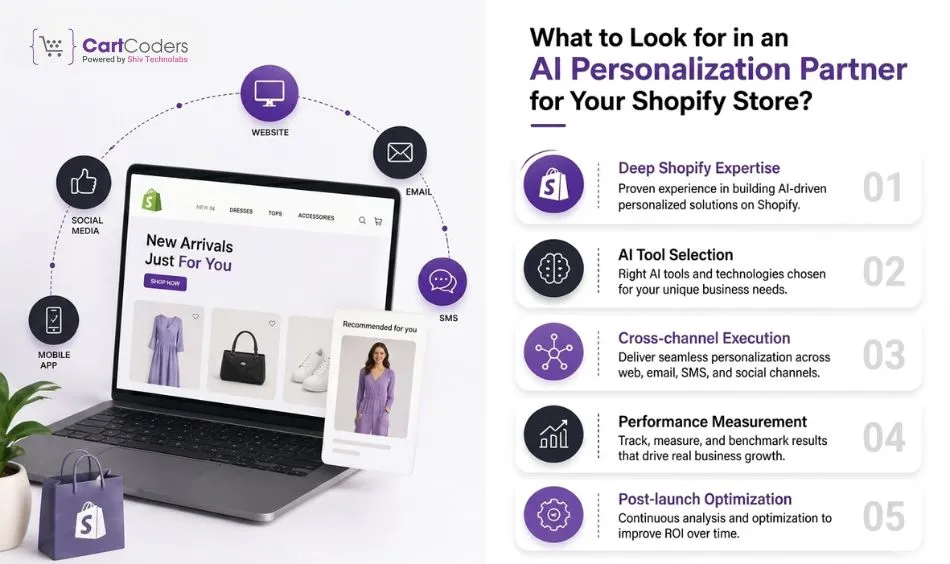
Not all personalization implementations deliver equal results. When evaluating a Shopify development partner for AI personalization, global fashion brands should assess the following.
- Deep Shopify expertise: Your Shopify development partner should have a proven track record building and customizing Shopify and Shopify Plus stores, not just integrating third-party apps.
- AI tool selection: The right partner selects personalization tools based on your catalog size, traffic volume, and customer data maturity, not a one-size-fits-all recommendation.
- Cross-channel execution: Personalization on-site is only part of the picture. Your partner should connect on-site behavior to email, SMS, and paid retargeting flows.
- Performance measurement: You should receive clear attribution between personalization changes and revenue outcomes, not just engagement metrics.
- Post-launch optimization: AI models improve with data. Your partner should support ongoing tuning as your store grows and seasonal trends shift.
How to Implement AI Personalization on Your Shopify Fashion Store?
Most fashion brands know they need personalization. The gap is usually in knowing where to start. Implementation does not have to be a massive overhaul. Done right, it is a phased process that builds on what your store already has.
Step 1: Audit Your Customer Data Readiness
Before any AI tool can personalize effectively, it needs clean, structured data to learn from. The foundation starts at the Shopify store development stage, where behavioral tracking, event capture, and data architecture should be built in from day one, not added as an afterthought. Review what your store currently captures, including browse events, add-to-cart actions, purchase history, and session duration by product category.
If your store is newer or traffic is still growing, begin with rule-based personalization, such as “customers who bought X also bought Y,” while your AI models build enough signal to become predictive.
Step 2: Choose Tools Matched to Your Catalog Size and Traffic Volume
A store with 150 SKUs has different needs than one with 5,000. Select AI tools based on catalog depth, international market coverage, the channels you want to personalize (on-site, email, SMS, paid), and how much control your merchandising team needs over recommendation logic.
Avoid tools that prioritize their own bestseller bias over your brand’s curation standards. For fashion brands, editorial control matters.
Step 3: Configure Recommendation Logic Around Your Brand Rules
AI left unconfigured will recommend whatever converts fastest in the short term. For fashion brands, that can work against brand positioning. This is why, during Fashion Shopify store development, clear merchandising rules matter. They help prevent AI from surfacing out-of-season stock, discontinued lines, or products that do not match a customer’s established style profile.
Configure separate recommendation logic for homepage, collection pages, product detail pages, and cart; each touchpoint has a different intent and needs a different approach.
Step 4: Connect Personalization Across Marketing Channels
On-site personalization alone recovers only part of the opportunity. Connect your Shopify behavioral data to your email platform, SMS tool, and paid retargeting audiences. A shopper who viewed a product three times but did not buy should receive a follow-up that references that exact product, not a generic newsletter.
This cross-channel continuity is where personalization compounds. Each touchpoint reinforces the last, and the cumulative effect on conversion is significantly higher than any single channel working alone.
Step 5: Test, Measure, and Refine Continuously
AI personalization is not a one-time setup. Run A/B tests on recommendation placements, dynamic content variations, and recovery flow timing. Measure impact on conversion rate, average order value, and repeat purchase rate, not just click-through rates.
Allocate time each month to review model performance, especially around seasonal peaks when shopper behavior shifts rapidly. Fashion is one of the most trend-sensitive categories in eCommerce, and your personalization logic needs to move with it.
A note on investment: Implementation scope varies significantly based on catalog size, the number of channels being personalized, and the degree of custom configuration required. Brands working with a Shopify specialist typically see faster results and avoid costly misconfigurations. Contact CartCoders for a scoped estimate based on your specific store setup.
How CartCoders Builds AI-Personalized Shopify Fashion Stores?
CartCoders is a Shopify-specialist development agency with deep experience building AI-powered eCommerce solutions for fashion, apparel, footwear, and accessories brands across the US, UK, Australia, and Canada.
We build personalization systems tailored to each brand’s catalog, audience, and growth stage. Not off-the-shelf configurations, but custom-engineered experiences that reflect your brand identity and convert at scale.
What we build for fashion brands
- AI product recommendation engines: Custom-configured to match your catalog depth, merchandising rules, and brand guidelines.
- Dynamic storefront personalization: Homepage, collection, and product page content that adapts to each visitor in real time.
- Virtual try-on and AR integration: For fashion brands looking to reduce returns and increase buyer confidence.
- Personalized marketing automation: Email, SMS, and retargeting flows that reference actual shopper behavior.
- Shopify Plus checkout personalization: Custom checkout flows that surface upsells and cross-sells relevant to each buyer.
- AI-powered chatbot integration: Style-aware support bots that guide shoppers and handle pre-sales questions at scale.
CartCoders has delivered Shopify solutions for fashion brands that move. If you are ready to make your store work harder for every visitor it receives, we are the team to build it.
Ready to Build a Fashion Store That Converts?
Talk to the CartCoders team about AI personalization for your Shopify fashion store. We offer a free initial consultation to assess your current setup and identify the highest-impact opportunities for your brand. Contact us at cartcoders.com to get started.
FAQ
It is the use of AI and data to tailor each shopper’s experience in a fashion store, including product feeds, content, pricing, and marketing, based on their individual behavior and preferences.
AI tools analyze real-time and historical data from each shopper and use it to serve personalized product recommendations, dynamic banners, and targeted recovery flows across the Shopify storefront and connected marketing channels.
No. AI personalization scales to any catalog size. However, brands with larger catalogs and established traffic see compounding returns faster because AI models learn more quickly from richer data sets.
By showing shoppers products that match their size, style, and purchase history, and by integrating virtual try-on tools that let customers visualize items before buying, AI significantly reduces the likelihood of mismatched purchases.
Depending on the complexity of the implementation, most Shopify AI personalization projects are delivered in 4 to 10 weeks. Basic recommendation engine integrations are faster. Custom dynamic content systems or AR integrations take longer.
Most Shopify fashion stores see measurable impact on conversion rates and average order values within 60 to 90 days of a properly configured implementation. Initial results appear faster for stores with existing traffic and purchase history data. Full model accuracy improves over 3 to 6 months as the AI learns from more shopper interactions.
Core AI personalization features work on standard Shopify plans. For advanced checkout personalization, flow automation, and enterprise integrations, Shopify Plus provides the most flexibility.
AI personalization for a Shopify fashion store typically costs between $3,000 and $25,000+. Basic recommendation engine setups sit at the lower end, while full builds covering on-site personalization, virtual try-on, and cross-channel automation sit higher.
Yes. CartCoders works with both new store builds and existing Shopify stores. We assess your current setup, identify personalization opportunities, and implement changes without disrupting your live store.
CartCoders specializes exclusively in Shopify. We combine technical Shopify development expertise with AI integration experience and fashion eCommerce knowledge to deliver solutions that are built for your brand, not copied from a template.


