

Running a Shopify store has become more complex than choosing a theme and adding products. Many brands now want personalized shopping experiences, content-rich landing pages, lightning-fast storefronts, and integrations with CRM. These requirements have made Headless Shopify an increasingly popular option.
At the same time, Shopify has continued investing in Hydrogen and Oxygen, giving merchants an official way to build custom storefronts while keeping Shopify as the commerce engine.
The answer is not the same for every store.
A headless Shopify architecture can provide greater flexibility, better frontend control, and opportunities to build unique customer experiences. However, it also introduces additional development, maintenance, SEO, and integration responsibilities that many businesses underestimate. For some brands, a modern Shopify theme can deliver excellent results with lower costs and faster implementation.
This guide explains when Headless Shopify is worth the investment, when a traditional Shopify theme remains the smarter choice, and how to evaluate the decision based on business goals instead of industry trends.
Quick Answer: Is Shopify Hydrogen Worth It in 2026?
Yes, but only when your business has clear technical and commercial reasons to go headless.
| Choose Hydrogen When | Choose a Traditional Shopify Theme When |
| You need a fully custom storefront. | Your store follows a standard eCommerce journey. |
| You want advanced content experiences. | You want to launch faster. |
| You manage multiple markets or regions. | You have a limited development budget. |
| You need greater frontend performance control. | Your store depends heavily on Shopify apps. |
| You require deep third-party integrations. | Your team prefers simpler maintenance. |
| You need a scalable architecture for long-term growth. | Your current theme supports your business needs. |
The biggest mistake businesses make is assuming that Headless Shopify automatically delivers better SEO, higher conversions, or faster performance. Those outcomes depend on the quality of implementation rather than the architecture itself.
According to Shopify, Hydrogen and Oxygen are its recommended technologies for building and hosting custom headless storefronts, while Shopify continues managing products, checkout, inventory, payments, and orders. This allows businesses to separate the customer experience from the commerce engine without rebuilding core eCommerce functionality.
What Is Headless Shopify?
Headless Shopify separates the customer-facing storefront from Shopify’s commerce backend. Instead of Shopify themes, developers build a custom frontend using frameworks like Hydrogen, Next.js, or Nuxt, while Shopify continues managing products, inventory, checkout, payments, orders, customer accounts, discounts, taxes, and shipping through APIs.
Independent Frontend
The frontend runs independently, giving developers complete flexibility to create personalized shopping experiences, PWAs, product configurators, multi-brand stores, and localized storefronts without Liquid theme limitations.
How the Storefront API Works
The Storefront API connects the custom frontend to Shopify. It delivers product details, pricing, inventory, images, collections, customer information, and cart data whenever customers browse products, search, add items to the cart, sign in, view recommendations, or begin checkout.
What Happens During Checkout?
Headless Shopify does not replace Shopify Checkout. Customers shop on the custom storefront but complete purchases in Shopify’s secure checkout, where Shopify handles payments, taxes, shipping, fraud protection, order creation, and security. Shopify Plus merchants can further extend checkout using supported customization features.
What Is Shopify Hydrogen in 2026?
Hydrogen is Shopify’s official framework for building headless storefronts. It provides pre-built components, templates, routing, and data-fetching tools, allowing developers to focus on creating custom shopping experiences instead of building commerce functionality from scratch.
Built for Shopify Commerce
Unlike general frontend frameworks, Hydrogen is designed specifically for Shopify. It includes built-in support for product pages, collections, carts, customer accounts, the Storefront API, localization, search, and commerce routing, reducing development time and simplifying integrations.
Oxygen for Hosting
Oxygen is Shopify’s hosting platform for Hydrogen storefronts. It offers edge hosting, global deployment, faster content delivery, simplified deployments, and native Shopify integration, making headless deployments easier to manage.
Why Hydrogen Matters
Hydrogen has made headless development faster and more practical by providing better Shopify API integration, long-term platform support, and streamlined deployment with Oxygen. However, success still depends on strong architecture, performance optimization, quality content, and ongoing maintenance, not simply replacing a Shopify theme.
Shopify Hydrogen vs a Standard Shopify Theme
A Shopify theme and a Hydrogen storefront can both support a fast, conversion-focused eCommerce store. The main difference lies in how the storefront is built, connected, updated, and maintained. Shopify describes Hydrogen as its opinionated headless stack, with tools and patterns designed for Storefront API data.
| Area | Standard Shopify Theme | Shopify Hydrogen |
| Frontend architecture | Shopify Liquid theme | Separate React Router storefront |
| Launch time | Usually faster | Usually longer |
| Initial development cost | Lower | Higher |
| Design control | Strong within theme structure | Full frontend control |
| App compatibility | Most apps work directly | Some apps need API-based integration |
| Content management | Shopify theme editor and metaobjects | Shopify, headless CMS, or both |
| Performance control | Good with clean theme development | Greater control over rendering and caching |
| SEO setup | Many basics are native | More elements need custom implementation |
| Hosting | Included with Shopify | Oxygen or another supported environment |
| Maintenance | Lower technical overhead | Continued frontend engineering required |
| Best fit | Most growing D2C stores | Complex, differentiated storefronts |
Architecture and Frontend Ownership
Standard Shopify themes use the built-in theme editor and app blocks, while Hydrogen separates the frontend from Shopify. Shopify manages commerce, and the custom frontend handles the shopping experience. This provides greater flexibility but requires managing a separate codebase, hosting, deployments, and integrations.
Design Flexibility
Shopify themes suit most stores, while Hydrogen enables advanced experiences like product configurators, buying guides, custom portals, and app-like interfaces. Choose headless only when these capabilities support business goals.
App Compatibility
Many Shopify apps work natively with themes, but headless storefronts may require API integrations or custom frontend development for reviews, subscriptions, loyalty, search, wishlists, and personalization. A compatibility audit is recommended. CartCoders provides Shopify app development services for stores that need custom functionality or integration work beyond standard app capabilities.
SEO Responsibility
Hydrogen gives full control over SEO but requires developers to implement server-side rendering, metadata, structured data, sitemaps, redirects, internal linking, and other technical SEO elements. Better rankings depend on implementation—not headless architecture alone.
Maintenance
Unlike theme-based stores, Hydrogen storefronts require ongoing frontend maintenance, API updates, deployments, monitoring, testing, and integration support. It should be treated as a long-term software application rather than a one-time storefront project.
When Should You Choose Shopify Hydrogen?
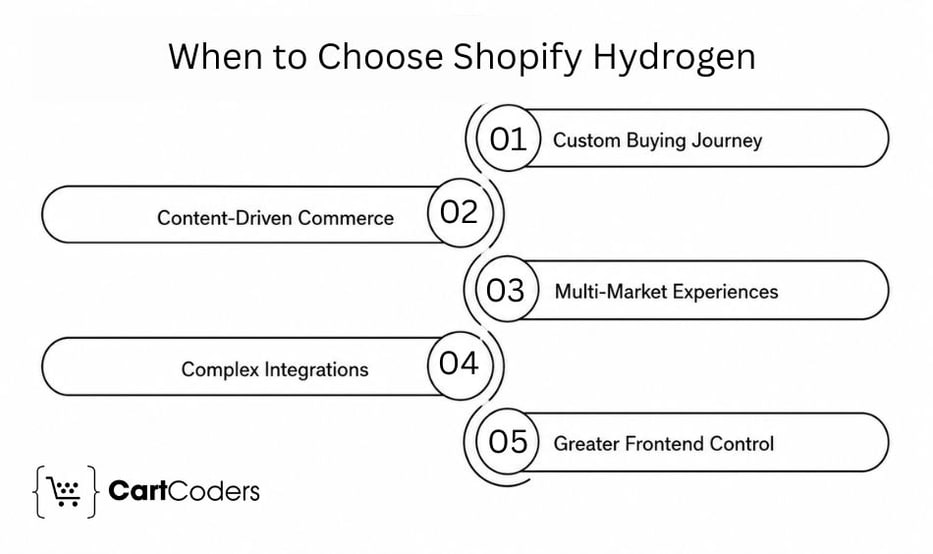
Shopify Hydrogen is worth considering when a standard theme limits a store’s buying journey, content structure, international experience, integrations, or frontend performance. The investment should solve a measurable business problem rather than provide technical flexibility alone. Shopify also provides several headless storefront build options, so Hydrogen is not the only approach.
Your Brand Needs a Custom Buying Journey
Hydrogen suits stores that need guided product selection, complex configuration, interactive bundles, personalized discovery, customer-specific catalogs, or consultation flows. It gives developers greater control over how shoppers move from research to checkout.
Content Directly Influences Sales
Brands with buying guides, product education, quizzes, lookbooks, recipes, or regional campaigns can connect Shopify with a headless CMS. This supports reusable content blocks, localization, publishing workflows, and commerce-led editorial pages.
Different Markets Need Different Experiences
Hydrogen can support localized navigation, content, products, pricing, availability, languages, and campaign pages. It becomes valuable when markets need meaningfully different experiences, not only currency or language changes.
Your Store Requires Complex Integrations
A headless storefront can combine Shopify data with ERP, CRM, PIM, CMS, search, loyalty, and recommendation platforms. CartCoders’ Shopify integration services help connect these systems while defining clear data ownership and workflows.
You Need Greater Frontend Control
Hydrogen gives technical teams more control over rendering, caching, data requests, scripts, images, and route performance. However, it does not make a storefront fast automatically. Strong architecture, careful API use, and ongoing testing remain essential.
Shopify continues releasing quarterly Hydrogen and Storefront API updates. The January 2026 Hydrogen release moved supported Storefront API and Customer Account API versions to 2026-01, showing why active version management remains part of long-term ownership.
When Is Shopify Hydrogen Not the Right Choice?
Shopify Hydrogen may not be worth the cost when a standard theme already supports the store’s buying journey, content, apps, regional needs, and customer accounts. In these cases, custom Shopify theme development can provide better design control and performance with lower maintenance.
You Need a Faster Launch
Hydrogen requires architecture planning, frontend development, API connections, SEO setup, testing, and deployment. A theme-based store is often better for startups or brands that need to launch quickly and validate demand.
Your Store Depends on Shopify Apps
Many Shopify apps rely on theme extensions or scripts. In a headless storefront, reviews, subscriptions, loyalty, bundles, filters, and other features may require custom API integrations or replacement tools.
Your Team Cannot Maintain Custom Code
A Hydrogen storefront needs ongoing support for framework updates, API changes, integrations, analytics, security, and performance. It may create operational delays when the business lacks reliable technical resources.
Your Budget Covers Only the Build
Headless Shopify costs continue after launch through maintenance, CMS support, integration updates, testing, and new frontend components. Hydrogen is best avoided when the budget does not cover long-term technical ownership.
How Much Does Headless Shopify With Hydrogen Cost?
A Shopify Hydrogen storefront usually costs more than a custom theme because the development team must build and maintain a separate frontend application.
| Hydrogen Project Type | Approximate Cost | Common Scope |
| Focused headless storefront | $8,000 to $25,000 | Core pages, catalog, cart, checkout, and basic CMS |
| Mid-sized custom storefront | $25,000 to $60,000 | Custom UX, CMS, search, analytics, and several integrations |
| Advanced Shopify Plus build | $60,000 to $150,000+ | Multi-market, B2B, ERP, PIM, custom apps, and personalization |
| Ongoing maintenance | $1,000 to $8,000+ monthly | Updates, QA, integrations, performance, and support |
These figures are planning ranges, not fixed Shopify prices. A smaller project may cost less, while an enterprise build may exceed them.
Is Headless Shopify Good for SEO?
Headless Shopify can support strong SEO, but Hydrogen does not improve rankings automatically. Results depend on rendering, metadata, structured data, redirects, internal linking, and ongoing maintenance.
Important Content Must Be Crawlable
Product names, prices, descriptions, headings, links, and availability should appear in rendered HTML. Hydrogen’s server-side rendering can help search engines access important product, collection, and content pages.
Brands planning a migration should also review their wider technical setup through professional Shopify SEO services before changing the storefront architecture.
Metadata Needs Clear Rules
Every indexable page should include an SEO title, meta description, canonical URL, Open Graph data, and indexing instructions. Fallback rules should prevent blank, duplicate, or incorrect metadata.
Structured Data Must Match the Page
Product schema should reflect visible prices, availability, reviews, images, and product details. Teams should also prevent duplicate schema from Shopify, apps, and custom frontend code.
Redirects Need Careful Planning
Theme-to-Hydrogen migrations may change product, collection, blog, and regional URLs. Valuable pages should redirect to the closest relevant replacement, not the homepage.
For additional guidance, this Shopify SEO guide for 2026 explains practical ways to improve crawlability, content structure, and search visibility.
International SEO Needs Defined Market Logic
Multi-market stores need clear rules for hreflang, regional URLs, languages, currencies, canonicals, and location redirects. Poor setup can create duplicate pages or redirect loops.
SEO Teams Need Editing Access
SEO and content teams should be able to update metadata, headings, internal links, image alt text, and indexing settings without depending on developers for every change.
Is Shopify Hydrogen Faster Than Shopify Themes?
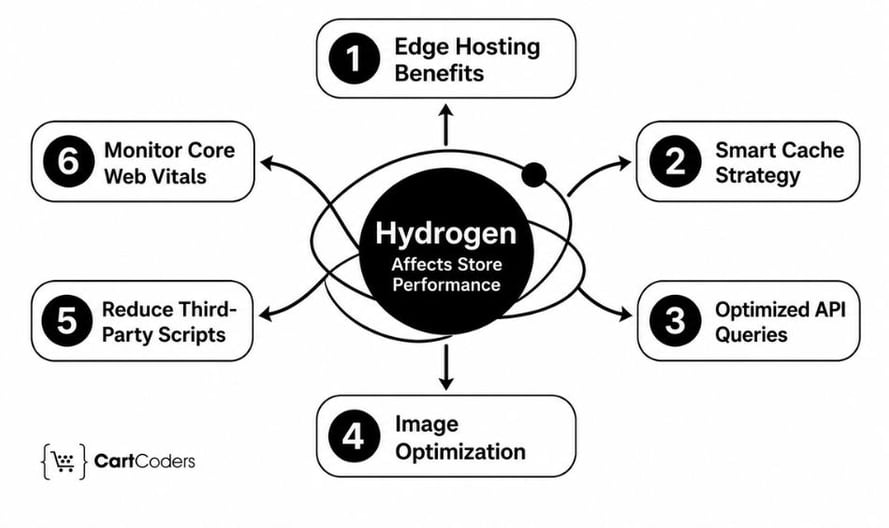
Hydrogen gives developers more control over rendering, data loading, caching, and frontend code, while Oxygen provides edge hosting through Shopify’s infrastructure. However, speed still depends on API queries, images, JavaScript, fonts, personalization, third-party tools, and external data sources. A well-built Shopify theme can still outperform a poorly planned Hydrogen storefront.
Edge Hosting Can Improve Delivery
Oxygen can serve cached content closer to customers, which may improve performance for international stores. It cannot fix slow APIs, oversized images, or heavy scripts.
Caching Must Match the Data
Content, prices, inventory, carts, and customer accounts need different caching rules. Excessive caching can show outdated information, while limited caching can increase API requests.
Storefront API Queries Need Control
Developers should request only required fields, paginate large results, reuse cached data, and prevent unavailable services from breaking pages.
Images Often Have the Largest Impact
Images should use correct dimensions, compression, responsive formats, lazy loading, and reserved space to reduce loading delays and layout shifts.
Third-Party Scripts Can Slow the Store
Analytics, reviews, chat, advertising, personalization, and testing tools can affect responsiveness. Each script should have a clear purpose and be reviewed regularly.
Core Web Vitals Need Ongoing Testing
Compare the existing theme and Hydrogen storefront before and after launch. Test Core Web Vitals, API latency, image weight, JavaScript, and server response across product, collection, search, cart, account, and campaign pages.
App Compatibility Is a Major Headless Shopify Risk
A polished Hydrogen storefront can still create operational issues when essential Shopify apps lack headless support. Review every app before approving the project scope, budget, and architecture.
Apps that rely on Liquid snippets, theme blocks, app embeds, or injected scripts may not work in Hydrogen. The team may need to connect them through APIs, rebuild their storefront interfaces, replace them, or remove the features. This Headless Commerce Shopify guide explains the wider technical and operational considerations.
Review platforms may require custom displays for ratings, images, filters, submissions, moderation, and structured data. Subscription apps also need complete testing across selling plans, discounts, recurring orders, payment updates, customer accounts, skipped deliveries, and cancellations.
Search tools may provide APIs while still requiring custom predictive search, filters, sorting, recommendations, and analytics. Loyalty and personalization tools also need reliable customer identity, consent, and profile syncing. Without proper planning, stores may face duplicate profiles, missing points, weak recommendations, and costly custom maintenance.
What Technical Architecture Does a Hydrogen Storefront Need?
A Hydrogen storefront is one part of a larger eCommerce system. Shopify usually manages products, pricing, inventory, cart, checkout, and orders. Hydrogen manages the customer-facing experience. Oxygen or another host manages deployment.
| Layer | Main Responsibility |
| Shopify | Products, pricing, inventory, cart, checkout, and orders |
| Hydrogen | Customer-facing storefront |
| Oxygen or another host | Deployment and storefront delivery |
| Storefront API | Commerce data |
| Customer Account API | Login and account experience |
| CMS | Editorial and campaign content |
| Search platform | Search, filtering, and recommendations |
| ERP or PIM | Operational or detailed product data |
| Analytics stack | Customer and revenue measurement |
| CI/CD process | Testing and releases |
| Monitoring | Errors, performance, logs, and uptime |
The architecture should remain as simple as the business requirements allow. Adding more systems does not always create a better storefront.
Hydrogen vs Next.js, Nuxt, and Other Headless Frameworks
Shopify does not require every headless storefront to use Hydrogen. The right framework depends on the team’s existing skills, hosting preferences, content stack, engineering standards, and long-term ownership plan.
Hydrogen vs Next.js, Nuxt, and Other Headless Frameworks
Shopify does not require every headless storefront to use Hydrogen. The Storefront API can connect with different frontend frameworks, so the best option depends on team skills, existing technology, hosting preferences, content requirements, and long-term maintenance.
Shopify’s official headless storefront build options include Hydrogen and custom storefront approaches. CartCoders also provides Headless Shopify development services for Hydrogen, Next.js, Nuxt, CMS, API, and third-party integrations.
| Comparison Point | Shopify Hydrogen | Next.js | Nuxt | Astro and Other Frameworks |
| Core technology | React and React Router | React | Vue | Astro, Svelte, React, Vue, or another stack |
| Best suited for | Shopify-first storefronts | Businesses already using Next.js | Teams experienced with Vue | Content-heavy or specialised storefronts |
| Cart and commerce setup | Shopify cart utilities available | Custom cart architecture may be needed | Custom cart architecture may be needed | Greater development effort for dynamic commerce |
| Rendering | Server and static rendering | Server, static, and dynamic rendering | Server, static, client, and hybrid rendering | Static-first with server rendering where required |
| Hosting options | Oxygen or compatible platforms | Vercel, Node, cloud, or container hosting | Node, edge, serverless, or cloud hosting | Vercel, Netlify, Cloudflare, Node, or others |
| Development speed | Faster for Shopify-specific requirements | Faster when Next.js systems already exist | Faster for established Vue teams | Depends on commerce complexity |
| App integration | Headless APIs may still be required | Custom API integration | Custom API integration | Custom API integration |
| Main advantage | Official Shopify commerce foundation | Large React ecosystem and platform reuse | Strong organisational fit for Vue teams | Lower JavaScript for content-heavy experiences |
| Main limitation | Requires React and Hydrogen knowledge | More Shopify logic must be planned | Fewer Shopify-specific utilities | Dynamic carts and accounts may require more work |
What Should You Review Before Selecting a Framework?
The framework should support more than page design. Review:
- Storefront API and customer account support
- Cart, pricing, inventory, and checkout behaviour
- Server-side rendering and caching
- CMS and app integrations
- Analytics and consent tracking
- SEO and structured data
- Hosting and deployment requirements
- Developer availability
- Framework update frequency
- Long-term maintenance costs
Which Headless Shopify Framework Should You Choose?
| Business Situation | Better Starting Point |
| Shopify is the main platform and the team uses React | Hydrogen |
| The company already operates a Next.js platform | Next.js |
| The development team mainly works with Vue | Nuxt |
| Content drives most traffic and product discovery | Astro |
| The business has strict internal engineering standards | Existing approved framework |
| The team lacks long-term frontend resources | Shopify theme instead of headless |
Shopify’s Framework-Agnostic Hydrogen Direction
In June 2026, Shopify introduced an early developer preview for a newer Hydrogen direction. Shopify described it as a framework-agnostic toolkit that moves commerce logic out of React Router and provides Shopify commerce primitives for different JavaScript frameworks. Shopify also states that this release is an early developer preview.
This direction may give future teams more framework freedom. However, production projects should separate stable tools from preview features. A business should not base a critical launch on preview technology without reviewing its support status, documentation, breaking-change risk, and migration path.
Hydrogen React already provides framework-agnostic React components and utilities for working with Shopify’s Storefront API.
Headless Shopify vs a Shopify Plus Theme
Shopify Plus does not automatically require a headless storefront. Many enterprise stores can manage large catalogs, B2B buyers, international sales, custom apps, and high order volumes through a well-built Shopify Plus theme.
Choose a Shopify Plus Theme for Simplicity
A Shopify Plus theme is often better for standard buying journeys that need faster development, strong app compatibility, easier content editing, and lower frontend maintenance.
Choose Hydrogen for Custom Frontend Needs
Hydrogen suits brands that need interactive product builders, custom B2B portals, multi-region experiences, connected content platforms, or shared storefront architecture. Our Headless Commerce Shopify guide explains how headless architecture, APIs, CMS platforms, and custom storefronts work together.
Compare Long-Term Ownership
A theme requires app management, performance work, and design updates. Hydrogen also needs framework maintenance, API updates, hosting management, integration testing, and technical support.
Can You Use a Hybrid Shopify Architecture?
A hybrid Shopify architecture keeps the main catalog, product pages, cart, and customer accounts on a Shopify theme while using Hydrogen for selected experiences. This approach preserves app compatibility and merchant editing while adding custom frontend control where it creates value.
Use Headless for High-Value Experiences
Hydrogen can support product configurators, buying guides, B2B portals, content hubs, regional campaigns, or product finders without rebuilding the entire store. Each experience should connect smoothly with Shopify products, accounts, carts, and checkout.
Plan SEO and Analytics Carefully
Multiple domains or subdomains require clear internal linking, canonical tags, consent settings, cross-domain tracking, and campaign attribution. This prevents duplicate pages and fragmented customer sessions.
Use a Phased Migration
Start with one region, product line, or customer journey. Measure performance, conversions, maintenance, and integration reliability before expanding. Expert Shopify migration services support phased planning, data transfer, redirects, testing, and launch preparation.
What Are the Most Common Headless Shopify Mistakes?
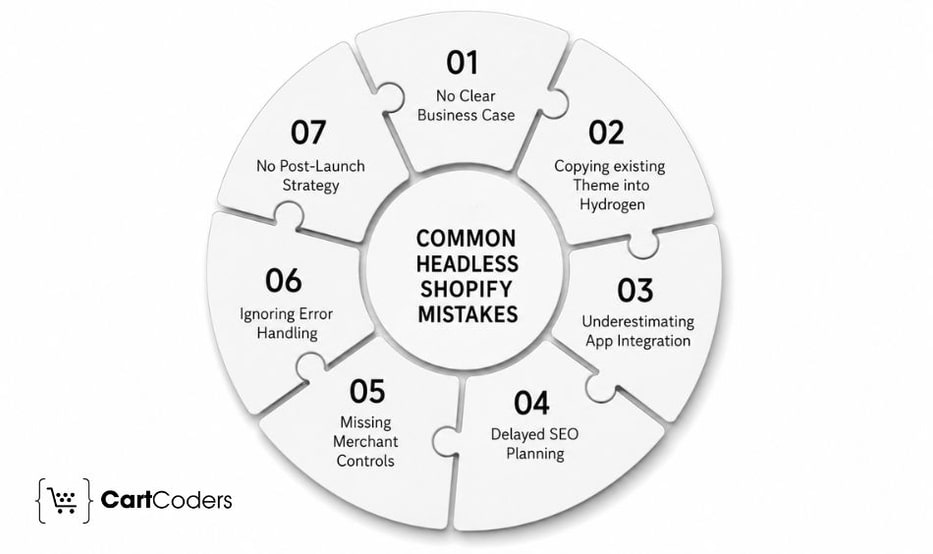
Most Headless Shopify problems begin before development. They often come from weak business reasoning, incomplete integration planning, or unclear ownership.
Choosing Headless Without a Business Case
A business may choose Hydrogen because competitors use headless commerce or because the technology sounds more advanced. A clear architecture decision should connect the investment with measurable needs. These may include reducing product discovery friction, improving content publishing, supporting regional journeys, or connecting several commerce systems. When a theme can meet those needs, headless may only add cost.
Copying the Existing Theme Into Hydrogen
Rebuilding the same storefront in React rarely creates enough value to justify a full headless project. The migration should improve something important. It may create better product discovery, richer content, stronger regional control, or easier integration with business systems. When the new storefront looks and behaves exactly like the old theme, the business receives little return for the added technical responsibility.
Underestimating App Work
A project estimate may include the main storefront pages while ignoring review, subscription, loyalty, search, referral, and customer service apps. Each app should have a confirmed headless integration path before the final estimate is approved. Apps that appear small in the theme can require substantial custom frontend work.
Leaving SEO Until the End
SEO cannot be added as a final launch task. Page routes, rendering methods, metadata sources, canonical rules, structured data, international URLs, redirects, and internal linking affect the architecture itself. Late SEO reviews often reveal issues that require frontend or content model changes.
Recreating the Store Without Merchant Controls
A custom storefront can reduce marketing speed when content teams cannot update it. Developers should build controlled flexibility into Shopify or the connected CMS. Editors should be able to create campaigns and update approved content without risking the storefront structure.
Ignoring Error and Fallback States
External systems sometimes respond slowly or become unavailable. The storefront should remain useful when reviews, recommendations, CMS content, search, or personalization services fail. A product page should not disappear because one secondary service returns an error. Developers need fallback content, clear error messages, retry rules, and monitoring.
Treating Launch as the End of the Project
Hydrogen requires continued maintenance. The team must manage API versions, framework releases, security updates, analytics changes, new browser behavior, app updates, and campaign needs. Shopify’s 2026 Hydrogen releases show that API and framework changes continue through quarterly updates.
How Can You Decide Whether Hydrogen Is Ideal for Your Business?
The decision should combine customer experience needs, technical feasibility, budget, app compatibility, and long-term ownership.
| Decision Area | Hydrogen May Be Worth It When | A Theme May Be Better When |
| Customer journey | Buyers need a highly custom flow | Standard eCommerce patterns work well |
| Content | Several teams need advanced CMS workflows | Shopify content tools are sufficient |
| Integrations | The storefront combines several data sources | Most tools already work through theme apps |
| Regional needs | Each market needs a distinct experience | Basic localization meets requirements |
| Performance | The team needs detailed rendering and caching control | Theme improvements can meet performance goals |
| Budget | The business can fund the build and maintenance | The budget mainly covers the initial launch |
| Technical ownership | A capable team or partner is available | Continued frontend support is uncertain |
| SEO | Technical SEO ownership is established | The business needs more native defaults |
| Time | The business can support a longer discovery and build | The store must launch quickly |
Use a Simple Readiness Check
Hydrogen deserves further assessment when most of the following statements are true:
- A Shopify theme creates clear customer or operational limits.
- The desired storefront needs custom interactions or content flows.
- Important apps provide headless support or can be replaced.
- The business has a realistic development and maintenance budget.
- A technical team can support the storefront after launch.
- SEO, analytics, content, and eCommerce responsibilities are assigned.
- The expected business value can be measured.
A theme is likely the safer choice when most of these conditions are missing.
Compare Hydrogen With Improving the Existing Theme
Before approving a rebuild, estimate what could be achieved through theme changes. A theme project may improve page speed, navigation, search, product information, app usage, content presentation, accessibility, and conversion paths at a lower cost.
The business should compare three options:
- Improve the current theme.
- Build a new custom Shopify theme.
- Move to Hydrogen.
This comparison gives decision-makers a more useful view than comparing only the current store with a full headless rebuild.
Define Success Before Development
The business should set measurable targets before approving the architecture. Relevant targets may include faster content publishing, lower product discovery time, greater regional conversion, improved Core Web Vitals, higher engagement with buying guides, or fewer manual data updates. Headless should be measured against those outcomes. A successful technical launch does not prove that the architecture has created business value.
How CartCoders Helps With Headless Shopify and Hydrogen
CartCoders helps brands choose between Hydrogen, a custom theme, or a hybrid setup based on performance, integrations, SEO, content workflows, and maintenance needs. Our Headless Shopify development services cover Hydrogen storefronts, Storefront API integration, CMS setup, cart and checkout flows, testing, and launch support.
For larger stores, our Shopify Plus development services support B2B workflows, multi-store setups, custom integrations, and complex commerce requirements. We also plan technical SEO, analytics, redirects, structured data, and performance testing during development.
Brands that need continued technical capacity can hire Shopify developers with experience in frontend development, apps, APIs, Shopify Plus, and integrations. CartCoders lists dedicated frontend, app, and Shopify Plus specialists within this service.
Contact us to review whether Hydrogen, a custom Shopify theme, or a hybrid architecture is the right fit for your store.
Final Verdict: Is Shopify Hydrogen Worth It in 2026?
Shopify Hydrogen is worth considering when a brand needs a highly custom storefront, advanced content delivery, deep system connections, distinct regional journeys, or more frontend performance control.
It is not automatically better than a Shopify theme.
A well-built theme remains a strong choice for stores that value faster delivery, native app support, lower maintenance, and familiar merchant controls. Shopify Plus brands should also choose headless only when their frontend requirements justify the added technical work.
Shopify continues developing Hydrogen, Oxygen, the Storefront API, and its wider headless tools. Its 2026 documentation presents Hydrogen and Oxygen as Shopify’s official headless stack, while newer framework-agnostic Hydrogen capabilities remain in developer preview.
The final decision should come down to business value.
Choose Hydrogen when it solves a clear customer, content, integration, or regional challenge that a theme cannot address efficiently. Keep or improve the Shopify theme when headless would add technical complexity without a measurable return.
The best storefront architecture is not the most advanced option. It is the one the business can operate, measure, and improve over the long term.
Frequently Asked Questions
Headless Shopify separates the customer-facing storefront from Shopify’s backend. Shopify manages commerce functions, while a custom frontend displays products, content, carts, and customer experiences.
Shopify Hydrogen is Shopify’s headless storefront stack. It provides commerce tools, API clients, and React Router-based development patterns for building custom Shopify storefronts.
Hydrogen is worth it when a business needs custom customer journeys, advanced content, deep integrations, multi-market storefronts, and continued technical ownership.
Hydrogen offers greater frontend control. A theme is often better for faster launches, native app compatibility, simpler content management, and lower maintenance costs.
Hydrogen provides more control over rendering, caching, API calls, and content delivery. Store speed still depends on development quality, images, scripts, APIs, and hosting.
Headless Shopify can support strong SEO when developers correctly handle rendering, metadata, schema, canonicals, redirects, sitemaps, internal links, and international pages.
Main risks include higher costs, custom app work, unclear SEO ownership, tracking gaps, frontend maintenance, API changes, content dependency, and weak post-launch support.
Some apps provide headless APIs or frontend packages. Theme-based widgets may require custom development, replacement, or a different integration approach.
A focused build may start near $8,000. Advanced projects can cost $25,000 to $150,000 or more, depending on integrations, design, CMS, and scale.
Shopify Plus is not strictly required for every headless storefront. It is commonly used for larger projects needing enterprise, B2B, international, or complex operational features.
Avoid headless when a theme meets the business requirements, the launch budget is limited, apps lack headless support, or no team can maintain the frontend.
This final part follows the migration, framework comparison, Shopify Plus, hybrid architecture, decision, promotional, conclusion, and FAQ structure from the supplied content plan


