
Starting an eCommerce business is one of the most accessible paths to building a sustainable revenue stream in 2026. Whether you are creating your first online store from scratch or moving an existing brick-and-mortar business online, the steps are largely the same, and the opportunity is very real. Global eCommerce sales are on track to cross $8 trillion this decade, and a growing share of that revenue belongs to independent brands, not just large retailers.
What separates businesses that gain traction from those that stall is not capital or connections. It comes down to a clear sequence of decisions made in the right order. This guide walks you through every step, from choosing your niche and picking a business model to building your store, driving traffic, and measuring results.
Quick Answer
To start an eCommerce business, pick a niche with clear demand, choose a business model that fits your capacity, build an online store on a platform like Shopify, source your products, set up payments and shipping, and run marketing to bring in your first buyers. Each step builds directly on the previous one.
What Does It Take to Start an eCommerce Business?
Many business owners assume that starting an eCommerce business means building a website and listing products. In practice, it involves several layers of decisions, each affecting the next. Get one wrong and the rest becomes harder to correct without significant rework.
You need a clear niche, a business model that matches your resources, a store that turns visitors into buyers, and a marketing approach that brings consistent traffic. In 2026, the tools available make all of this more manageable than ever, but having the right tools does not replace having a clear plan.
How Do You Pick the Right Niche and Products?
Picking a niche is the first decision in building an eCommerce business, and it shapes everything that follows. A focused niche gives you a specific audience to speak to, a tighter product range, and a stronger reason for buyers to choose you over a generic store.
The most common mistake at this stage is choosing products based on personal preference rather than researched demand. Your job is to find what a defined group of buyers is already searching for and willing to pay for.
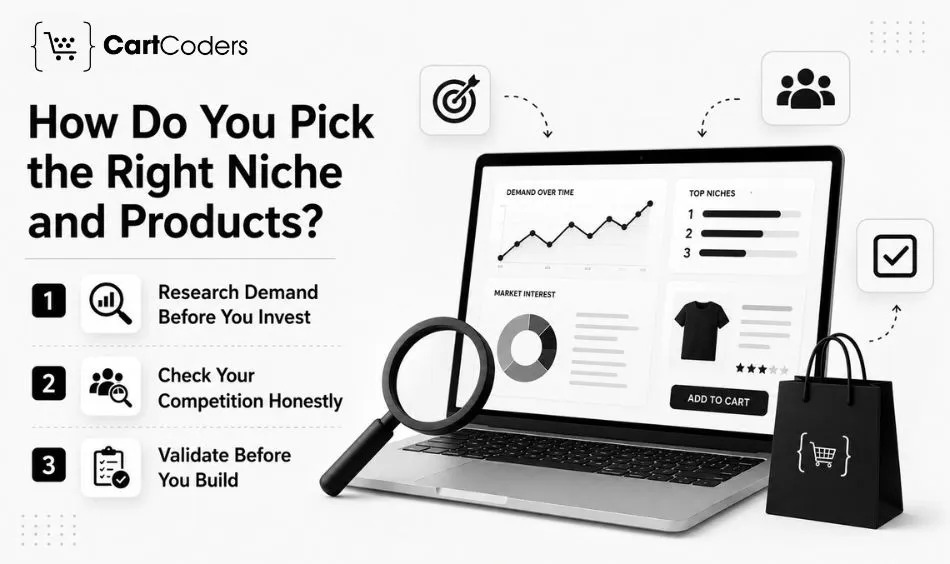
Research Demand Before You Invest
Start with search data, not gut feeling. Tools like Google Trends, keyword research platforms, and category pages on Amazon and Etsy show you what buyers are actively looking for and how stable that demand is over time.
Look for niches where search volume is growing or consistent, where the product has a solid price-to-margin ratio, and where buyer intent is clear. Categories like pet accessories, home improvement tools, specialty foods, and fitness gear tend to have passionate buyers who search with high intent and purchase with confidence. A well-researched niche also gives your content and SEO a clear target, which matters as your store grows.
Check Your Competition Honestly
Before committing to a niche, study the stores already competing there. Look at what they sell, how they price it, what their reviews reveal, and where they fall short. Gaps in product quality, customer service, or content are often the fastest way to find your angle in an otherwise crowded space.
A niche dominated by three or four established brands with strong SEO and thousands of reviews is a difficult entry point for a new store. A sub-niche within that category, serving a specific buyer type the large brands ignore, is a far better starting position. The goal is not to beat everyone at once but to own a clear slice of the demand.
Validate Before You Build
Test demand before investing in a full store build. A landing page with a pre-order option, a small product batch listed on a marketplace, or a social media post with a direct link to purchase can show you whether real buyers exist, not just whether the idea sounds good.
This step prevents a large number of eCommerce failures that happen when business owners build first and discover demand second. Spend a week validating before spending months building, and you will avoid the most costly mistake new stores make.
Which eCommerce Business Model Fits Your Goals?
Your business model determines how you source products, manage risk, handle inventory, and grow over time. Choosing the wrong model based on what seems easiest, rather than what fits your actual capacity, creates problems that compound quickly.
There are four models most business owners choose from, each with a different risk and effort profile.
Dropshipping
With dropshipping, you list products in your store without holding any stock. When a buyer places an order, your supplier ships the product directly to them. Your profit comes from the difference between your retail price and the supplier’s cost.
This model requires minimal upfront capital, which makes it the most common starting point for first-time eCommerce owners. The trade-off is thin margins, limited control over shipping speed and product quality, and heavy dependence on supplier reliability. Dropshipping works best when paired with strong branding and a specific niche, rather than a wide catalogue of generic products that any other store can also list.
Private Labeling
Private Labeling means sourcing a manufactured product and selling it under your own brand name. You work with a manufacturer, add your branding, and sell the product as your own.
This model gives you more control over quality, pricing, and brand identity. Margins are stronger than dropshipping, and the product becomes an asset that builds value over time. The downside is a higher upfront cost, since manufacturers typically require minimum order quantities before production begins. Private Labeling suits business owners who want to build a lasting brand rather than resell commodity products.
Also Read: 45 Best Private Branding Products to Sell Online
Wholesale and Inventory-Based Selling
Buying products in bulk from a supplier and selling them at retail price is the traditional eCommerce approach. You manage the inventory, set your pricing, and handle fulfillment from your own space or a third-party logistics partner.
This model gives you the most control over the buyer experience from order to delivery. It requires capital for stock and storage, which makes it a better fit for business owners who already have supplier relationships or who are moving an existing product business online. The upfront investment is higher, but so is the return when the operation runs well.
Subscription-Based Selling
Subscription eCommerce delivers products to customers on a recurring basis, weekly, monthly, or quarterly. It builds predictable revenue, stronger retention, and a loyal buyer base that is much harder to achieve through one-time purchase models.
This model works well for consumables, curated product boxes, and memberships tied to exclusive items. Building it requires consistent fulfillment and a reliable customer experience, since one poor shipment can drive cancellations quickly. The revenue model is attractive, but the operational standard it demands is higher than standard eCommerce.
How Do You Build and Launch Your Online Store?
For most business owners, Shopify is the strongest platform choice. It handles hosting, security, and payment infrastructure in one place and supports growth from a single-product store to a full enterprise operation.
The decision between a pre-built vs custom-built eCommerce platform selection is worth thinking through carefully, especially if you have specific integration or design needs.
Setting Up Your Store the Right Way
Follow this process to build your eCommerce store correctly from the start.
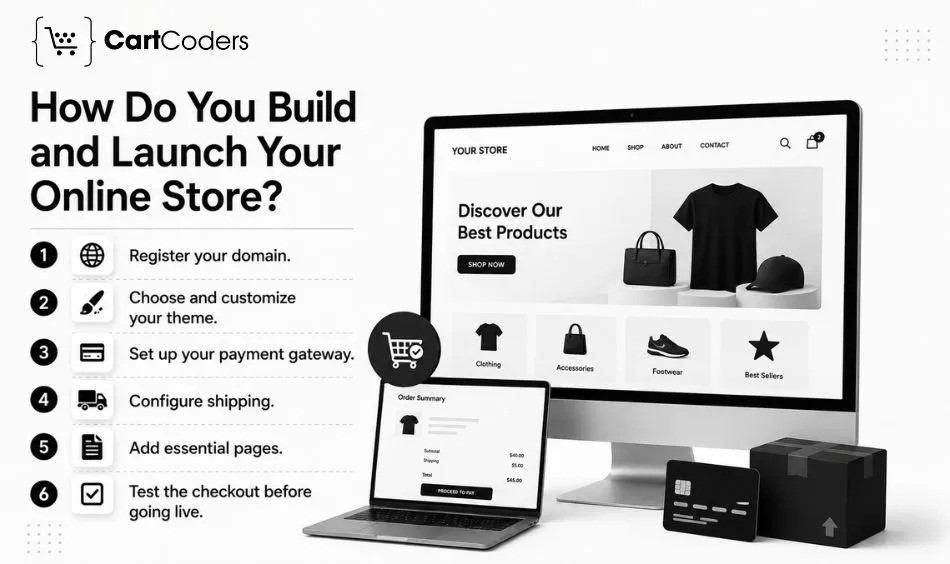
- Step 1 — Register your domain. Choose a name that is short, easy to spell, and tied to your niche. Avoid hyphens and names that are too generic to stand out in search results.
- Step 2 — Choose and customize your theme. Pick a theme built for eCommerce performance, not just visual appeal. Your layout should direct attention toward products and toward the checkout button.
- Step 3 — Set up your payment gateway. Offer card payments, digital wallets like Apple Pay and Google Pay, and a buy-now-pay-later option if your price point supports it. Fewer payment options mean more abandoned checkouts.
- Step 4 — Configure shipping. Set clear rates based on weight or order value. Display estimated delivery times before checkout, not after, since post-checkout surprises drive abandonment.
- Step 5 — Add essential pages. Every store needs an About page, Contact page, Shipping Policy, and Return Policy before launch. These pages build trust with first-time visitors and reduce buyer hesitation.
- Step 6 — Test the checkout before going live. Place a full test order and review the experience on both desktop and mobile. Most checkout problems are invisible until a real buyer encounters them.
Already Running a Business?
Take It Online Without Starting Over with CartCoders. We handle full Shopify build while you focus on building your business.


Building Product Pages That Convert
A product page is not just a description and a photo. It is the moment where a browser decides whether to become a buyer, and most stores lose that moment through weak copy, poor images, or missing trust signals.
So, it is very important to follow Shopify product page best practices for CRO. Every strong product page has a benefit-focused description, high-quality images from multiple angles, visible reviews, clear pricing, and a CTA that is impossible to miss.
How Do You Handle Inventory and Fulfillment?
Inventory is where many new eCommerce businesses start losing money without realizing it. Overstocking ties up cash. Running out of stock during a busy period loses sales and damages buyer trust. Getting this right from the beginning matters more than most business owners expect.
Choosing Your Sourcing Approach
Your sourcing method follows from your business model. Dropshipping removes inventory risk entirely but reduces your control over quality and delivery speed. Wholesale requires upfront investment but gives you the most flexibility over pricing and the end-to-end buyer experience. Private label sits between the two, with manufacturing lead times being the biggest risk factor to plan around.
For business owners handling physical inventory, start with smaller quantities and track sell-through rates before placing large orders. Having at least two reliable suppliers for your top products also protects you if one runs into a stock issue at a critical time.
Managing Inventory from Day One
Use your eCommerce platform’s built-in inventory tools or connect a dedicated tracking app. Check stock levels weekly, not monthly. Set reorder points for your top-selling products so you never run out during a traffic spike or a seasonal push.
How Do You Market Your Store and Get Your First Sales?
Building a store is only half the work. Without traffic and a clear path to purchase, a well-built store earns nothing. Marketing is where business owners either see fast results or burn through budget with no return.
A strong approach uses multiple channels at different stages of the buyer journey rather than relying entirely on one platform.
SEO and Content for Long-Term Traffic
Search engine optimization brings in buyers who are already looking for what you sell. It takes longer to build than paid advertising, but the traffic it generates costs nothing per click once it is established. Focus on product page SEO, collection page structure, and blog content targeting the search terms your buyers use. If SEO is hard to manage alongside everything else, CartCoders offers SEO services for eCommerce stores.
Paid Advertising for Faster Results
Paid ads on Google and Meta put your products in front of buyers immediately. The trade-off is that results stop the moment you stop spending, so paid advertising works best when supported by a strong organic strategy running alongside it.
Start with a small daily budget on your best-selling products. Use retargeting campaigns to bring back visitors who browsed but did not complete a purchase. Track your cost per acquisition per channel carefully and cut any ad group that does not produce a positive return within a defined test window. Speed matters less here than precision.
Email for Retention and Repeat Purchases
Email is one of the highest-return channels in eCommerce, and most new store owners ignore it in favour of social media. Set up an abandoned cart sequence, a welcome flow for new subscribers, and a post-purchase follow-up from the start.
A basic three-email abandoned cart sequence can recover 10% to 15% of lost sales without any additional ad spend. That is revenue that requires no extra budget, just a properly configured automation that runs without ongoing effort.
What If You Already Run an Offline Business?
Many of the business owners reading this guide are not starting from zero. They already operate a retail shop, a wholesale distribution business, or a service-based company, and they want to add an online sales channel alongside what they already have.
The process is largely the same as starting from scratch, but with real advantages built in. You already have products, supplier relationships, brand recognition, and an existing customer base. These are assets that most new eCommerce stores take months to build from nothing.
The main work is translation. Your offline brand needs a digital presence that carries the same credibility it has earned locally. Your product range needs to be structured for online browsing, which often requires cleaner product photography, detailed descriptions, and a logical category structure. Your pricing may also need adjustment to account for shipping costs and the expectations of online buyers.
If your current business runs on a different platform or a manual system, CartCoders can handle the complete migration to Shopify, including product data, customer records, and order history. Many offline-to-online transitions are faster and smoother than business owners expect when the technical side is handled correctly from the start.
What Should You Track Once Your Store Goes Live?
Going live is the starting point, not the finish line. Without tracking key numbers consistently, you cannot tell what is working, what is losing you money, or where buyers are dropping off before they purchase.
These are the metrics every business owner should monitor from day one.
- Conversion rate shows what percentage of store visitors complete a purchase. A typical eCommerce conversion rate sits between 1.5% and 4%, depending on niche and traffic source. If yours is below 1%, something in the product page, checkout flow, or trust signals needs attention.
- Cart abandonment rate shows how many shoppers add products but leave before buying. A rate above 70% usually points to a pricing issue, a weak checkout experience, or a missing payment option that buyers expect.
- Customer acquisition cost (CAC) measures how much you spend on marketing to win one new customer. Track this per channel so you know which sources bring the most cost-efficient buyers over time.
- Average order value (AOV) reflects how much each customer spends per transaction. Growing AOV through bundles, upsells, or free shipping thresholds is one of the fastest ways to grow revenue without increasing ad spend.
- Customer lifetime value (CLV) shows the total revenue a customer generates across all their purchases. A high CLV means your retention strategy is working. A low CLV means buyers purchase once and do not return.
How CartCoders Helps Business Owners Build eCommerce Stores?
CartCoders is a Shopify development agency with 250+ projects delivered across 30+ countries. The team builds eCommerce stores from the ground up, improves existing Shopify stores for conversion performance, and handles technical integrations that most business owners prefer not to manage alone.
Business owners working with CartCoders get Shopify development services built for their specific niche and business model, not a template applied without context.
The work covers store architecture, custom theme development, payment and shipping setup, app integrations, and post-launch performance support. To see the kind of results delivered for real eCommerce brands, browse the CartCoders case studies.
Ready to Build Your eCommerce Store on Shopify?
CartCoders helps business owners build Shopify stores that convert from day one. Whether you are starting from scratch or moving an offline business online, the team handles the technical build while you focus on your products and customers. Hire a Shopify developer to map out your build plan.
Conclusion
Starting an eCommerce business in 2026 puts you in one of the most opportunity-rich commercial environments of recent years. The niche you choose, the model you operate under, the platform you build on, and the channels you use to drive traffic all determine whether your store becomes a steady revenue source or stalls after launch.
The steps in this guide give you a clear, ordered starting point. Take them in sequence, validate as you go, and adjust based on what the data shows you. That process, repeated consistently, is what turns an idea into a working eCommerce business.
Frequently Asked Questions
The cost depends on your model. Dropshipping can begin under $500. A fully custom Shopify store with branding and initial marketing typically runs between $3,000 and $15,000, depending on scope and complexity.
Shopify is the most widely recommended platform for new and scaling eCommerce businesses. It handles hosting, payments, and security in one place and supports growth from a small store to a large enterprise operation.
Dropshipping is the lowest-cost entry model. You still need a store subscription, a domain, and a basic marketing budget. A zero-cost start is not realistic, but the barrier is lower than most other business types.
A basic Shopify store can go live within a few days. A custom-built store with integrations, a unique theme, and a content strategy typically takes four to eight weeks, depending on scope and the team involved.
You do not need coding knowledge to operate a Shopify store. For custom features, integrations, or performance improvements, working with a Shopify developer saves time and avoids costly mistakes down the line.
Private Labeling and wholesale typically produce the strongest margins. Dropshipping margins are thinner due to supplier pricing. Subscription models can achieve strong margins over time through repeat purchases and high retention.
Start by choosing a platform that fits your product range. Transfer your catalogue, set up payment and shipping, and build a digital brand presence that reflects your existing reputation. CartCoders handles full Shopify migrations for businesses making this transition.


