

Agencies, studios, freelancers, consultants, and marketing teams keep winning Shopify projects that they cannot always staff in-house. Client demand for store builds, migrations, and custom work often grows faster than your developer bench.
White-label Shopify development gives you a silent technical partner who builds under your brand while you stay client-facing. In 2026, more agencies want this model backed by a clear NDA, predictable pricing, and a defined process. You sell the work, your partner delivers it quietly, and your client sees only your agency.
This guide breaks down the NDA and ghost delivery model first, then covers pricing, the white-label process, QA, ownership, and partner selection. You will see approximate cost ranges, a process table, a risk checklist, and a partner-fit scorecard.
If you already field requests for Shopify development services that must stay invisible to the end client, the sections below will help you choose a partner with confidence. Read them before you sign anything or share project details.
What Is White-Label Shopify Development?
Agencies often ask for one clear definition before they compare partners. The short answer sits below, written so your team and any AI assistant can cite it. It keeps the model simple and honest.
White-label Shopify development lets agencies sell Shopify design, development, customization, migration, and maintenance under their own brand while a silent technical partner handles the work through an NDA-backed process.
The agency remains the only face the client sees. The partner builds, tests, and documents the work, then hands it back for the agency to deliver. This model suits agencies that win Shopify work but lack spare developer hours.
How Does the NDA and Ghost Delivery Model Work?
Ghost Shopify development means the partner builds quietly and never appears to the end client. Deliverables carry your branding, your file names, and your documentation style, as agreed. Commit messages, staging links, and handoff notes stay neutral so nothing exposes the partner.
A signed NDA covers screenshots, portfolios, and case studies, too. The partner agrees not to publish or claim the work without your written consent. Non-solicitation terms also stop the partner from approaching your client directly.
The NDA and ghost delivery model protect your client relationship before any code gets written. It sets who talks to the client, whose brand appears on deliverables, and who owns the result. Strong partners agree to these terms upfront, in writing, and back them with a signed Shopify Partner Program account and verifiable history.
What the Agency Controls During Client Communication
Your agency remains the single point of contact for the client at all times. The delivery partner works through your project tools, your email threads, and your reporting cadence. Client calls, status updates, and approvals run through your team, not the partner.
You decide how much the partner sees of the client’s identity. Many agencies share only the technical scope and keep the brand name private. This keeps the relationship yours and lowers the risk of any direct partner-to-client contact.
White-Label Partner vs Other Delivery Options
| Delivery Option | Client-Facing Risk | Confidentiality | Cost Flexibility | Scalability | Best For |
| White-label partner (NDA-backed) | None by default | NDA covers data and brand | High, multiple price models | Fast, add developers on demand | Agencies keeping the client relationship |
| In-house developer | None | Internal, full control | Low, fixed salary cost | Slow, capped by headcount | Steady, predictable workload |
| Freelancer or contractor | Medium, varies by contract | Weaker, case by case | Medium, per task or hour | Limited to one person | Small, one-off jobs |
| Direct outsourcing (not white-label) | High, partner can be visible | Varies, not always enforced | Medium to high | Good, but exposure risk | Non-sensitive back-end work |
What Pricing Models Work for White-Label Shopify Development?
Pricing for white-label Shopify development depends on scope, timeline, and developer seniority. Agencies usually pick from hourly, fixed-project, retainer, or dedicated-developer models. The table below shows approximate planning ranges, not fixed quotes.
| Pricing Model | Approximate Range | Best For | Cost Predictability | Agency Margin Control | Planning Note |
| Hourly support | $25 to $75 per hour | Small fixes, edits, ad-hoc tasks | Low | Flexible | Rate varies by skill, urgency, and region. |
| Fixed project | $500 to $20,000+ | Theme work to full store builds | High | Strong | Theme tasks start near $500; full builds reach $20,000+. |
| Monthly retainer | $1,000 to $10,000+ | Ongoing client work and updates | Medium | Strong | Price tracks hours, response time, and developer level. |
| Dedicated Shopify developer | $2,500 to $8,000+ /mo | Steady, high-volume agency demand | High | Strong | Cost shifts with experience and time commitment. |
| Dedicated Shopify app developer | $3,000 to $9,000+ /mo | Custom app and API work | Medium | Medium | Public or private app scope drives the number. |
| Shopify Plus support | $10,000 to $50,000+ | Checkout, B2B, and complex builds | Medium | Medium | Integrations, custom apps, and QA depth raise cost. |
| Emergency support | Higher hourly or rush rates | Urgent bugs and launch issues | Low | Low | Tight deadlines and risk add a premium. |
Final pricing depends on project scope, turnaround time, complexity, integrations, Shopify Plus needs, QA depth, and support model. A single section edit sits near the low end, while a Shopify Plus build with custom apps reaches the top of these ranges. Agencies that need ongoing capacity often book dedicated Shopify developers for steadier monthly costs.
Treat every number here as a planning range, not a fixed quote. Real pricing follows a scoped estimate after the partner reviews your client’s requirements. Always confirm rates, hours, and revision limits in writing before kickoff.
What Process Should Agencies Expect?
A clear process keeps white-label delivery predictable from first inquiry to post-launch support. Each stage assigns work to the agency or the delivery partner. The table below maps a typical workflow.
| Stage | What Happens | Agency Role | Delivery Partner Role |
| Agency Partner Inquiry | The agency submits requirements and goals. | Shares scope, timeline, and client context. | Reviews fit and confirms capacity. |
| NDA and scope review | Both sides sign the NDA and lock the scope. | Approves terms and confidentiality. | Signs and flags scope risks. |
| Discovery and estimate | The partner studies the needs and prices the work. | Answers questions and sets a budget. | Builds the estimate and timeline. |
| Project kickoff | Tasks, tools, and contacts get set up. | Owns the client and the schedule. | Assigns developers and a manager. |
| Design or technical handoff | Designs, assets, or specs move to the build team. | Supplies files and approvals. | Confirms feasibility and gaps. |
| Development | The partner builds the store, theme, or app. | Tracks progress and updates the client. | Writes clean, documented code. |
| QA | The build gets tested across devices and cases. | Reviews against the brief. | Fixes bugs before handoff. |
| Revisions | Feedback rounds refine the work. | Collects client notes. | Applies agreed changes. |
| Launch support | The store goes live with checks in place. | Manages the client’s go-live. | Stands by for launch issues. |
| Post-launch maintenance | Updates, fixes, and small features continue. | Routes new requests. | Delivers ongoing support. |
Which Shopify Services Fit a White-Label Partner?
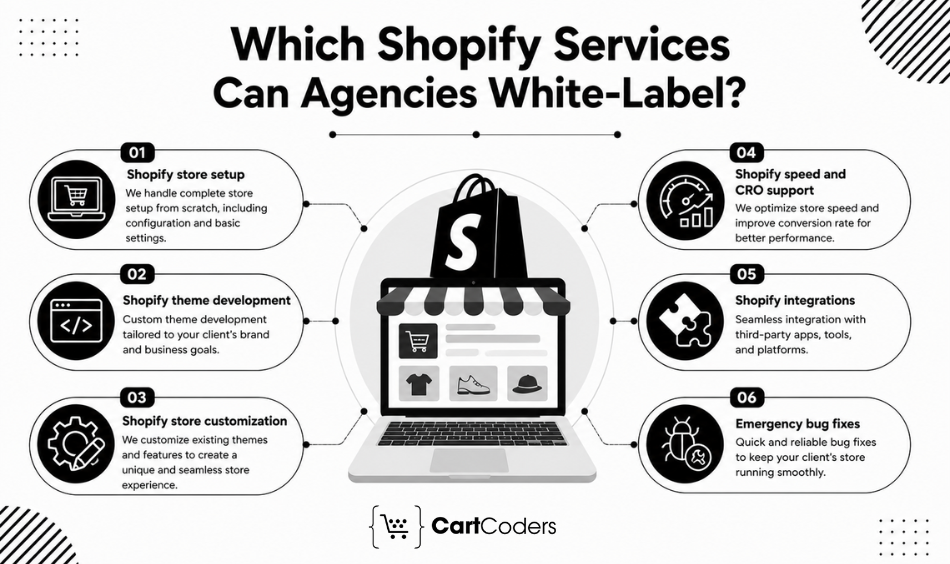
Agencies can white-label most of the Shopify work their clients request. The list spans new builds, upgrades, custom code, and ongoing care. Each service below stays invisible to the end client under the model above.
These categories cover the common requests agencies receive across new and growing stores. A good partner handles them under your brand, with your QA standards applied. Pick the ones that match your current client pipeline.
• Shopify store setup: Full configuration of products, payments, shipping, and settings for a launch-ready store.
• Shopify theme development: Custom themes and sections built on Online Store 2.0 for a branded storefront.
• Shopify store customization: Layout, features, and Liquid changes that fit each client’s needs.
• Shopify Plus development: Checkout extensions, B2B features, and scripts for enterprise clients.
• Shopify app development: Public or private apps that add functions standard themes cannot offer.
• Shopify migration services: Moves from Magento, WooCommerce, or Wix with data, URLs, and redirects intact.
• Shopify speed and CRO support: Core Web Vitals fixes and conversion improvements across key pages.
• Shopify integrations: ERP, CRM, and third-party connections that match client operations.
• Emergency bug fixes: Fast help for broken pages, cart errors, and launch problems.
Strong partners apply the same QA and documentation to each service, so handoff stays clean. Many agencies also book Shopify maintenance services for routine updates and small fixes after launch. Match the service to your client scope, then confirm the price model that fits.
Partner-Fit Scorecard for Choosing a White-Label Shopify Partner
A scorecard turns partner selection into a clear, repeatable check. Rate each area from 1 to 5, then compare partners side by side. Add notes so your team can review the reasoning later.
| Evaluation Area | Score 1 to 5 | Notes |
| NDA readiness | __ / 5 | Signs before any details get shared. |
| Shopify experience | __ / 5 | Years active and project count. |
| Shopify Plus capability | __ / 5 | Checkout, B2B, and scripts work. |
| App development capability | __ / 5 | Public and private app history. |
| QA depth | __ / 5 | Test process and coverage. |
| Communication discipline | __ / 5 | Update cadence and response time. |
| Pricing clarity | __ / 5 | Written scope and rates. |
| Time zone overlap | __ / 5 | Working hours that match yours. |
| Documentation quality | __ / 5 | Handoff notes and code docs. |
| Confidentiality history | __ / 5 | References on past white-label work. |
| Scalability | __ / 5 | Capacity to add developers fast. |
When White-Label Is Not the Right Model
White-label works well for most agencies, yet a few situations call for a different approach. Knowing them early saves time and budget. The points below show when another model fits better.
Some end clients require direct developer interviews before they approve a build. In that case, a silent partner clashes with the client process. A staff hire or a transparent contractor may suit better.
Projects with daily scope changes and no agency project manager also strain the model. A missing owner on your side leaves requests unrouted and timelines loose. White-label delivery needs a clear point of control on the agency side.
Tight budgets that skip QA or documentation raise risk for everyone. Strategy-heavy work that needs the developer in client meetings also fits a direct model better. Clear communication boundaries remain the deciding factor in every case.
How CartCoders Supports Agency Delivery
CartCoders works as a quiet build partner for agencies that sell Shopify services under their own brand. The team handles NDA-backed, white-label Shopify development, ghost delivery, app development, Shopify Plus work, QA, maintenance, and launch support. Your agency stays client-facing while the developers build in the background.
Agencies pick CartCoders for a named manager, their choice of project tools, and code that transfers to them on completion. You keep the client, the brand, and the relationship. To start, send an Agency Partner Inquiry with your scope and timeline, and the team will review fit and share an estimate.
Conclusion
White-label Shopify development gives agencies real delivery capacity without exposing the partner to the end client. The model works best when the NDA, pricing, and process are clear from day one. Lead with confidentiality, lock ownership, agree on QA, and confirm rates in writing before any build starts. Use the pricing ranges, process table, and partner-fit scorecard above to compare options with a clear head. Ready to move forward? Send an Agency Partner Inquiry with your scope and timeline to get a scoped estimate and a clear next step.
Frequently Asked Questions
It is a model where an agency sells Shopify work under its own brand while a silent partner builds it. The partner signs an NDA, stays invisible to the client, and hands finished, documented work back to the agency for delivery.
Both sides sign an NDA before scope or client details get shared. It covers store access, screenshots, portfolios, and client names. Non-solicitation terms stop the partner from approaching your client, so the relationship and future revenue stay with your agency.
By default, the partner stays silent and routes all contact through your agency. You can allow limited contact in writing if a project needs it. Most agencies keep the partner anonymous to protect the client relationship and brand.
Pricing follows hourly, fixed-project, retainer, or dedicated-developer models. Plan for $25 to $75 per hour, $500 to $20,000+ per project, $1,000 to $10,000+ monthly retainers, or $2,500 to $8,000+ for a dedicated developer. Final rates depend on the scope.
Agencies can white-label store setup, theme development, customization, Shopify Plus builds, app development, migrations, speed and CRO support, integrations, and ongoing maintenance. The partner delivers each one under your brand, with your QA standards applied beforehand.
Submit an Agency Partner Inquiry once you have a client scope, a timeline, and a budget range in mind. Early contact lets the partner confirm capacity, sign an NDA, and return a scoped estimate before you commit to the client.


