
Car parts are one of the most searched product categories online. Buyers look up specific part numbers, compatibility details, and stock availability before they even think about walking into a store. If you want to sell car parts online, you are entering a market where demand already exists, and a well-built store backed by the right Shopify development services can outperform a physical shop in terms of reach and revenue.
This guide walks you through every step. From picking a niche to setting up shipping and driving your first sale. Whether you run a garage, source parts from suppliers, or are starting fresh with no inventory, there is a model here that fits your situation.
Quick Answer
To sell car parts online, choose a focused niche, pick a business model (stock and ship, dropship, or hybrid), build a Shopify store with fitment-based product listings, set up carrier-calculated shipping, and promote through Google Shopping and automotive communities. Most sellers can launch a working store in two to four weeks.
Why the Online Auto Parts Market Is Worth Entering
The automotive aftermarket is one of the few retail sectors where online buying has grown steadily year over year. Car owners, mechanics, and DIY enthusiasts all search online first. They compare prices, check compatibility, and often order parts before the car is even in the garage. Here’s what makes this market strong for new sellers:
High Average Order Values
Car parts regularly run from $50 to $500 per item. A single order can generate significant revenue without needing high volume. Buyers are used to paying fair prices for accurate parts because cheap, wrong-fit parts cost them more in labour and time.
Repeat Purchase Behaviour
Cars need ongoing maintenance. A buyer who gets the right part the first time will return for their next repair, their next service, or their next build project. Repeat customer rates in auto parts are significantly higher than in general retail.
Niche Depth Over Broad Appeal
You don’t need to sell parts for every car ever made. A focused catalog for specific makes, models, or categories builds credibility faster and ranks better in search. A store dedicated to Toyota OEM parts earns more trust from Toyota owners than a marketplace listing 50,000 SKUs with no clear focus.
Room for Both New and Used Inventory
The online auto parts space supports new OEM parts, aftermarket alternatives, and used or refurbished parts in the same market. Each segment has its own loyal buyer base and pricing expectations.
How to Sell Car Parts Online: Step by Step
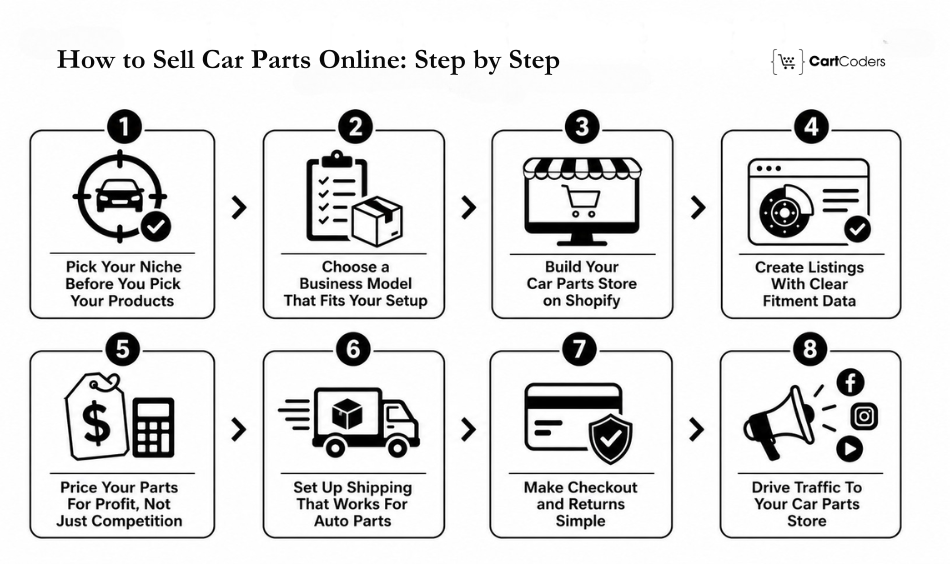
Getting started does not require a large budget or a warehouse full of stock. What it does require is a clear plan. Each step below builds on the last, so work through them in order.
Step 1: Pick Your Niche Before You Pick Your Products
Trying to sell every type of car part from day one is one of the most common mistakes new sellers make. A focused niche is easier to rank for, easier to market, and easier to manage as your catalog grows.
OEM Parts For Specific Brands
Buyers of Toyota, Honda, BMW, or Mercedes vehicles often search by exact part number and need confirmed fitment. OEM-focused stores benefit from strong brand search volume and high buyer intent. People searching ‘Toyota Camry brake pads’ are ready to buy, not browsing.
Aftermarket Performance Parts
Muscle cars, sports cars, and off-road vehicles have passionate owners who modify and upgrade. Performance buyers spend more per transaction and are active in forums and communities, which gives you a built-in promotion channel for your store.
Spare Parts for Electric Vehicles
The EV segment is growing fast. Parts for Tesla, BYD, Rivian, and other brands are increasingly searched online, and fewer dedicated stores exist compared to traditional auto parts. Getting into this segment now, while competition is still manageable, creates an early advantage.
Vintage and Restoration Parts
Classic car owners are passionate, have money to spend, and hate wasting time on the wrong parts. This is a high-margin, high-loyalty segment. Restoration buyers research extensively before purchasing, so a detailed and well-structured store earns their trust quickly.
Tools, Fluids, and Garage Accessories
These add-ons work as a companion niche alongside your main parts catalog. They increase average order value without requiring vehicle compatibility data. Selling a brake pad set alongside a bleed kit or torque wrench makes sense for the buyer and improves your revenue per order.
Step 2: Choose a Business Model That Fits Your Setup
There is no single right model for selling car parts online. The best one depends on how much capital you have, how much storage space is available, and how much control you want over delivery.
Stock and Ship
You buy parts in advance, store them, and ship orders yourself or through a fulfilment centre. This model gives you full control over quality, packaging, and delivery speed. Margins are higher because you buy at wholesale prices. The trade-off is upfront investment and the need for organised inventory management.
Dropshipping
You list parts in your store without holding stock. When a buyer places an order, your supplier ships directly to them. This requires less capital and lets you test demand before committing to inventory. The downsides are thinner margins, less control over delivery quality, and potential stock gaps.
Hybrid Model
You stock your fastest-moving, highest-margin parts and dropship the rest. Most successful auto parts stores eventually land here. Starting hybrid lets you test the market, identify which parts sell most reliably, and gradually build stock in those lines without overcommitting capital.
Marketplace Reselling
Listing products on eBay, Amazon, or specialist auto platforms gives you immediate access to buyers. The downsides are no brand ownership, high fees, and stiff competition on price. Marketplace selling works as a testing channel or secondary revenue stream, but should not be your primary strategy if brand building matters to you.
Step 3: Build Your Car Parts Store on Shopify
Shopify is the most practical platform for selling car parts online, especially when your store is planned with proper Shopify store development services. It handles complex product variants, supports fitment apps, scales with your catalog, and gives you full control over your store’s design, checkout, and customer experience.
Fitment App Support
Apps like Convermax and PartFinder let you add year-make-model compatibility lookup directly to your product and collection pages, while custom Shopify app development services can support advanced fitment workflows. Buyers find the right part without guessing. Fitment tools reduce returns dramatically. When a customer can confirm compatibility before checkout, you remove the most common reason for refunds in auto parts eCommerce.
Flexible Product Variants
A single listing can carry multiple SKUs based on size, grade, position (front/rear, left/right), or vehicle fit. This keeps your catalog clean without duplicating pages. Clean product architecture also concentrates your ranking signals on the strongest version of each listing rather than splitting them across duplicates.
Mobile-Optimised Checkout
A large share of auto parts buyers research and purchase on mobile, especially when they are already in a garage or at a shop. Shopify’s themes are built for mobile first. A slow or confusing mobile checkout loses buyers at the final step, which is why many stores review ways to customize Shopify checkout before launch.
App Integrations For Shipping and SEO
Carrier-calculated rates, real-time inventory sync, review collection, and schema markup are all available through Shopify’s app ecosystem. For sellers starting out, apps let you add professional functionality without custom development.
Scalability With a Clear Growth Path
Whether you have 50 products or 50,000 SKUs, Shopify handles the catalog without performance issues. Shopify Plus, the enterprise tier, is used by some of the largest auto parts retailers online. Starting on standard Shopify and growing into Plus is a supported path with no migration required.
Step 4: Create Listings With Clear Fitment Data
Fitment is the single most important factor in auto parts eCommerce. If a buyer cannot immediately confirm that a part fits their vehicle, they will not buy. If they buy the wrong part, they return it and leave a negative review. Every product listing needs to clearly answer: “Will this work for my car?” This is also why automotive sellers should review key Shopify features for automotive eCommerce.
Include a Full Fitment Table
List every compatible year, make, model, trim level, and engine size. Do not assume buyers know which trim applies. Be explicit in every row of the compatibility table. Fitment tables also feed search engine indexing. When Google crawls a listing and finds structured compatibility data, it can match the page to more specific queries.
Use the OEM Part Number
Buyers often search by part number, especially mechanics and trade buyers. Including the OEM number in your listing connects your page to those searches. Even if you are selling an aftermarket replacement, listing the OEM equivalent part number tells buyers your part is a confirmed match.
Write Descriptions That Answer Installation Questions
Does the part come with hardware? Is it a direct bolt-on, or does it require modification? How long does installation typically take? Buyers want to know what they are getting into before they add to cart. Descriptions that answer these questions reduce pre-purchase support queries and build purchase confidence.
Add Real Photos From Multiple Angles
Show the part alone and, where possible, show it installed on the vehicle. Buyers need to visually confirm that the part looks right for their application. Photo quality directly affects trust. Blurry, single-angle product images are one of the most common reasons buyers choose a competitor’s listing.
State Condition Clearly
Specify whether the part is new, OEM remanufactured, aftermarket new, or used. For used parts, describe the condition with specific details rather than vague terms like ‘good condition.’ Clear condition labelling prevents disputes and builds repeat business.
Step 5: Price Your Parts For Profit, Not Just Competition
Pricing in auto parts is competitive, but not a race to the lowest number. Buyers care about fitment accuracy, stock availability, and delivery speed as much as price. If your listings are accurate and your shipping is reliable, you can hold a fair margin.
Start With Your Landed Cost
Factor in the part cost, packaging, shipping to you where applicable, and any platform or transaction fees. Your sale price needs to cover all of these before you see profit. Sellers who skip this step often find they are earning less per order than expected.
Use Competitor Pricing As Context, Not a Ceiling
Check what similar parts sell for on eBay, Amazon, and dedicated auto parts sites. Use that range as a reference point. If competitors are consistently lower, the question is whether they are profitable at that price. You do not need to follow pricing that does not make business sense.
Price Niche and Hard-to-Find Parts Higher
If you carry a part that is difficult to source, buyers will pay a premium for availability. Stock certainty and fast dispatch have real value for a buyer facing a car that is off the road. Rare or discontinued parts command significantly better margins than commodity lines.
Use Bundles to Increase Order Value
Pair related parts together, such as a brake pad and disc set, filter and gasket kit, or a full suspension kit, and price the bundle with a small saving versus buying each item individually. Bundles serve the buyer and your revenue per transaction at the same time.
Step 6: Set Up Shipping That Works For Auto Parts
Auto parts range from small filters and seals to large bumpers and engine components. A single flat-rate shipping setting will not work across your entire catalog. You need carrier-calculated rates or weight and dimension-based rules that reflect actual shipping costs.
Carrier-Calculated Rates At Checkout
Show buyers the real shipping cost based on their location and the part’s weight and dimensions. This removes the surprise at checkout that causes cart abandonment. Shopify integrates with major carriers, including FedEx, UPS, USPS, and DHL. You can display multiple rate options and let buyers choose their preferred speed and cost.
Defined Rules for Large or Heavy Items
Exhaust systems, body panels, and engine blocks need freight shipping. Set up clear rules in your shipping profiles so these items trigger the right carrier and rate automatically. Selling a large part at standard shipping cost and then upgrading it to freight after the order is placed is a fast way to lose money and buyer trust.
Free Shipping Thresholds
Offering free shipping on orders above a set value, for example, orders over $150, increases average order value. Buyers add an extra item to qualify. Calculate your threshold based on your average margin so the offer is sustainable. Display the threshold clearly on your product pages, not just at checkout.
Clear Delivery Timelines On Every Product Page
Tell buyers how long processing takes and what the expected delivery window is. Accurate expectations set at the point of purchase reduce support volume significantly. Buyers who know what to expect are far more patient than buyers left wondering about their order.
Step 7: Make Checkout and Returns Simple
Buyers who are uncertain about fitment are already making a high-consideration decision. If your checkout feels complicated or your return policy is buried or vague, they will not complete the purchase. Simplicity and clarity at this stage convert hesitant buyers into customers.
Multiple Payment Options
Accept major credit and debit cards, PayPal, and, where relevant, buy-now-pay-later options. Different buyers have different payment preferences, and friction at this stage costs you sales. Shopify Payments supports all major methods and is included with most Shopify plans.
A Clearly Visible Return Policy
State your return window, the condition parts that need to be in for return, and who covers return shipping. Put this on every product page, not just in a footer link. A fair, clearly written return policy increases purchase confidence more than almost any other trust signal.
Order Confirmation and Shipping Updates
Send an email when the order is placed, when it ships, and when it is delivered. Include tracking information from the moment it becomes available. Proactive updates reduce inbound ‘where is my order’ queries by a significant margin and leave buyers feeling looked after, which drives repeat purchases.
Simple Returns Process
If a buyer does need to return a part, make the process clear and low-friction. A complicated return creates a negative review. A smooth return creates a loyal customer. Many auto parts buyers will re-order the correct part from you if the return experience is positive.
Step 8: Drive Traffic To Your Car Parts Store
A store with no visitors makes no sales. Once your listings are live and your store is working, you need a traffic plan. For auto parts, the most effective channels are search-based because buyers are actively looking for specific parts, not browsing casually.
Google Shopping
List your products on Google Shopping with accurate titles, part numbers, and fitment data. This puts your listings in front of buyers at the exact moment they search for a specific part. Buyers who click on a Shopping result are typically ready to buy. It is one of the highest-converting paid channels for this category.
SEO for Part-Specific and Fitment Queries
Create collection pages and product pages built around searches like ‘Toyota Camry brake pads 2023’ or ‘Honda Civic front bumper OEM.’ These long-tail queries have lower competition and high purchase intent. A well-structured Shopify store with clean URL patterns, proper title tags, and schema markup can rank for these queries over time with focused Shopify SEO services.
YouTube and Short-Form Video
Installation guides, fitment comparisons, and product walkthroughs build trust and drive buyers to your store. People who watch an installation video are highly likely to buy the part used in the video. You do not need professional production. A clear, well-lit garage video is more useful to buyers than a polished promotional ad.
Automotive Forums and Communities
Many car owner communities have dedicated sections for sourcing parts. Being genuinely helpful in these spaces builds awareness without feeling like advertising. Engage first, promote second. Members of niche forums trust recommendations from community contributors far more than from accounts that appear only to sell.
Email Marketing For Repeat Buyers
Collect emails at checkout and use them to notify buyers of related parts, seasonal maintenance reminders, and new stock arrivals. A buyer who purchased brake pads from you will likely need new pads again in two to three years. Email has one of the highest return-on-investment figures of any channel in eCommerce.
Common Problems When Selling Car Parts Online (And How to Avoid Them)
Even well-planned auto parts stores hit specific problems that are not common in other eCommerce categories. Knowing these in advance means you can build your store to handle them before they affect your sales or reviews.
Fitment Errors Leading to Returns
A buyer orders a part that does not fit because your compatibility data was incomplete or incorrect. This is the most common reason for returns in auto parts eCommerce. Fix this before it starts. Use a fitment app, review your listing data regularly, and add a vehicle confirmation prompt on every product page.
Shipping Cost Surprises at Checkout
A buyer adds a heavy part to their cart, reaches checkout, and sees a shipping cost they were not expecting. They abandon the order. Use carrier-calculated rates so buyers see accurate shipping costs before they are committed, and connect shipping tools properly through Shopify integration services. If you offer free shipping, display it clearly on the product page.
Inventory Discrepancies with Dropship Suppliers
You list a part that your supplier has just gone out of stock on. The buyer waits. The experience turns negative. Sync your inventory with your supplier as frequently as possible. Set buffer stock alerts and pause listings that go out of stock rather than letting orders queue with no clear timeline.
Poor Product Data Quality
Missing part numbers, vague descriptions, no condition details, and single-angle images all reduce conversion and increase returns. Every incomplete listing costs you sales. Treat product data as a core business asset. A catalog of 200 excellent listings will outperform 2,000 mediocre ones.
No Follow-up After Purchase
The buyer receives the right part, it fits perfectly, and they are satisfied, but they do not return because nothing encouraged them to buy from you again. Set up an automated email sequence. A satisfaction check at three days, a related parts suggestion at two weeks, and a maintenance reminder at six months keep your store in the buyer’s mind without being aggressive.
CartCoders Builds Shopify Stores for Auto Parts Sellers
Setting up a car parts store on Shopify involves more than picking a theme and uploading products. Fitment compatibility tools, complex shipping profiles, product data structure, and mobile checkout all need to work together.
CartCoders has built Shopify stores for automotive eCommerce sellers across multiple categories. The team handles store setup, fitment app integration, product data architecture, and custom features so you launch with a store that is ready to sell from day one.
Start Small, Build What Lasts
Selling car parts online is not complicated when you break it into the right steps. You don’t need a large catalog, a big warehouse, or a big budget to get started. You need a focused niche, accurate listings, a store that buyers can trust, and a clear plan for getting your first visitors.
Pick the segment you know best. Build your store around it. Get your fitment data right before you go live. Set up shipping that reflects what you’re actually selling. Then put your store in front of the right buyers, and let the results tell you where to invest next.
The sellers who do well in auto parts online are not the ones who move fastest. They’re the ones who get the details right from the start, earn buyer trust with accurate listings, and build repeat business through good service.
Your store doesn’t need to be perfect on day one. It needs to be honest, functional, and easy to shop. The rest comes with time.
Ready to build your auto parts store on Shopify? Talk to the CartCoders team and get a plan tailored to your catalog, your niche, and your goals.
Frequently Asked Questions
Start with a dropshipping model. Find a supplier with an auto parts catalog, connect their product feed to your Shopify store, and list their products as your own. You only pay for a part when a buyer orders it. Margins are lower, but your starting cost is minimal, and the risk is manageable.
Shopify is the most practical option for most sellers. It supports fitment apps, complex shipping rules, and large product catalogs. It handles mobile checkout well, which matters because a large share of auto parts buyers shop on their phones. It also has a clear growth path from a small store to an enterprise-level store.
In most countries, yes. You will need a registered business entity and potentially a sales tax or VAT registration, depending on where your buyers are located. Check with a local accountant or legal advisor for the requirements specific to your region before you launch.
Set a clear return policy that specifies the return window, typically 30 days, the condition the part must be in, and who covers return shipping. Put this on every product page. Process returns promptly and refund quickly. Buyers who have a smooth return experience are far more likely to come back.
Yes. Used parts are a legitimate and in-demand category, especially for older or discontinued models. Be specific about the condition in every listing. Include photos of actual wear or any damage. Buyers of used parts expect honesty over optimism, and accurate listings drive repeat business.
Install a fitment app on your Shopify store. These tools let buyers enter their year, make, and model to filter your catalog to only show compatible parts. It is the single most effective step you can take to reduce wrong-part orders and returns in your store.
A basic store with a focused catalog can go live in two to four weeks. If you are building a large catalog with fitment data, custom features, and integrations, plan for six to twelve weeks. Working with an experienced Shopify team shortens this timeline considerably.
Focus on three areas: driving traffic through Google Shopping and part-specific SEO, collecting and responding to buyer reviews, and expanding your catalog based on what buyers are searching for in your niche. Review your Google Search Console data regularly to find new keyword opportunities to target.


