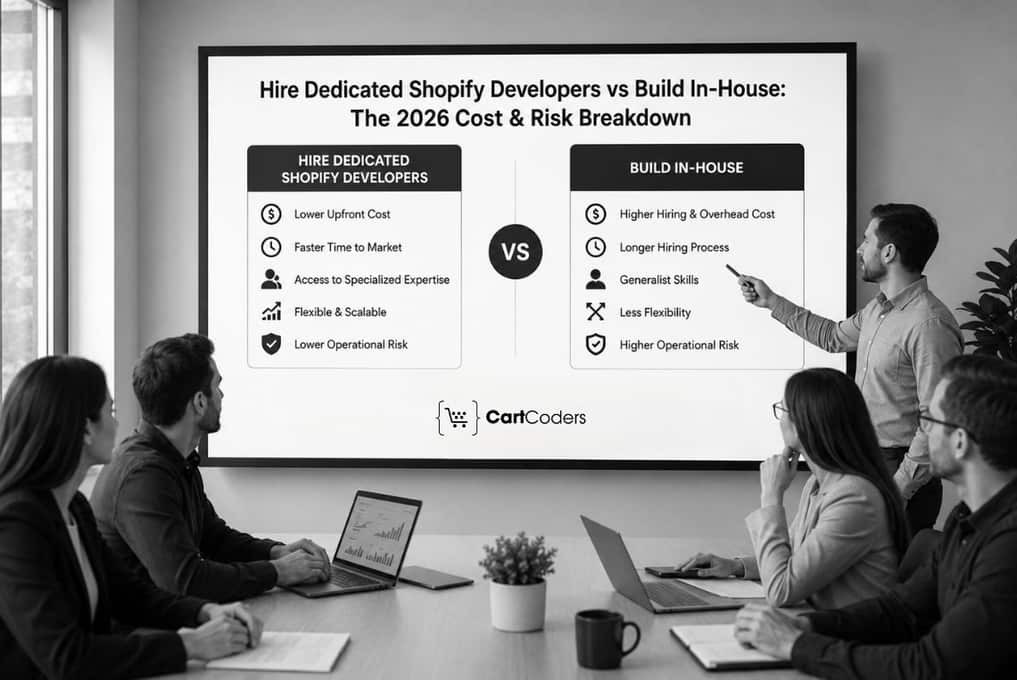

Hiring Shopify talent is not just a staffing decision. It affects launch speed, development cost, store stability, customer experience, and how fast your eCommerce roadmap moves.
Most merchants compare only hourly rates or annual salaries. That gives an incomplete picture. The real comparison is between fully loaded cost, delivery risk, skill coverage, backup support, and long-term scalability.
You have two common paths. You can hire dedicated Shopify developers through a specialized partner, or you can build an in-house Shopify team. Both models can work, but they fit different revenue stages, workloads, and risk levels.
This guide compares hiring Shopify developers vs in-house across cost, speed, skills, control, quality, risk, and long-term value. The goal is to help you choose the right Shopify hiring model for 2026.
Quick Answer: Should You Hire Dedicated Shopify Developers or Build In-House?
For most growing Shopify merchants, dedicated Shopify developers offer better speed, flexibility, and lower total cost than building an in-house team. An in-house Shopify team makes more sense when you have constant development work, proprietary systems, and enough revenue to support full-time technical roles.
Simple Rule by Revenue Stage
| Store Stage | Best Hiring Model | Why |
| Under $1M annual revenue | Dedicated Shopify developers | Lower commitment, faster access, less hiring risk |
| $1M–$8M annual revenue | Dedicated or hybrid | Flexible support while workload grows |
| $8M–$10M+ annual revenue | Hybrid model | In-house ownership plus external Shopify depth |
| $10M+ annual revenue | In-house + dedicated support | Internal strategy with specialist backup |
Choose Dedicated Shopify Developers If
You need Shopify expertise quickly without permanent hiring overhead. This model works well for theme updates, custom features, Shopify apps, integrations, migrations, Shopify Plus work, CRO fixes, and ongoing store support.
Choose In-House If
You have a constant development backlog, proprietary systems, strong internal technical leadership, and enough budget to support developers, designers, QA, tools, benefits, and management overhead.
Best Practical Answer
Most merchants should start with dedicated developers or a hybrid setup. Build in-house only when Shopify development becomes a permanent, full-time function with enough work to justify the full cost.
Dedicated Shopify Developers vs In-House Team Comparison at a Glance
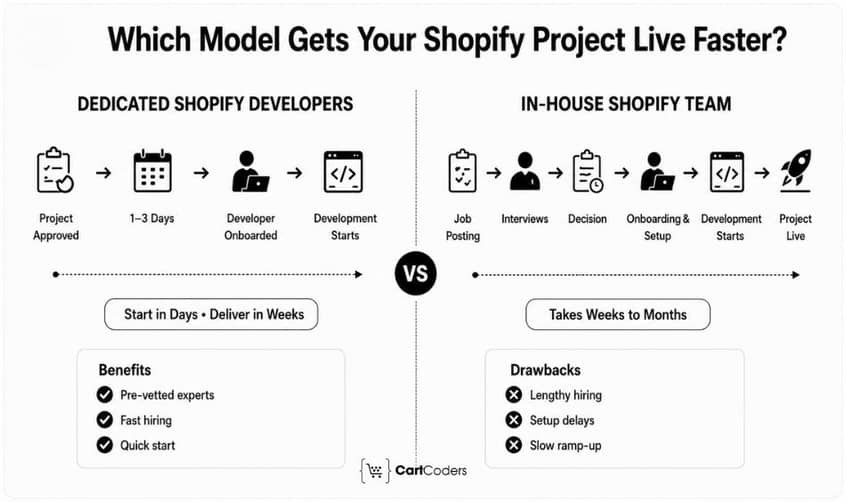
The key difference is simple. Dedicated developers give you flexible Shopify capability without hiring full-time employees. An in-house team gives you direct control but comes with salary, overhead, hiring time, and key-person risk.
| Factor | Dedicated Shopify Developers | In-House Shopify Team |
| Cost Model | Hourly or monthly engagement that can scale up or down based on workload. | Salary, benefits, taxes, tools, management time, and long-term overhead. |
| Time to Start | Developers can often start within days once scope and access are ready. | Hiring can take 2–4 months, plus onboarding and ramp-up time. |
| Skill Breadth | Access to Shopify theme, app, Plus, migration, integration, QA, and CRO specialists. | Limited to the skills of the people you hire internally. |
| Continuity | A partner can reassign backup resources if one developer is unavailable. | One developer leaving can pause work and create knowledge gaps. |
| Control | Structured control through standups, sprint boards, reports, and shared repositories. | Direct daily control through internal meetings and management systems. |
| Best For | Variable workloads, specialized Shopify tasks, migrations, peak season, and fast delivery. | Constant development workload, proprietary systems, and mature eCommerce teams. |
| Risk Level | Lower hiring and replacement risk because the provider manages resource continuity. | Higher hiring, attrition, and skill-gap risk if the team is small. |
What Does Hiring Dedicated Shopify Developers Mean?
Hiring dedicated Shopify developers means working with Shopify specialists who focus on your store for a fixed schedule or engagement. They may work part-time, full-time, hourly, or monthly based on your roadmap.
Unlike a freelancer, a dedicated developer model is usually backed by a wider team. That means you can access designers, QA testers, Shopify app developers, Shopify Plus experts, integration specialists, and project managers when needed.
If your store needs reliable Shopify execution without building a full internal team, this model gives you speed and flexibility.
How the Dedicated Developer Model Works
In a dedicated model, pre-vetted Shopify developers work on your store under a defined engagement. You agree on scope, hours, communication process, access, reporting cadence, and responsibilities.
The developer may join your Slack, project board, sprint calls, or daily communication system. You get direct collaboration without taking on employee overhead. The biggest advantage is flexibility. You can start with one developer and add more support when your roadmap expands.
Modern Shopify stores need more than simple theme edits. Shopify’s official developer platform covers areas such as themes, APIs, apps, Functions, checkout extensions, and Hydrogen. You can review the official Shopify developer docs for the technical scope Shopify developers now handle.
What Dedicated Shopify Developers Usually Handle
Dedicated developers cover theme work, custom features, and app builds. They also handle integrations, migrations, Shopify Plus builds, headless projects, and conversion work.
When This Model Works Best
The dedicated developer model works best when your workload changes month to month or when you need specialized Shopify skills quickly.
It is a strong fit when:
- You need fast development support
- Your roadmap changes often
- You have seasonal workload spikes
- You need Shopify-specific skills
- You want to avoid long recruitment cycles
- You need backup resource coverage
- You want lower fixed overhead
- You need ongoing Shopify improvements
- You are preparing for migration, redesign, or Plus upgrade
This model also works well when your internal eCommerce manager knows what needs to be done but needs reliable technical execution.
What Does Building an In-House Shopify Team Mean?
Building an in-house Shopify team means hiring full-time employees to manage development, design, QA, and technical support inside your company.
This model gives you direct control over daily priorities and deeper internal brand knowledge. It can work well for larger merchants with constant Shopify work and enough budget to keep a team busy.
However, one full-time Shopify developer rarely covers everything a modern store needs. A complete in-house setup usually needs more than one hire.
Roles Needed in an In-House Shopify Team
One developer rarely covers modern Shopify work. A complete team needs a developer, a designer, a QA tester, and someone to manage delivery. Each role adds salary and overhead.
What In-House Teams Usually Manage
An in-house Shopify team usually handles daily priorities and long-term internal roadmap items.
Common responsibilities include:
- Daily store updates
- Product page changes
- Theme maintenance
- Campaign landing pages
- App management
- Bug fixes
- Performance monitoring
- Internal stakeholder requests
- Custom feature planning
- Brand-specific workflows
- Long-term roadmap execution
The biggest strength of in-house hiring is context. Internal teams understand brand priorities, customer segments, marketing calendars, and internal processes deeply.
When In-House Hiring Works Best
In-house hiring works best when your development workload is steady to justify full-time salaries.
It is an ideal fit when:
- You have constant Shopify development work
- You need direct ownership of daily priorities
- Your store has proprietary internal systems
- Your company has strong technical leadership
- Your revenue supports multiple full-time roles
- Your roadmap runs continuously across quarters
- You can afford hiring, benefits, tools, and management overhead
In-house teams work well when paired with external specialists for peak workload, Shopify Plus complexity, app development, or headless builds.
That hybrid model gives you internal ownership and external depth.
Why is the Right Hiring Model Important?
Shopify development has become more specialized. In the past, one developer could manage most theme changes and basic app integrations. Many stores need deeper expertise across Shopify Functions, checkout extensibility, APIs, Hydrogen, headless commerce, performance, CRO, accessibility, B2B, and custom app development.
This makes the hiring decision more important.
A weak hiring model can cause:
- Slow feature delivery
- Higher long-term cost
- Poor code quality
- App overload
- Checkout issues
- Missed peak-season deadlines
- Delayed migrations
- Lower conversion performance
- Key-person dependency
A strong hiring model gives you the right technical capability at the right stage of growth.
Cost Breakdown of Dedicated Shopify Developers vs In-House
The real cost difference between dedicated Shopify developers and an in-house Shopify team is not just hourly rate or salary. You need to compare total cost, speed to productivity, benefits, tools, management time, backup coverage, and the cost of idle capacity.
Dedicated developers usually give merchants more flexible cost control. In-house hiring becomes cost-effective when Shopify development is constant, strategic, and large enough to justify full-time roles.
Monthly Cost of Dedicated Shopify Developers
Dedicated Shopify developer costs usually depend on experience, engagement type, region, and technical scope. Offshore and nearshore teams often cost less than full-time in-house hiring, while still giving access to Shopify-specific skills.
| Dedicated Developer Type | Estimated Monthly Cost | Best Fit |
| Part-time Shopify developer | $1,500–$4,000/month | Small updates, bug fixes, minor theme work |
| Full-time dedicated Shopify developer | $3,500–$8,000/month | Ongoing store improvements, app setup, integrations |
| Senior Shopify developer | $6,000–$12,000/month | Shopify Plus, complex Liquid, APIs, checkout work |
| Dedicated Shopify team | $8,000–$25,000+/month | Redesigns, migrations, Plus builds, headless projects |
The biggest advantage is scalability. You can increase or reduce resources based on workload without carrying permanent salary costs.
Annual Cost of an In-House Shopify Developer
An in-house Shopify developer may look cheaper when you only consider base salary. But the true cost includes benefits, payroll taxes, equipment, software, recruiting, training, management time, and downtime.
| In-House Cost Item | Estimated Annual Cost | Why It Matters |
| Base salary | $70,000–$140,000/year | Depends on seniority, region, Shopify experience, and market demand. |
| Benefits, taxes, and overhead | +25%–30% | Includes payroll burden, insurance, paid leave, and administrative costs. |
| Equipment and tools | $3,000–$10,000/year | Includes laptop, testing tools, design tools, monitoring, and developer software. |
| Recruiting cost | $5,000–$25,000+ | Includes hiring platforms, recruiter fees, interviews, and internal time. |
| Ramp-up time | 1–3 months | Productivity is lower while the developer learns your store and workflows. |
| Replacement cost if they leave | High | Hiring restarts and project knowledge may be lost. |
A $100,000 developer can easily become a $130,000–$160,000 annual cost once overhead and tools are included. The U.S. Bureau of Labor Statistics lists median pay for web developers and digital designers as a useful salary context. You can review the official U.S. Bureau of Labor Statistics web developer data before publishing final salary claims.
Cost Comparison by Team Size
A fair comparison should include the roles needed to run a Shopify store properly. One in-house developer rarely covers development, design, QA, performance, CRO, integrations, and app work at a high level.
| Team Scenario | Dedicated Developer Model | In-House Model |
| 1 Shopify developer | $42,000–$96,000/year | $90,000–$180,000/year fully loaded |
| Developer + designer + QA | $96,000–$250,000/year | $250,000–$450,000/year fully loaded |
| 6-role Shopify capability | $180,000–$500,000+/year | $600,000–$1M+/year fully loaded |
| Long-term internal ecommerce department | Varies by scope | High but strategic |
Dedicated teams often give access to more Shopify capabilities for less than the cost of building a full internal department.
Total Cost of Ownership Beyond Salary
Total cost of ownership, or TCO, gives a more honest comparison than salary alone. It shows the hidden expenses behind each Shopify hiring model.
| Cost Line | In-House Shopify Team | Dedicated Shopify Developers |
| Base pay or rate | $70,000–$140,000/year per developer | Hourly or monthly engagement |
| Benefits, taxes, overhead | Adds roughly 25%–30% | Usually included in provider pricing |
| Equipment and tools | You pay for devices, software, testing tools, and licenses | Provider usually covers developer tools |
| Recruiting and hiring | Takes 2–4 months and requires internal interview time | Resource matching can start within days |
| Ramp-up time | Usually 1–3 months before full productivity | Faster onboarding with Shopify-specific experience |
| Idle capacity | Paid even during slow development months | Can scale down when workload drops |
| Backup coverage | Requires another internal hire or contractor | Provider can assign replacement or backup resources |
| Management time | Fully internal responsibility | Shared through reporting, project management, and delivery support |
| Long-term risk | Attrition, mis-hire, skill gaps, and knowledge loss | Lower replacement risk if contract terms are clear |
This is why dedicated developers often win on cost for growing merchants. In-house wins only when workload is steady enough to keep full-time roles productive every week.
Hidden Costs Most Shopify Hiring Comparisons Miss
Most Shopify hiring comparisons focus on rates and salaries. That misses the costs that usually hurt delivery, especially for growing stores.
Recruitment and Interview Time
Finding a strong Shopify developer can take months. You need to source candidates, review portfolios, run technical interviews, compare rates, negotiate offers, and wait for notice periods.
During that time, no development work gets done.
A delayed hire can affect:
- Product launches
- Theme updates
- App cleanup
- Shopify migration
- Checkout fixes
- Peak-season readiness
Dedicated developers reduce this delay because the provider already maintains a resource pool.
Onboarding and Store Knowledge Transfer
Even skilled developers need time to learn your theme, app stack, custom code, integrations, workflows, and business rules. In-house deployment can take 1–3 months before the developer reaches full productivity.
Dedicated Shopify developers often grow faster because they already understand common Shopify setups, Shopify Plus workflows, app conflicts, Liquid patterns, and theme structures.
Tools, Licenses, and Testing Setup
In-house teams require more than salaries. They need tools and infrastructure.
Common costs include:
- Design tools
- QA tools
- Browser testing tools
- Monitoring tools
- Code repositories
- CI/CD setup
- Theme licenses
- App testing environments
- Project management tools
Dedicated teams often include these operational requirements inside the engagement.
Developer Downtime and Backup Support
In-house developers still cost the same during slow months, sick leave, vacations, or low-priority periods. If one developer handles most Shopify work, progress stops when they are unavailable.
Dedicated teams reduce this problem because backup support can be planned into the engagement.
This matters during:
- Black Friday/Cyber Monday preparation
- Migration launches
- Shopify Plus upgrades
- App releases
- Checkout updates
- Store redesigns
Attrition and Replacement Risk
When an in-house Shopify developer leaves, they take project knowledge with them. Replacement hiring can take months and create delivery gaps.
Common risks include:
- Unfinished tasks
- Poor documentation
- Delayed releases
- Lost theme knowledge
- Incomplete app understanding
- Integration handover issues
Dedicated teams reduce attrition risk because the provider can replace resources and maintain delivery continuity.
| Dedicated Shopify developers are usually more cost-effective when your workload changes, your store needs specialized skills, or you cannot afford hiring delays.In-house hiring becomes stronger when your Shopify roadmap is large, constant, proprietary, and supported by internal technical leadership.For most growing merchants, the best answer is not purely dedicated or purely in-house. It is often a hybrid model where an internal ecommerce owner guides priorities while dedicated Shopify developers handle technical execution. |
Risk Comparison: Dedicated Shopify Developers vs In-House Team
Cost is only one part of the decision. A delayed product launch, poor code quality, or an unavailable developer can cost far more than the difference in salary or hourly rate. That is why successful Shopify brands evaluate hiring models based on risk, continuity, and long-term execution instead of price alone.
| Risk Area | Dedicated Shopify Developers | In-House Shopify Team |
| Hiring risk | Low because developers are already vetted and available through the agency. | High because recruitment, interviews, and onboarding can take several months. |
| Skill gap risk | Low with access to specialists across Shopify themes, apps, Plus, QA, and integrations. | Medium to high if one developer is expected to handle every technical requirement. |
| Delivery continuity | Better because backup developers can step in when needed. | Higher dependency on individual employees and internal documentation. |
| Scalability risk | Low because the team can expand or reduce based on workload. | High because adding resources requires another hiring cycle. |
| Cost overrun risk | More predictable with defined monthly or project-based engagement. | Higher due to recruitment costs, salary increases, benefits, and unexpected turnover. |
| Knowledge retention | Shared documentation and multiple contributors reduce dependency. | Knowledge may remain with one employee unless documentation is maintained carefully. |
| Security and access | Managed through NDAs, secure repositories, and role-based access controls. | Full internal control, but security depends on internal governance practices. |
| Long-term flexibility | High because engagement size can change with business priorities. | Lower because salaries remain fixed regardless of workload. |
Delivery Delay Risk
Launching Shopify features on time can directly affect revenue, especially during seasonal campaigns, new product launches, paid promotions, checkout updates, CRO work, and customer experience improvements.
Dedicated Shopify developers often reduce delay risk because skilled Shopify experts are available faster, and agencies can add app developers, QA engineers, designers, or Shopify Plus experts when needed. This helps keep timelines steady even when priorities change.
In-house teams may face delays if a developer resigns, hiring takes longer, several projects compete for attention, or advanced Shopify knowledge is missing.
Shopify Skill Gap Risk
Modern Shopify projects need skills across Liquid, Shopify Functions, Checkout Extensibility, APIs, custom apps, Hydrogen, performance, accessibility, ERP integrations, and B2B features.
Dedicated Shopify developers usually bring access to specialists across these areas, so advanced work does not depend on one person learning everything from scratch.
In-house developers often become generalists because they handle many business requests, which can create challenges when the store needs deeper Shopify Plus, checkout, app, or integration expertise.
Code Quality and Long-Term Maintainability
Poor Shopify code may not create problems immediately, but it can make future updates, integrations, and performance improvements harder.
Dedicated Shopify teams often follow coding standards, documentation, version control, code reviews, staging checks, QA testing, and reusable development practices. This reduces technical debt over time.
With an in-house team, code quality depends on the developer’s experience and internal review process. Without clear standards, long-term maintenance can become costly.
Dependency on Individual Developers
Relying on one developer creates business continuity risk. If that person understands every custom feature, integration, and workflow, any absence or resignation can slow future work.
Dedicated Shopify teams reduce this risk through shared documentation, version control, and multiple developers who can support the project.
Small in-house teams may depend heavily on one experienced developer, and replacing that knowledge can take weeks or months.
Scalability Risk
Shopify workload often changes during Black Friday Cyber Monday, holiday campaigns, store redesigns, product launches, international growth, or Shopify Plus migrations.
Dedicated Shopify developers give more flexibility because businesses can add developers, bring in specialists, create a larger project team, or reduce resources after launch.
In-house scaling usually needs budget approval, recruitment, interviews, notice periods, and onboarding, which can take months.
Security and Access Risk
Every Shopify project needs secure development practices, including role-based access, two-factor authentication, Git-based version control, limited production access, secure credential handling, and confidentiality agreements.
Dedicated Shopify agencies usually follow structured security processes because they manage multiple client stores.
In-house teams give direct control over systems and credentials, but security still depends on strong internal governance, documentation, and access rules.
Cost Overrun Risk
Shopify projects often go over budget because of unclear scope, changing requirements, delayed delivery, or missing skills.
Dedicated Shopify developers can make costs easier to manage when the scope, sprint planning, reporting, and resource needs are clear.
In-house teams may carry hidden costs such as recruitment fees, salary revisions, training, software licenses, turnover, and delayed launches. These costs are often missed during early planning.
Risk Assessment Matrix
| Business Situation | Dedicated Shopify Developers | In-House Shopify Team |
| Fast product launch | Low risk | Moderate risk due to hiring time |
| Shopify Plus implementation | Strong specialist support | Depends on internal expertise |
| Long-term roadmap | Flexible scaling | Strong internal ownership |
| Seasonal workload | Easy to scale resources | Fixed staffing costs |
| Complex integrations | Access to experienced specialists | May require additional hiring |
| Team continuity | Backup resources available | Dependent on employee retention |
| Cost predictability | More predictable engagement | Higher long-term overhead |
| Business control | Shared execution model | Complete internal control |
Which Hiring Model Has Lower Overall Risk?
For most growing Shopify businesses, dedicated Shopify developers offer lower delivery risk because they reduce hiring delays, provide access to broader technical expertise, and scale with changing workloads.
An in-house Shopify team becomes the stronger option when development is continuous, the business has mature technical leadership, and long-term product ownership outweighs staffing flexibility.
Many successful Shopify brands reduce overall risk by combining both approaches. An internal eCommerce or product team sets priorities, while dedicated Shopify specialists provide technical depth for complex projects, Shopify Plus implementations, and peak development periods.
Productivity Comparison: Which Hiring Model Delivers Faster Results?
Development speed depends on more than coding ability. It also depends on how quickly the right people start, how efficiently work is assigned, and how well the team adapts to changing priorities.
| Stage | Dedicated Shopify Developers | In-House Shopify Team |
| Resource availability | Developers can usually start within a few days after project approval. | Hiring, interviews, and onboarding often take 8–16 weeks before work begins. |
| Project onboarding | Shopify specialists understand common store structures and development workflows, reducing ramp-up time. | New hires need time to learn your store architecture, internal processes, and business goals. |
| Access to specialists | Agencies can involve Shopify Plus experts, QA engineers, designers, or integration specialists when required. | Additional expertise usually requires hiring another employee or outsourcing temporarily. |
| Scaling during projects | Team size can increase or decrease as project priorities change. | Expanding capacity requires another recruitment cycle. |
| Overall delivery speed | Faster for most Shopify projects because expertise is available immediately. | Better for long-term product ownership once the team is fully established. |
Dedicated Shopify developers usually deliver projects faster because experienced resources are available immediately. In-house teams may take longer to reach full productivity due to hiring, onboarding, and knowledge transfer.
Speed to Launch: Which Model Gets You to Market Faster?
Launching new features at the right time often has a direct impact on revenue. Delays during seasonal campaigns, migrations, or major releases can reduce sales opportunities and increase operational pressure.
Dedicated Shopify Developers
Dedicated developers help accelerate launches by bringing proven Shopify experience from similar projects. They can begin development without spending weeks learning the platform.
This model is especially effective for:
- Shopify store launches
- Theme redesigns & customizations
- Shopify Plus upgrades
- Checkout customization
- App development
- ERP, CRM and Third-party integrations
- Migration projects
- Holiday campaign preparation
In-House Team
Internal teams often deliver consistently once they are fully established. However, the initial setup requires time for hiring, onboarding, and knowledge sharing.
If your roadmap has immediate deadlines, this preparation period can delay project delivery.
Which Hiring Model Delivers Better Quality?
Development quality affects future maintenance, store performance, and customer experience. Poor implementation often creates technical debt that becomes expensive to fix later.
Dedicated Shopify Developers
Experienced Shopify agencies usually follow structured development processes.
Typical quality practices include:
- Code reviews
- QA testing
- Staging deployment
- Performance optimization
- Cross-browser testing
- Mobile responsiveness testing
- Documentation
- Version control
Because agencies work on multiple Shopify stores, they often apply established best practices across projects.
In-House Shopify Team
Quality depends on internal standards and the experience of your developers.
An experienced internal team can produce excellent work, but smaller teams may have limited capacity for peer reviews, QA, or specialized testing.
Maintaining documentation and development standards becomes increasingly important as the store grows.
How Teams Communicate and Collaborate
Communication influences project success as much as technical skills. The right hiring model should make collaboration clear, predictable, and transparent.
Dedicated Shopify Developers
Modern Shopify agencies typically work as an extension of your internal team.
Common communication methods include:
- Slack
- Microsoft Teams
- Jira
- ClickUp
- Trello
- Asana
- GitHub
- Weekly sprint reviews
- Daily stand-ups
You receive regular progress updates while avoiding the responsibility of managing recruitment and staffing.
In-House Shopify Team
Internal teams naturally have easier access to business stakeholders.
Advantages include:
- Face-to-face collaboration
- Immediate decision-making
- Better understanding of company culture
- Direct alignment with business priorities
For organizations with constant development work, this can improve long-term planning.
Decision Matrix: Which Hiring Model Matches Your Store Stage?
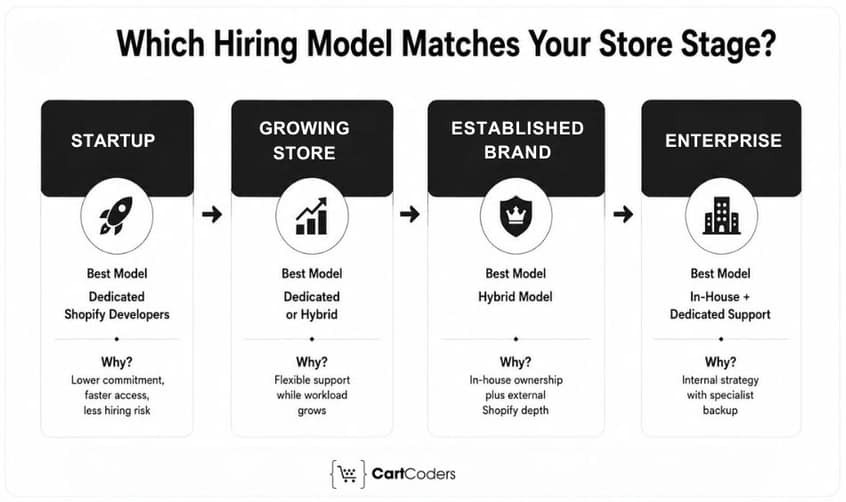
The right model shifts with your store stage. This table gives a quick recommendation.
| Store stage | Better fit | Why |
|---|---|---|
| New store launch | Dedicated | Fast start, full skill set |
| Redesign or rebuild | Dedicated or hybrid | Project depth, then maintenance |
| Migration to Shopify | Dedicated | Specialist, time-boxed work |
| Shopify Plus upgrade | Dedicated | Plus expertise on demand |
| Ongoing maintenance | Dedicated or in-house | Depends on workload volume |
| CRO and performance | Dedicated | Blended UX and technical skills |
| B2B or custom pricing | Dedicated | Catalog and pricing expertise |
| Headless project | Dedicated | React and architecture depth |
| Enterprise roadmap | Hybrid | Owner inside, team outside |
For enterprise builds, our Shopify Plus development team supports migration, B2B, and headless work.
Why Many Brands Choose a Hybrid Model
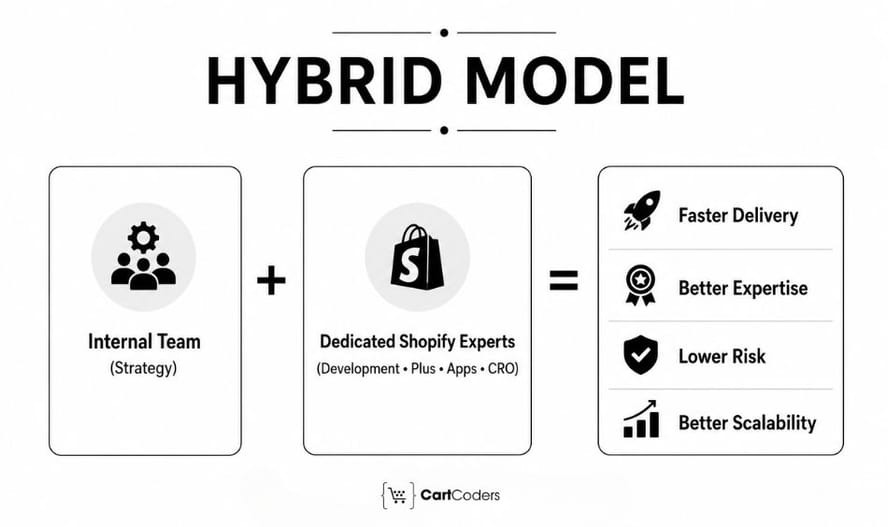
Many successful eCommerce businesses combine the strengths of both hiring models. Instead of choosing one approach exclusively, they build a small internal team and extend it with dedicated Shopify specialists when needed.
When a Hybrid Hiring Model Is the Best Choice
A hybrid model works well when:
- Your development workload changes throughout the year.
- You need Shopify expertise that is difficult to hire internally.
- Internal teams focus on product strategy rather than coding.
- Seasonal campaigns require additional development capacity.
- Shopify Plus or headless projects need specialist knowledge.
- You want to reduce hiring risk without losing business control.
Many businesses adopt this model as they move from startup to mid-market or enterprise eCommerce operations.
How CartCoders Helps Businesses Scale Shopify Development
High-performing Shopify store development requires more than writing code. It requires experienced developers, proven processes, and the flexibility to support changing business priorities. Here is how we support merchants at CartCoders.
Requirement Audit and Hiring Model Recommendation
We review your workload, roadmap, and budget first. Then we recommend the model that fits, even when that means a lean setup.
Dedicated Developer Setup
We offer flexible engagement: hourly, part-time, full-time, and project-based. Onboarding usually takes one to three business days.
Technical Delivery and QA Support
Our developers work with code review, QA, and clear reporting. You also get design support when you hire a Shopify designer for storefront work.
Backup Resources and Scaling Support
We keep coverage during leave and peak season. You can hire Shopify Plus developers when a project needs enterprise depth.
Long-Term Maintenance and CRO Support
We support your store after launch with maintenance and conversion work. That keeps performance strong as you grow.
Final Recommendation
There is no single hiring model that works for every Shopify business. Choose dedicated Shopify developers if you want faster delivery, lower hiring risk, specialized expertise, and the flexibility to scale your team as projects evolve.
Choose an in-house Shopify team if development is a long-term strategic function, your workload remains consistently high, and you have the budget to support multiple technical roles.
For many growing eCommerce brands, the hybrid approach offers the best balance. Internal teams maintain business ownership while dedicated Shopify specialists provide the technical expertise needed for complex projects and peak workloads.
The right decision depends on your business goals, development roadmap, available budget, and expected growth over the next few years.
Frequently Asked Questions
In most cases, yes. Dedicated Shopify developers eliminate recruitment expenses, employee benefits, equipment costs, and long-term payroll commitments. They also allow businesses to scale resources based on project needs.
An in-house team is a better choice when Shopify development is a continuous business function and you have enough work to keep multiple technical roles fully utilized throughout the year.
Yes. Many businesses use a hybrid approach where internal teams manage strategy and dedicated Shopify developers provide specialized development, Shopify Plus expertise, integrations, and additional capacity during busy periods.
Most dedicated Shopify developers can begin within a few days after project requirements, contracts, and access are finalized. Building an in-house team typically takes several weeks or months.


