
Restaurant owners spend months planning menus, interiors, and staff before opening day. But many put off building a website until the last moment. By then, a significant number of potential customers have already searched for the restaurant online, found nothing useful, and chosen a competitor with a cleaner web presence.
If you are now ready to invest in a website, the first real question is, what does restaurant website development cost for your specific situation, and how do you make sure every dollar goes toward something that brings customers through the door?
This guide covers every cost layer involved, from the development approach you choose to the features you add and the ongoing expenses after launch. By the end, you will know exactly how to build a realistic budget and avoid the surprises that catch most restaurant owners off guard.
Quick Answer
Restaurant website development costs range from $500 to $25,000 or more, depending on how you build it. A DIY builder costs $500 to $1,500 per year to run yourself. A professionally built template-based site falls between $1,500 and $5,000. A fully custom website typically runs $12,000 to $25,000. Ongoing hosting, maintenance, and promotion add $500 to $3,000 per year. Your final number depends on features, design complexity, and the team you hire.
What Does a Restaurant Website Actually Need to Do?
Before looking at costs, it helps to understand what your website is actually responsible for. A restaurant website is not just a digital brochure. It is the first impression most new customers will have of your business, often before they ever visit in person. Getting clear on its job makes it easier to budget for what actually matters.
Core Jobs a Restaurant Website Must Handle
Most restaurant websites need to do three things well. First, show up when someone nearby searches for a place to eat. Second, give visitors the information they need within a few seconds. Third, make it easy for those visitors to take action, whether that means placing an order, making a reservation, or finding directions.
A website that handles these three jobs well directly affects foot traffic, online orders, and repeat visits. One that does them poorly sends potential customers to a competitor with a better web presence. This is why the quality of development matters as much as the cost.
The Baseline Pages Every Restaurant Site Needs
At a minimum, a restaurant website needs a homepage with clear branding, a menu page with current pricing, a contact page with location and hours, and an About page that tells your story. These four pages form the foundation of any restaurant’s web presence.
Beyond these, most restaurants benefit from a gallery page, a reservation section, and links to social profiles. These are not optional extras. They are what customers now expect when they visit a restaurant website. Any development quote that does not include at least these elements is quoting for an incomplete site.
What Affects Restaurant Website Development Cost?
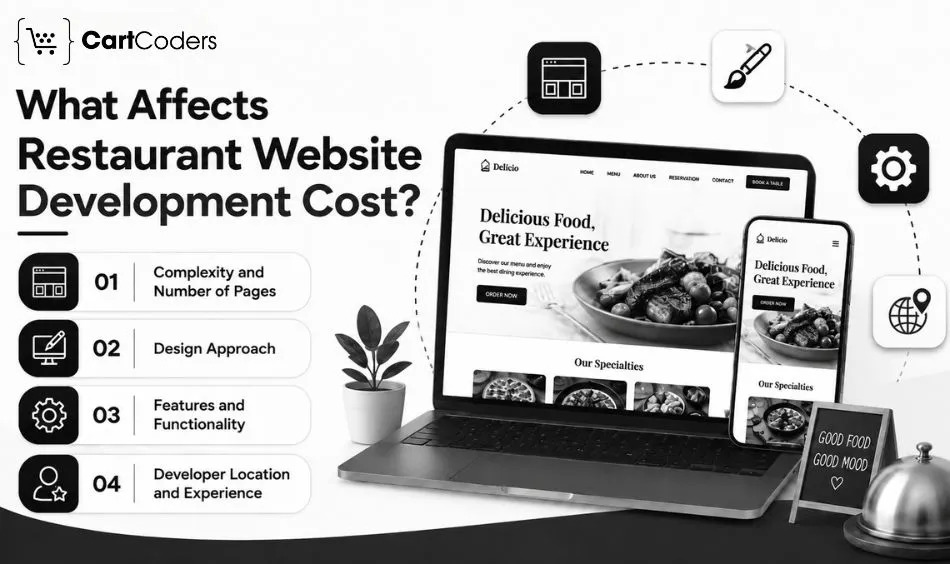
The cost to build a website for a restaurant varies widely because several independent factors each push the price in different directions. Understanding these factors helps you build a realistic budget before you approach any developer or agency. It also helps you ask sharper questions and spot quotes that are either too vague or too low to be trusted.
Complexity and Number of Pages
A five-page site costs far less to build than a site with fifteen pages, custom integrations, and a multilingual setup. Each additional page requires design work, content placement, and testing across devices.
A simple informational site costs between $1,500 and $5,000 for professional work. A feature-heavy site with ordering, reservations, and a loyalty program can push $15,000 to $25,000 or beyond. The key decision is identifying which pages and sections are essential for launch and which can be added in a second phase after you see real visitor data.
Design Approach
Using a pre-built template is the most affordable design route. Templates cost a fraction of custom design work and still give restaurants a polished, mobile-ready result. The limitation is that your site may look similar to other businesses using the same template.
Custom design builds the visual identity of your site from scratch. It costs more because a designer spends time on layouts, typography, color systems, and responsive behavior across screen sizes. For restaurants with a strong brand identity or a distinct atmosphere they want to convey online, the investment in custom design typically pays off through stronger first impressions and higher visitor trust.
Features and Functionality
Basic informational features, such as a menu display, contact form, and photo gallery, are inexpensive to build. They involve standard components that developers can set up in a short amount of time.
More complex features like online ordering, real-time table reservations, customer account management, and loyalty point tracking each require significant development and testing time. Every feature you add to the build scope increases the total cost. The smart approach is to list your features in priority order and build only the essential ones in the first version of the site.
Developer Location and Experience
Development rates differ significantly across regions, and this has a direct impact on your total project cost. When you hire dedicated developers from the US, UK, Canada, and Australia, they typically charge $80 to $200 per hour. Teams in Eastern Europe and Latin America generally charge $30 to $80 per hour. Developers in South Asia and Southeast Asia often charge $15 to $50 per hour.
Most restaurants are better served by project-based quotes than hourly billing. A fixed-scope quote lets you plan your budget with confidence rather than tracking hours and worrying about overruns. Before you commit, ask any agency whether their quote is fixed or estimated, and what happens if the project runs longer than planned.
How Much Does It Cost to Build a Website for a Restaurant?
Here are the actual numbers across each development path. The cost to build a website for a restaurant depends most on the approach you choose. Each path offers a different tradeoff between price, control, and quality of the final result.
| Development Type | Cost Range | Best For | Timeline |
| DIY Website Builder | $500 – $1,500/yr | Owners on a very tight budget with time to self-manage | 1 – 2 weeks |
| Template-Based Development | $1,500 – $5,000 | Independent restaurants wanting a professional result fast | 2 – 4 weeks |
| Semi-Custom Development | $5,000 – $12,000 | Restaurants with specific design or feature requirements | 4 – 8 weeks |
| Fully Custom Development | $12,000 – $25,000+ | Multi-location groups, hotel dining, or complex operations | 8 – 16 weeks |
What Are the Ongoing Costs After Launch?
Restaurant website development cost does not end when the site goes live. Ongoing expenses keep the site running, secure, and visible in search results. Planning for these from the start prevents budget surprises six months down the road and gives you a realistic picture of the total annual investment.
| Cost Item | Typical Range | Notes |
| Domain name | $10 – $20/yr | Annual renewal via your registrar |
| Website hosting | $5 – $50/month | Shared plans for basic sites; managed plans for ordering sites |
| SSL certificate | Often free | Included with most modern hosting plans |
| Maintenance plan | $50 – $300/month | Security updates, plugin updates, and support |
| SEO services | $300 – $1,000/month | Local SEO to rank for restaurant searches in your area |
| Email marketing | $15 – $100/month | Depends on your subscriber list size |
How Do You Pick the Right Development Partner?
The team you hire shapes the final result as much as the budget you set. A higher-priced agency is not always better, and a lower-priced freelancer is not always risky. What matters is how clearly they communicate, how much industry experience they bring to the project, and how well their past work matches what you need. What to look for:
Experience With Food and Hospitality Businesses
Restaurant sites have specific requirements. Menus need to be easy to update without a developer’s help. Mobile performance matters above almost everything else because most customers will find you on their phone. Local SEO setup needs to be correct from day one, or you lose weeks of visibility waiting for Google to index the site properly. Look for a team that has already solved these problems for other food businesses.
Quality of Past Work Over Time
Ask to see past restaurant or food business sites and check whether those sites still perform well today, not just on launch day. A site that looks good initially but runs slowly or ranks poorly a year later tells you something important about the team’s approach to long-term quality. Use a free tool like Google PageSpeed Insights to check the performance of any site they show you as a reference.
Red Flags To Watch Before Signing
Not every development partner who looks good in a sales call delivers on that promise once the project starts. A few specific warning signs, visible before you sign anything, can save you from months of frustration and a website that needs to be rebuilt from scratch.
No Written Contract With a Defined Scope
Any development partner who cannot provide a written contract that defines exactly what will be built, by when, and for what price is a significant risk. Without a clear scope document, you have no way to hold the team accountable when the project runs late or falls short of expectations. Never begin a project without a signed agreement in place.
Full Payment Required Before Any Work Starts
A standard payment structure for web development is typically 30% to 50% upfront, with the remainder tied to project milestones. Any partner who demands 100 percent payment before starting work removes all your leverage if the project is delivered late, incomplete, or below the standard discussed in the sales conversation.
Unrealistically Low Quotes
A quote that seems too good to be true usually involves limited features, junior developers handling senior work, or a site built on a locked proprietary platform that charges ongoing fees. Compare quotes carefully and ask every team to list exactly what is and is not included. The cheapest quote is often the most expensive option by the time the project is complete.
How Can You Reduce the Cost Without Losing Quality?
Reducing restaurant website development cost does not mean accepting lower quality or cutting essential features. It means making smarter decisions about what you build first, how you prepare for the project, and how you structure the work over time.
Start With Core Features Only
Build the essential version of your site first: homepage, menu, contact, about, and one clear conversion action such as “order online” or “make a reservation.” Get that version live, tested, and performing before adding anything else.
This approach reduces upfront cost significantly. It also gives you real visitor data to inform which features to invest in next. Many restaurant owners discover that a clean, fast five-page site drives more conversions than a bloated site with features that nobody uses. The data tells you where to spend next, rather than guessing at launch.
Prepare Your Content Early
Development time costs money. Every time a developer waits for photos, menu text, or branding files, that project clock keeps running. Having all your content ready before development starts is one of the simplest and most overlooked ways to reduce the final project bill.
This means having a finalized menu with current prices, high-quality food and interior photos in the correct file sizes, your logo in vector or PNG format, and a short description of your restaurant ready before the first development meeting. Teams that receive a complete content brief at project start consistently finish faster and charge less than teams that are waiting on content throughout the build.
Use Phased Development
If the full site you want costs more than your current budget allows, build it in clearly defined phases. Phase one covers the core informational site with a polished design. Phase two adds online ordering. Phase three adds reservations or loyalty features. Each phase is a self-contained project with its own budget and delivery date.
This approach spreads the investment over time, lets you test what works before committing to more expensive features, and keeps each development phase manageable for both you and the team. It also means you go live sooner, which means you start ranking in search results and capturing customers earlier rather than waiting until a large all-at-once project is complete.
Working with CartCoders
CartCoders has built websites for food and hospitality businesses across multiple markets. The focus is always on mobile performance, clean menu management, and local search visibility from day one. If you want a clear project scope with no surprise costs, reach out for a free consultation before you finalize your budget.

Conclusion
Restaurant website development cost is not a fixed number. It depends on what you need the site to do, how you choose to build it, and who you work with to get it done. A DIY approach can get you online for under $1,500 per year. Professional development starts around $1,500 for template-based work and goes up to $25,000 or more for a fully custom build with complex features.
The most important thing is not finding the lowest price. It is finding the development approach that matches your restaurant’s current stage, your customer expectations, and your ability to manage the site after launch. Start with a clear scope, work with a team that knows the food industry, and build in phases if your budget requires it. That approach consistently delivers better results than either overspending on features you are not ready for or underspending on quality that costs more to fix later. Contact CartCoders today!
Frequently Asked Questions
For professionally built sites, the average falls between $3,000 and $10,000 depending on the number of pages and features. Template-based builds start around $1,500. Fully custom sites with ordering and reservations typically range from $12,000 to $25,000.
Building a fully custom restaurant website from scratch costs $12,000 to $25,000 or more. This includes custom design, full-stack development, feature implementation, and testing. Most independent restaurants find template-based or semi-custom development more practical as a starting point.
Integrating a third-party ordering platform into an existing site typically costs $500 to $1,500 in developer time, plus $100 to $500 per month for the ordering platform. Building a proprietary ordering system from scratch adds $3,000 to $8,000 to the project cost.
A monthly maintenance plan typically costs $50 to $300 per month. This covers security updates, plugin updates, backups, and basic technical support. Restaurants with online ordering or reservation systems tend to need the higher end of that range for adequate coverage.
A template-based restaurant website takes 2 to 4 weeks from project start to launch. A semi-custom build takes 4 to 8 weeks. A fully custom site with complex features takes 8 to 16 weeks. Timelines depend on how quickly content is provided and how many revision rounds the project involves.
Freelancers tend to cost less but may have limited availability for support after launch. Agencies cost more but offer a full team, structured processes, and ongoing maintenance plans. For restaurants that want reliable long-term support, an agency with food industry experience is usually the stronger choice.
Standard shared hosting costs $5 to $15 per month. Managed hosting, which is faster and better suited to sites with online ordering, costs $20 to $50 per month. Add $10 to $20 per year for the domain name. Most restaurants budget $150 to $600 per year for hosting and domain combined.


