
When operating a large online store, managers need to manage a large number of product items, make price updates, synchronize product details, and ensure their information remains consistent wherever their items are sold. According to reports, Shopify is positioned in the 4th place among the global eCommerce platforms.
Companies use applications like Shopify Plus to manage their ever-increasing product offerings. Doing everything manually is slow, creates mistakes, and makes progress much harder.
This is why Shopify Plus merchants look for Product Information Management solutions (PIM). PIM tools help bring all product data together in one place, making it easier to correct details and share the right product information with every sales platform.
For businesses using Shopify Plus and managing a large number of products, a PIM is more than just nice to have. The right PIM tool boosts speed, makes updates more accurate, and creates a seamless shopping experience for anyone buying from anywhere in the world.
What Is PIM for Shopify Plus?
Product Information Management systems are designed to consolidate all product details in one central location. With a PIM, store owners don’t need to juggle dozens of spreadsheets or keep the same product listed in multiple software systems.
Once a PIM is connected with Shopify Plus, the flow between managing items and showing them in the shop gets direct. Here’s what merchants can do with this kind of system:
- Save all product facts and details in just one software
- Quickly apply any changes because the new info instantly appears in Shopify Plus
- Connect the product details across all selling platforms—storefronts, apps, and global partners
Using a PIM with Shopify Plus means fewer errors when listing, and teams don’t waste time copying information. It also makes a huge business more organized and less stressed out when updating thousands of items.
Why Shopify Plus Merchants Need PIM Solutions
Businesses on Shopify Plus have to keep track of lots of different products, sometimes even across different stores and countries. Without a solid PIM solution, things get chaotic and mistakes are almost guaranteed to happen.
Here’s why a PIM makes a difference:
Duplicate Data Issues
Manually fixing multiple spreadsheets or sales channels always leads to duplicate work or mismatched product info. This only brings headaches and can push customers away.
Inconsistent Catalogs
If product pictures, descriptions, or prices are not the same everywhere, customers can lose confidence in the brand. Anyone seeing two different prices or an outdated photo might leave.
Scaling Problems
As stores get bigger and add more products, doing things manually no longer works. Moving to fresh platforms or foreign regions gets harder.
Slow Product Updates
If someone needs to change a product, it can take a really long time to fix each place where that info appears. This delay gives competitors an advantage.
Enterprise Complexity
Large Shopify Plus merchants require all stores, partner channels, and backend systems to display the same information. This only works with a good PIM tool in place.
15 Key Benefits of Using PIM Solutions With Shopify Plus
Below are the main benefits PIM solutions bring to Shopify Plus merchants:
Centralized Product Data Management
PIM enables stores to control and edit all aspects of each item from a single main dashboard. There’s no need to check everywhere to update a detail. Teams stop fighting over which document is right, since the PIM holds the only official version.
Faster Catalog Updates
Changing products manually is a slow and risky process. PIM solutions enable changes to occur in one location, and the new data is instantly updated across Shopify Plus and all platforms. It saves days of double-checking every update.
Multi-Channel Product Distribution
Shopify Plus stores rarely only sell in one location. PIM makes it easy to push updated items to Amazon, eBay, physical stores, and other online platforms simultaneously. No more confusion about where the latest information is.
Improved Product Data Accuracy
Stores lose sales if they display incorrect item details, sizes, or prices. A PIM system helps ensure that every change is accurate and sent out the moment it is approved, reducing the likelihood of incorrect orders and returns.
Rich Product Content (Images, Videos, Descriptions)
Online customers want more than a name and a price tag—good images, videos, and useful descriptions matter. PIM systems provide businesses with a centralized platform to manage all types of content associated with a product, enhancing product pages and encouraging buyers to click “Add to Cart.”
Support for Global and Multi-Language Stores
International brands utilize Shopify Plus to connect with customers worldwide. PIM tools help them switch languages and show the right currency. That way, shoppers get a good experience everywhere, and brands grow without translation mistakes.
Better Inventory Synchronization
Out-of-date stock data can lead to either excessive sales (resulting in canceled orders) or missed sales (if inventory isn’t refreshed). PIM makes sure the product count is up-to-date in every channel, preventing customer complaints.
Scalable Operations for Enterprises
Adding extra staff isn’t a good solution when a product list hits the thousands. Automating data with a PIM means businesses can continue to grow significantly—potentially tens of thousands of SKUs—without increasing their team size.
Streamlined Shopify Plus Product Catalog Management
A PIM improves the way teams organize and update product details in Shopify Plus. When every attribute, tag, and SKU is handled by the same system, routines are smoother and more reliable.
Faster Product Launches
Bringing out new products or seasonal collections can take a lot of manual labor without automation. With PIM, the moment a launch is ready, all shop channels and partners get the update—making new releases faster and easier.
Reduced Manual Work and Errors
Automation sits at the center of PIM solutions. Lowering the volume of typing or copying of information by a group diminishes errors and group members devote their efforts to larger projects such as campaigns and business growth.
Easier Third-Party Integrations (ERP, CRM, Marketplaces)
A good PIM is not associated with a store only. It can push and pull information via ERP, CRM, and other sales channels, saving weeks to set up and enhancing the reliability of the data to the whole of the business.
Data-Driven Insights for Marketing & Sales
It is easier to draw reports or identify trends by organized product data. Merchants are able to follow the sales, to compare which goods are most effective and to understand what customers want in reality, which promotes more successful marketing decisions.
Consistent Customer Experience Across Channels
People make purchases in numerous locations, and they are always ready to see the same information in all places. With PIM, there’s one version of the truth, no matter what website or app is being used.
Long-Term Growth With Shopify Plus Scalability + PIM
Bringing PIM and Shopify Plus together means businesses don’t hit a wall when they want to expand. It sets up stores with the right tools for tomorrow’s growth, no matter how fast demands increase.
How PIM Helps Shopify Plus Merchants Compete Better
In today’s fast-paced markets, businesses using Shopify Plus and PIM get a real edge over others.
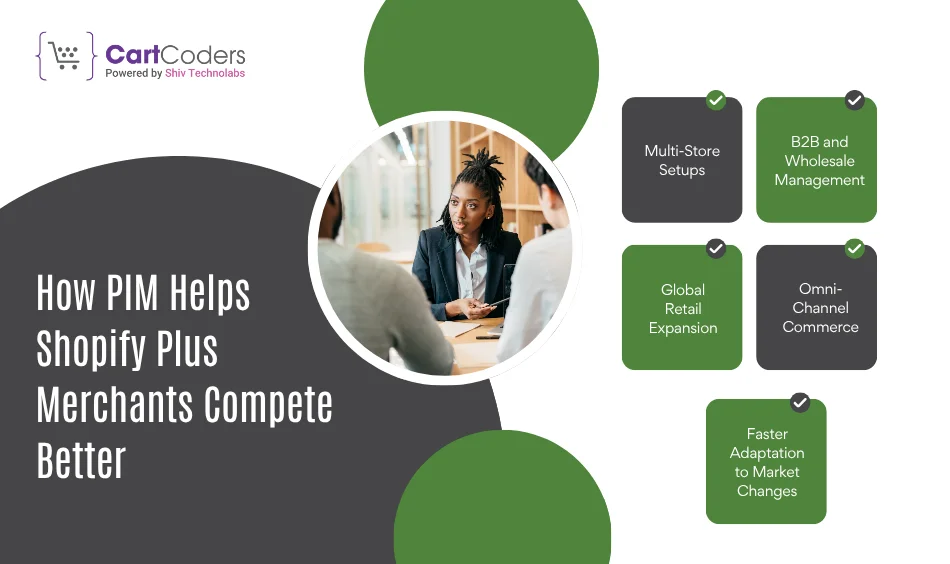
Multi-Store Setups
Stores with many brands or country-specific sites can handle them all through one PIM tool, making sure details stay consistent and correct.
B2B and Wholesale Management
Some companies serve other businesses, not just end customers. PIM solutions handle tricky pricing options, big product lists, and rules for wholesale clients, letting Shopify Plus merchants keep these buyers happy, too.
Global Retail Expansion
Moving into markets like Europe or Asia often requires localizing product data and adapting to new law and culture. PIM helps manage all the different language and pricing needs without extra headaches.
Omni-Channel Commerce
PIM can be used by brands that sell on Shopify Plus, online marketplaces, or in-store to provide the same high-quality and accurate details about items every time.
Faster Adaptation to Market Changes
If demand shifts or trends become hot, PIM tools let stores edit products and push the news everywhere faster than those still working by hand.
Choosing the Best PIM Solutions for Shopify Plus
All PIM products aren’t built the same. Here are the important things to check for:
Scalability for Enterprise Needs
The best PIM solution for Shopify Plus will be able to handle thousands of product listings and changes as the business grows quickly.
Seamless Integrations
The tools are expected to be compatible with other important systems in the business such as the ERP and CRM software, therefore, all business data can collaborate within Shopify Plus.
User-Friendly Interface
The system must be user-friendly by various teams, although they may not be tech specialists. An understandable design will allow anyone to start fast.
SaaS PIM vs. Enterprise-Grade PIM
Stores with average product numbers might find SaaS PIM works well enough. Larger or global operations benefit by picking enterprise-level PIM built for bigger, more complex needs.
Vendor Support and Customization
The best PIM partners offer ways to change the software for specific business goals, and provide technical help that makes setup simple.
Why Work With a Shopify Plus Development Company
Putting a PIM system in place isn’t always easy. Getting specialists involved often makes the process smoother.
Expertise in Shopify Plus Development Services
Professional teams know the way Shopify Plus works, and how to make a PIM system fit in without causing problems or lost sales.
Custom Shopify Plus PIM Integration
All businesses have certain requirements. A good development company adapts the software to fit those needs, not the other way around.
Reduced Implementation Risks
Having pros in charge reduces things going wrong. Stores stay online, and the switch-over happens with minimal trouble.
Ongoing Maintenance and Support
Good partners don’t walk away after launch. They offer continued help, updates, and tweaks to keep everything running well.
Faster ROI
Expert setups mean the investment in PIM pays off sooner, because there’s less wasted time and fewer problems from the start.
Partner With CartCoders for PIM + Shopify Plus Success
For any store on Shopify Plus looking to put in a PIM tool, CartCoders brings experience to the table.
Proven Shopify Plus Development Company
CartCoders has a history of helping large stores use Shopify Plus and PIM side by side, letting those businesses get bigger without slowing down.
Tailored Shopify Plus PIM Integration
Our solutions are shaped to fit the needs of each merchant, so brands get accuracy, can expand to new channels, and never have to worry about data getting lost.
Comprehensive Shopify Plus Development Services
CartCoders handles not just PIM setup, but also design, updates, and everything else related to keeping a Shopify Plus store growing.
Focus on Enterprise Scalability
Big brands planning for more products or international markets get the most gain. CartCoders has the tools and processes for steady, future-ready store builds.
Conclusion
For brands aiming to keep their product information organized in Shopify Plus, using a PIM is a big step forward. The main benefits include a single product data source, faster updates, cross-channel consistency, and the foundation needed for steady growth.
Merchants end up with less risk of mistakes, better store operations, and a setup that works as they add more customers or products over time.
If a business wants the full effect of combining Shopify Plus with a PIM, specialized help is the answer. CartCoders steps up as a guide for rolling out and maintaining the right PIM tool, making global selling and smooth product updates much easier.The path to better Shopify Plus growth and smart product management is clear. Connect with CartCoders today to let their team bring expert solutions to your store.
FAQs
PIM in Shopify Plus means using a system that collects all product data together. It works with Shopify Plus to help manage large sets of product info, so changes go live everywhere fast.
Bringing PIM into Shopify Plus lets any new product or edit show up right away across every shop channel. It keeps data up-to-date and accurate without lots of extra work.
Yes, PIM software is made for selling in lots of places. One update pushes to every Shopify Plus store, other websites, or data system at once.
Top PIM tools for Shopify Plus change by the store’s size and needs. SaaS is better for smaller shops, while enterprise-grade PIM helps big or global brands. Integration with Shopify Plus should be strong.
PIM software makes it easy to show the right language and price for shoppers anywhere. That’s how Shopify Plus stores can launch in new countries without trouble.
PIM is the main place to organize product catalogs, making sure every item number, detail, and category works with Shopify Plus and all shop channels together.
PIM streamlines work, so store owners do not need to hire more people just to keep up with adding new items. It lets Shopify Plus handle more SKUs smoothly.
Yes, expert help is recommended. Collaboration with a Shopify Plus Development Company helps to avoid errors, makes the process quicker, installs PIM according to the business requirements.
Big perks: simple data centralization, easy updates, fewer mistakes, and strong consistency across every shopping channel—the main factors for growing a business online.
Look for easy scaling, good compatibility, and simple tools. Decide on SaaS or enterprise, and check that there’s adequate support for connecting with Shopify Plus.


