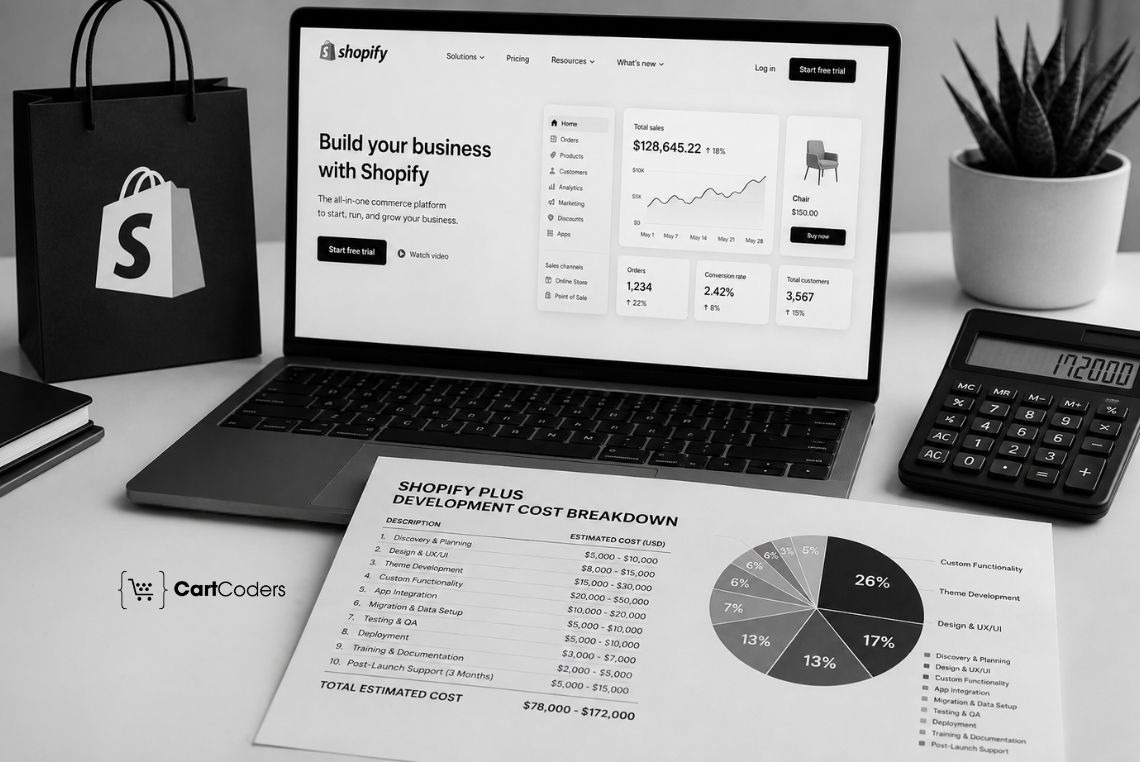

Shopify Plus can be a smart investment, but only when the budget is planned correctly. A well-planned Shopify Plus project helps you control costs without cutting quality. At first glance, Shopify Plus pricing seems simple. A monthly fee of roughly $2,300 gives businesses a number to budget around.
The challenge is that the subscription cost is only one piece of the investment, and unexpected expenses are often what push projects beyond budget. A migration, a custom theme, an ERP integration, and ongoing support each carry their own cost. Together, they often run two to three times the license fee. But with the right planning approach, you can balance costs, prioritize high-impact initiatives, and achieve sustainable growth.
This guide gives you the complete picture of Shopify Plus costs in 2026. It breaks down expenses by project type, helping you build realistic budgets and make informed investment decisions.
Quick answer: Shopify Plus costs about $2,300 per month on a 3-year term or $2,500 per month on a 1-year term in 2026. Once your monthly sales pass roughly $800,000, you switch to a variable fee of 0.35% to 0.40% of revenue, capped at $40,000 per month. The platform fee is only the floor. The real cost runs $5,000 to $25,000+ per month once you add development, apps, and integrations.
How Much Does Shopify Plus Cost in 2026?
Shopify Plus costs around $2,300 to $2,500 per month for the platform license alone in 2026. Your real spend depends on what you build on top of it. The table below shows the full picture at a glance.
| Cost layer | Typical 2026 range | Who charges it |
|---|---|---|
| Platform license | $2,300–$2,500 / month | Shopify |
| Build or migration (one-time) | $5,000–$80,000+ | Your Plus partner |
| Apps and add-ons | $500–$2,000 / month | App vendors |
| Payment processing | ~2.15% + $0.30 per order (US) | Shopify Payments |
| Maintenance and support | $1,000–$10,000 / month | Your Plus partner |
Read this as a map, not a final quote. A brand doing $1 million a year often pays $5,000 to $8,000 per month. A brand at $10 million can reach $15,000 to $25,000 per month. The rest of this guide explains each number so you can budget with confidence.
What is Included in Shopify Plus Development Costs?
Shopify Plus cost splits into three clear layers: the platform license, the implementation, and the running costs. Knowing the three layers stops budget surprises later.
Here is what each layer means in one line.
- Platform license is the monthly fee Shopify charges to use Plus.
- Implementation is the one-time cost to build, migrate, or customize your store.
- Running costs are the ongoing fees for apps, payments, and maintenance.
The license is fixed and easy to predict. Implementation and running costs vary by project, and that is where most of your budget goes. We price the implementation layer by project type later in this guide.
What Does Shopify Charge for Shopify Plus?
Shopify charges a flat platform fee until your revenue crosses a set threshold, then it switches to a percentage of sales. The model rewards longer commitments with a lower rate. You can confirm the latest figures on Shopify directly, since final pricing is quote-based.
Here is how the Shopify Plus monthly cost works in 2026.
| Term | Flat monthly fee | Variable rate above ~$800K GMV |
|---|---|---|
| 3-year term | $2,300 | 0.35% of sales |
| 1-year term | $2,500 | 0.40% of sales |
A few details shape your real license cost. The variable fee caps at $40,000 per month, so very high-volume brands never pay more than that. Shopify Plus requires a 12-month minimum commitment, and each brand needs its own contract. Pricing stays negotiable, so ask about thresholds and renewal terms before you sign.
How Much Does Shopify Plus Cost Based on Project Type?
Shopify Plus development cost depends almost entirely on what you build, not the platform fee. A simple theme setup and a headless replatform sit at opposite ends of the budget. The master table below gives typical 2026 ranges, and each section after it breaks the project into clear tiers.
| Project type | Typical 2026 cost | Typical timeline |
|---|---|---|
| New Shopify Plus store build | $10,000–$80,000+ | 4–16 weeks |
| Migration to Shopify Plus | $5,000–$40,000+ | 3–12 weeks |
| Theme design or redesign | $5,000–$25,000+ | 2–8 weeks |
| Checkout customization | $2,000–$15,000+ | 1–4 weeks |
| B2B and D2C blended setup | $8,000–$40,000+ | 4–10 weeks |
| ERP or CRM integration | $5,000–$40,000+ | 3–12 weeks |
| Custom app development | $5,000–$50,000+ | 4–16 weeks |
| Headless or composable build | $40,000–$150,000+ | 12–24 weeks |
| Ongoing support retainer | $1,000–$10,000 / month | Continuous |
Treat every range as a starting point. Final cost depends on scope, data complexity, and the integrations you need. Each tiered table below shows where your project lands and why.
New Shopify Plus Store Development
A new Shopify Plus store build usually costs $10,000 to $80,000 or more in 2026. Price rises with custom design, advanced features, and the number of integrations. The table below shows the three common tiers.
| Build tier | What’s included | Cost range | Timeline |
|---|---|---|---|
| Standard | Premium theme setup, light customization, core pages | $10,000–$18,000 | 4–6 weeks |
| Custom | Figma-to-store design, custom sections, app setup | $18,000–$35,000 | 6–10 weeks |
| Advanced | Custom logic, subscriptions, multiple integrations | $35,000–$80,000+ | 10–16 weeks |
A brand that needs custom product logic and several app connections pays more than one that wants a polished standard store. Our Shopify Plus development team scopes each build against real requirements before quoting, so you pay for what you use.
Migration to Shopify Plus
A migration to Shopify Plus typically costs $5,000 to $40,000 or more, based on your source platform and data volume. Clean data lowers the price, while messy data raises it. The table below prices migration by source platform and complexity.
| Source platform | Typical complexity | Cost range | Timeline |
|---|---|---|---|
| WooCommerce or Wix | Moderate data, standard features | $5,000–$12,000 | 3–5 weeks |
| Magento or BigCommerce | Large catalog, custom features | $12,000–$25,000 | 5–8 weeks |
| Custom or legacy build | Complex data, full rebuild | $20,000–$40,000+ | 8–12 weeks |
The biggest cost drivers are product count, order history, URL redirects, and custom features you rebuild. We have completed 25+ Shopify Plus migrations with zero data loss, and our Shopify migration services protect your SEO and uptime. A WooCommerce to Shopify migration follows a fixed process that avoids downtime.
Theme Design or Redesign
A Shopify Plus theme design or redesign usually costs $5,000 to $25,000 or more. A refresh sits at the low end, while a full custom storefront sits at the top. The table below shows the cost by design scope.
| Design scope | What’s included | Cost range | Timeline |
|---|---|---|---|
| Theme refresh | Restyle existing theme, brand update | $5,000–$10,000 | 2–4 weeks |
| Custom redesign | New UI/UX, custom sections, mobile-first | $10,000–$18,000 | 4–6 weeks |
| Full custom design | Figma-to-pixel build, full storefront | $18,000–$25,000+ | 6–8 weeks |
Custom design pays back through better conversion and faster pages. A weak theme raises bounce rates and lowers trust, so the spend often returns more than it costs. We convert design files into fast, mobile-first builds that hold up during peak sales events.
Checkout Customization
Shopify Plus checkout customization usually costs $2,000 to $15,000 or more, depending on the logic you need. Simple branding changes sit at the low end, while complex B2B flows cost more. The table below prices checkout work by level.
| Customization level | What’s included | Cost range | Timeline |
|---|---|---|---|
| Basic | Trust badges, custom fields, branding | $2,000–$5,000 | 1–2 weeks |
| Standard | Upsells, custom logic, delivery options | $5,000–$10,000 | 2–3 weeks |
| Advanced | B2B purchase order fields, approval flows, Functions | $10,000–$15,000+ | 3–4 weeks |
Checkout is the highest-value page to customize, and the data shows why. Research from the Baymard Institute puts the average cart abandonment rate at 70.22% in 2026. The same research finds that fixing checkout usability issues can raise conversion by up to 35.26%, with about $260 billion in abandoned revenue recoverable across the US and EU.
Shopify Plus supports checkout UI extensions and Functions for upgrade-safe builds, and our Shopify Plus checkout customization work targets the friction points that drive that abandonment.
B2B and D2C Blended Setup
A B2B and D2C blended setup typically costs $8,000 to $40,000 or more on Shopify Plus. Price depends on custom pricing rules, company accounts, and how many buyer experiences you run. The table below shows the cost by setup scope.
| Setup scope | What’s included | Cost range | Timeline |
|---|---|---|---|
| Core B2B setup | Company accounts, price lists, catalogs | $8,000–$15,000 | 4–6 weeks |
| Blended storefront | Wholesale and D2C from one admin | $15,000–$28,000 | 6–8 weeks |
| Advanced blended | Custom pricing logic, approvals, integrations | $28,000–$40,000+ | 8–10 weeks |
Shopify Plus supports native B2B features like company accounts, custom catalogs, and price lists. Setting them up correctly from day one avoids costly rework. Our Shopify Plus B2B and D2C blended solutions let you manage both models without a second platform.
ERP or CRM Integration
A Shopify Plus ERP or CRM integration usually costs $5,000 to $40,000 or more in 2026. The number depends on the system, the data flow, and the integration method. The table below prices integration by method.
| Integration method | What’s included | Cost range | Timeline |
|---|---|---|---|
| Native or connector | App-based sync, standard fields | $5,000–$12,000 | 3–5 weeks |
| iPaaS middleware | Mapped flows through a platform like Celigo | $12,000–$25,000 | 5–8 weeks |
| Custom integration | Custom API build, real-time two-way sync | $20,000–$40,000+ | 8–12 weeks |
Real-time sync with NetSuite, SAP, Salesforce, or Odoo removes manual data entry and reporting errors. The investment returns time across operations and finance. Our Shopify integration work keeps inventory, orders, and customer data in sync with zero downtime.
Custom App Development
Custom Shopify Plus app development usually costs $5,000 to $50,000 or more, based on the app’s complexity. A simple private app sits at the low end, while a multi-feature app sits at the top. The table below shows the cost by app type.
| App type | What’s included | Cost range | Timeline |
|---|---|---|---|
| Private app | Single workflow, internal use | $5,000–$12,000 | 4–6 weeks |
| Public or custom app | Multi-feature, external connections | $12,000–$30,000 | 6–12 weeks |
| Advanced app | AI features, complex logic, App Store ready | $30,000–$50,000+ | 12–16 weeks |
Custom apps reduce dependency on third-party tools and monthly app fees. They also add features the App Store cannot offer for your exact business. Our Shopify app development team builds private, public, and custom apps that extend your store.
Headless or Composable Build
A headless or composable Shopify Plus build usually costs $40,000 to $150,000 or more. This is the high end of Shopify Plus costs, reserved for brands with strict performance and design needs. The table below shows the cost by build scope.
| Build scope | What’s included | Cost range | Timeline |
|---|---|---|---|
| Entry headless | Storefront API, single-market frontend | $40,000–$70,000 | 12–16 weeks |
| Standard composable | Multi-page frontend, CMS, performance tuning | $70,000–$110,000 | 16–20 weeks |
| Enterprise composable | Multi-market, complex content, and integrations | $110,000–$150,000+ | 20–24 weeks |
Headless pays off for large catalogs, complex content, and multi-market storefronts. It costs more to build and maintain, so it suits brands with clear performance goals. Most mid-market brands reach their targets with a fast, themed build first.
Ongoing Support and Optimization
Ongoing Shopify Plus support and optimization usually costs $1,000 to $10,000 per month. A small retainer covers fixes and updates, while a larger one covers active growth work. The table below shows the cost by retainer level.
| Retainer level | What’s included | Monthly cost | Best for |
|---|---|---|---|
| Basic care | Bug fixes, minor updates, and monitoring | $1,000–$3,000 | Stable stores |
| Growth retainer | CRO, new features, performance work | $3,000–$6,000 | Scaling brands |
| Full optimization | Dedicated team, roadmap execution | $6,000–$10,000+ | High-growth brands |
A store is a living system, so monthly care protects revenue and uptime. Steady optimization often returns more than the retainer through better conversion. We provide post-launch support that keeps your store stable, secure, and ready to scale.
What Running Costs Should You Budget For?
Running costs cover the monthly fees you pay after launch: apps, payment processing, and maintenance. These add up quickly, so plan for them from the start. The table below shows realistic 2026 ranges.
| Running cost | Typical [2026] range | Notes |
|---|---|---|
| Apps and add-ons | $500–$2,000 / month | Scales with your tech stack |
| Payment processing | ~2.15% + $0.30 per order (US) | Lower with Shopify Payments |
| Theme and design updates | Varies | Seasonal refreshes and tests |
| Maintenance and support | $1,000–$10,000 / month | Bug fixes, updates, optimization |
Budget apps against your 12-month roadmap, not just launch day. Many brands add loyalty, search, reviews, and subscription apps over time. Custom development can replace some recurring app fees and lower this layer over the long run.
What are Common Factors Affecting Shopify Plus Costs?
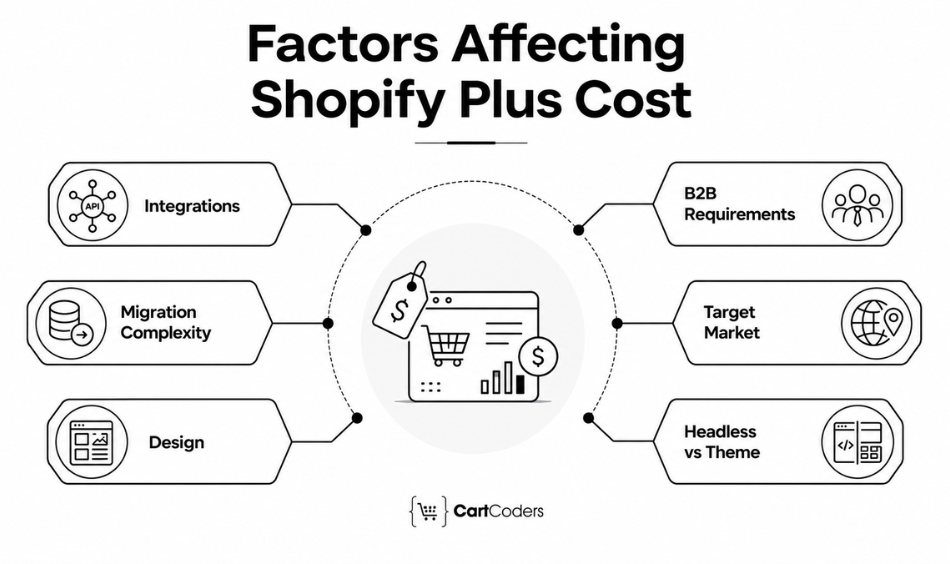
No two Shopify Plus projects cost the same. The final investment depends on the complexity of your store, the systems you need to connect, and the level of customization required. Understanding these factors helps you build a realistic budget and avoid unexpected costs later.
Number of Integrations
Integrations are often one of the biggest cost drivers in Shopify Plus projects. Connecting ERP systems, CRMs, warehouse platforms, accounting software, and marketing tools requires planning, development, and testing. The more systems involved, the more time is needed to ensure data flows correctly between platforms.
Data Complexity in Migration
Migrating a few hundred products is very different from migrating thousands of products with variants, customer records, order history, reviews, and custom fields. Stores with inconsistent or outdated data often require additional cleanup and validation, which increases project effort and cost.
Custom vs Template-Based Design
Using an existing Shopify theme with moderate customization is usually more affordable than creating a completely custom storefront. Custom designs involve UX planning, visual design, frontend development, and additional testing to ensure a consistent experience across devices.
B2B Requirements
B2B commerce introduces additional complexity beyond a standard online store. Features such as company accounts, custom pricing, wholesale catalogs, approval workflows, and payment terms require additional configuration and development, which increases the overall project scope.
Number of Markets
Selling in multiple countries requires more than currency conversion. Businesses often need language localization, region-specific pricing, tax configurations, shipping rules, and market-specific content. Each additional market adds implementation and testing requirements.
Headless vs Theme-Based Architecture
Theme-based Shopify Plus stores are generally faster and more cost-effective to launch. Headless commerce projects involve separate frontend development, API architecture, and ongoing maintenance. While headless offers greater flexibility, it typically represents the highest investment level among Shopify Plus implementations.
Shopify Plus Cost vs Shopify Advanced: Is the Jump Worth It?
Shopify Plus costs roughly ten times the Advanced plan, so the jump pays off only at scale. Advanced runs about $399 per month, while Plus starts at $2,300. The difference buys checkout control, higher API limits, native B2B, and dedicated support.
| Factor | Shopify Advanced | Shopify Plus |
|---|---|---|
| Monthly fee | ~$399 | $2,300–$2,500 |
| Checkout customization | Limited | Full control with Functions |
| API limits | Standard | Up to 10x higher |
| B2B features | App-based | Native |
| Staff accounts | 15 | Unlimited |
| Best fit | Growing stores | High-growth and enterprise |
The jump makes financial sense when checkout control, automation, or B2B features drive enough revenue to cover the cost. Shopify reports the highest checkout conversion rate and lowest total cost of ownership among major platforms, a position backed by a Forrester Total Economic Impact study it commissioned. Brands past roughly $1 million in annual revenue often reach the point where those gains cover the cost. Below that, Advanced usually delivers better value.
How Should You Budget for a Shopify Plus Project?
Budget for all three cost layers, not just the license, and plan against a 12-month roadmap. A clear budget prevents mid-project surprises. Use these sample all-in monthly ranges as a starting point.
- Scaling brand (~$1M revenue): $5,000–$8,000 per month all in
- Mid-market brand (~$10M revenue): $15,000–$25,000 per month all in
- High-volume brand: higher, with variable platform fees up to the $40,000 cap
Before you request a quote, confirm a few things to speed up scoping.
- What project type do you need: build, migration, or customization?
- Which systems need integration, such as ERP or CRM?
- How clean and complete is your product and order data?
- Do you need B2B, multi-market, or headless features?
- What is your target launch date and budget range?
How CartCoders Scopes Shopify Plus Projects
CartCoders scopes every Shopify Plus project against your real requirements before quoting, so you get a clear number, not a guess. We work as a Shopify Plus partner with 7+ years of experience and 250+ projects delivered. Our focus stays on conversion, performance, and scalable architecture.
Here is what you get when you work with us.
- Transparent scoping that ties cost to exact deliverables and milestones.
- Fixed-scope quotes with no surprise charges above the agreed number.
- Conversion-focused builds designed to turn traffic into revenue.
- Secure integrations with ERP, CRM, and payment systems.
- Post-launch support that keeps your store stable and growing.
The result is a Shopify Plus store built as a business system, not just a storefront. You spend on the work that moves revenue, and you see the roadmap before you commit.
Conclusion: What Will Shopify Plus Really Cost You in [2026]?
Shopify Plus costs about $2,300 to $2,500 per month for the license, but your real spend depends on what you build. Implementation by project type drives most of your budget, from a $5,000 migration to a $150,000 headless build. Running costs for apps, payments, and maintenance add a steady monthly layer.
Budget for all three layers, scope by project type, and ask for a fixed quote before you start. Get a free Shopify Plus cost estimate and project scope from our Plus partner team to plan your build with real numbers.
FAQs
Shopify Plus costs about $2,300 per month on a 3-year term or $2,500 per month on a 1-year term in 2026. Above roughly $800,000 in monthly sales, you pay a variable fee of 0.35% to 0.40% of revenue, capped at $40,000 per month.
A Shopify Plus store build typically costs $10,000 to $80,000 or more in 2026. A standard build starts near $10,000, a custom build runs $18,000 to $35,000, and an advanced build with custom logic and integrations reaches $35,000 or more.
A Shopify Plus migration usually costs $5,000 to $40,000 or more. A WooCommerce or Wix move starts near $5,000, a Magento or BigCommerce move runs $12,000 to $25,000, and a complex custom rebuild reaches $20,000 or more based on data volume.
Shopify Plus switches from the flat fee to a variable fee once your monthly sales pass roughly $800,000 in GMV. You then pay 0.35% of sales on a 3-year term or 0.40% on a 1-year term. The variable platform fee caps at $40,000 per month.
Shopify Plus costs about ten times the Advanced plan, so it pays off at scale. The jump makes sense when checkout control, automation, or native B2B features drive enough revenue to cover the difference. Brands past roughly $1 million in annual revenue often reach that point.
Total cost of ownership covers the license, the build or migration, and running costs. A brand at $1 million in revenue often pays $5,000 to $8,000 per month. A brand at $10 million can reach $15,000 to $25,000 per month once apps and development are included.
Shopify Plus pricing covers the platform license only, not development. Building, migrating, or customizing your store is a separate cost paid to your Plus partner. That implementation work usually drives most of your budget, which is why scoping by project type matters before you commit.
Yes, Shopify Plus pricing is quote-based and negotiable. You can push for higher revenue thresholds, ask about app discounts, and clarify onboarding support before signing. Existing merchants hold the most leverage at renewal, so negotiate before a contract auto-renews to secure better terms.


