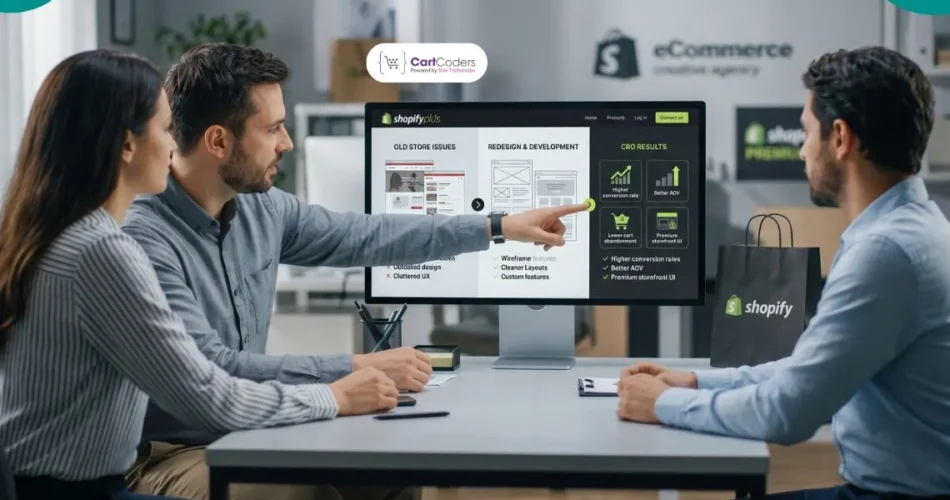

Store traffic is increasing. Marketing budgets are burning. Yet conversions remain stubbornly flat at 2%. Sound familiar? The harsh reality is that most Shopify Plus stores leave 60-70% of potential revenue on the table due to outdated design, poor mobile experience, and checkout friction.
A Shopify Plus store redesign isn’t just a visual refresh. It’s a strategic overhaul that transforms underperforming stores into conversion machines. When done right, a conversion-focused development approach can lift conversion rates by 20-40%, reduce cart abandonment by 35%, and future-proof the enterprise eCommerce platform for sustainable growth.
This comprehensive guide walks through everything enterprise brands need to know about Shopify Plus redesign services. From identifying the right timing and choosing development partners to understanding pricing structures and implementing CRO strategies that drive measurable results.
7 Critical Signs That Indicate You Need a Shopify Plus Redesign
Not every performance dip requires a complete redesign. However, certain patterns state that the store foundation is holding growth back rather than supporting it.
1. Declining Conversion Rates Despite Stable Traffic
When marketing campaigns deliver visitors, but sales remain flat, the problem often lies in user experience rather than audience quality. Industry benchmarks place average eCommerce conversion rates between 2-3%. Stores falling below this threshold, or experiencing downward trends, typically suffer from outdated design patterns that fail to guide visitors toward purchase.
Identifying conversion bottlenecks requires analyzing heat maps, session recordings, and funnel drop-off points. Common issues include unclear value propositions, weak calls-to-action, confusing navigation, and checkout friction. Professional Shopify conversion rate optimization services can diagnose these issues and implement data-driven solutions.
2. Slow Page Load Times
Google’s Core Web Vitals have made speed a ranking factor, not just a nice-to-have feature. Pages loading in under 2 seconds convert significantly better than those taking 3+ seconds. Mobile users are especially intolerant of delays. 40% abandon sites that take longer than 3 seconds to load.
Speed benchmarks for Shopify Plus stores should target:
- Largest Contentful Paint (LCP): under 2.5 seconds
- First Input Delay (FID): under 100 milliseconds
- Cumulative Layout Shift (CLS): under 0.1
Slow performance often stems from bloated themes, unoptimized images, excessive app scripts, or outdated code structure. Implementing proper performance optimization techniques can dramatically improve these metrics.
3. Poor Mobile Experience
Mobile commerce now accounts for 70% of eCommerce traffic. Stores designed with desktop-first thinking fail to serve this dominant user segment. Responsive design is baseline. Mobile-first design is the standard.
Warning signs include small tap targets, horizontal scrolling, illegible text, slow mobile load times, and difficult mobile checkout flows. Enterprise brands losing mobile conversions are missing sales from 70% of their customers.

4. Outdated Brand Identity
Visual trends evolve. Brands that looked modern three years ago can appear outdated today. Outdated design signals to customers that the business might be behind on product quality, customer service, or security practices.
Competitive analysis matters here. When competitors upgrade their designs, outdated stores lose customers by comparison. Modern Shopify Plus redesigns incorporate current design trends while maintaining brand recognition.
5. High Cart Abandonment Rates
The average cart abandonment rate is around 69%, according to the Baymard Institute’s comprehensive cart abandonment research. While some abandonment is inevitable, rates consistently above 70% indicate structural problems. Common causes include unexpected shipping costs, complicated checkout processes, limited payment options, security concerns, or forced account creation.
Common causes include unexpected shipping costs, complicated checkout processes, limited payment options, security concerns, or forced account creation.
Shopify Plus offers exclusive checkout customization capabilities that address many abandonment triggers. Redesigns should leverage these features to reduce cart abandonment through streamlined flows and progressive disclosure.
6. Difficulty in Managing Content
As businesses scale, content management becomes critical. Stores built on restrictive themes or outdated architectures make simple updates painful. Marketing teams need developers to change banners, launch promotions, or update product collections.
Shopify Plus team redesigns and implements flexible content architectures using sections and blocks, enabling non-technical teams to manage day-to-day operations independently.
7. Security and Compliance Issues
Data breaches affect 81% of consumer trust permanently. Enterprise stores handling high-value transactions and large customer databases must maintain robust security standards. Customers who experience or learn about a breach typically won’t return.
Compliance requirements vary by region and industry. Stores selling to EU customers need GDPR compliance. Payment processing requires PCI DSS standards. Outdated platforms often lack the infrastructure to meet evolving security and regulatory requirements.
Understanding Shopify Plus Redesign Services

Professional redesign services extend far beyond aesthetic updates. Enterprise-level projects require strategic planning, technical expertise, and conversion optimization focus.
Full Redesign vs. Refresh: What’s the Difference
Understanding the scope distinction helps set appropriate expectations and budgets.
A full redesign restructures the site’s foundation. It involves changing user experience elements, overhauling information architecture, rebuilding from new themes or custom code, implementing new features and functionality, and migrating to updated platforms. Full redesigns typically take 8-16 weeks and cost $24,000-$72,000 for standard Shopify Plus implementations.
A refresh keeps existing structures while updating visual elements. It addresses typography, color schemes, and layouts without changing core navigation or functionality. Refreshes work well for stores with solid foundations needing contemporary aesthetics. Timeline runs 4-8 weeks with costs ranging $7,000-$25,000.
The decision between approaches depends on how deeply structural issues run. Stores with high bounce rates, poor mobile conversion, or difficult content management typically need full redesigns. Those with solid architecture but dated appearance benefit from refreshes.
How to Build a Store That Actually Converts
Conversion rate optimization isn’t something to add later. It’s what separates stores that grow from stores that struggle. Every design choice should help turn visitors into paying customers.
Homepage Optimization
First impressions happen in milliseconds. The homepage must instantly answer “why buy here” and guide visitors toward products.
Clear value propositions, strategic calls-to-action, and trust signals (certifications, customer counts, security badges) build immediate credibility. Reviews and testimonials validate the decision to stay and explore.
Product Page Enhancement
Product pages are where browsers become buyers. High-quality images from multiple angles, zoom functionality, and lifestyle shots build confidence. Persuasive copy focuses on benefits over features. Rating summaries, detailed reviews, and customer photos reduce purchase hesitation. Size guides and specifications eliminate uncertainty.
Checkout Optimization
Shopify Plus checkout customization can reduce cart abandonment by 20-35%. Custom fields, trust badges, and branded experiences create seamless flows. Guest checkout removes barriers. Multiple payment methods (Apple Pay, Google Pay, Shop Pay, buy now pay later) meet diverse preferences. Progress indicators show customers exactly how close they are to completing purchase.
Navigation & Site Architecture
Mega menus organize large catalogs without overwhelming visitors. Faceted search enables filtering by size, color, price, or brand. Smart filtering remembers preferences and suggests relevant products. Clear hierarchies help customers move from broad categories to specific products efficiently.
Mobile Conversion Tactics
Mobile shoppers need thumb-friendly design with interactive elements within easy reach. Simplified forms use autofill and address lookup. Mobile payment options enable one-tap checkout. Sticky add-to-cart buttons stay visible as users scroll.
Advanced Features for Shopify Plus Redesigns
Shopify Plus offers exclusive capabilities that standard Shopify plans lack. Enterprise redesigns should leverage these features fully.
Scripts for Custom Discounts and Logic
Scripts enable complex discount rules, custom pricing logic, and dynamic shipping calculations impossible on standard Shopify. Common applications include tiered volume discounts, BOGO offers with complex rules, custom payment method filtering based on cart value or customer tags, and dynamic shipping rates based on custom logic.
Flow Automation
Flow automates repetitive tasks and complex workflows without coding. Use cases include inventory management automation, customer tagging based on purchase behavior, fraud detection and order flagging, fulfillment routing, and loyalty program management.
Launchpad for Scheduled Events
Launchpad schedules product launches, theme changes, and promotional campaigns to activate automatically at specified times. This eliminates manual work during crucial launch windows and ensures perfect timing for sales events.
Wholesale Channel
The dedicated wholesale channel provides separate storefront for B2B buyers with custom pricing, minimum order quantities, and simplified bulk ordering interfaces.
Custom Checkout Experiences
Checkout customization is perhaps the most valuable Plus feature. Custom fields capture additional information, upsells present relevant offers at high-intent moments, trust badges reinforce security, and branding creates cohesive end-to-end experiences.
Expansion Stores (International)
Expansion stores enable launching separate storefronts for different countries or brands, all managed from a single admin panel with centralized inventory management.
Must-Have Integrations
Enterprise stores rarely operate in isolation. Integrations connect Shopify Plus to broader business systems.
ERP Systems
NetSuite, SAP, Microsoft Dynamics, and Oracle integrations synchronize inventory, orders, customers, and financial data between Shopify and enterprise resource planning systems.
CRM Platforms
Salesforce, HubSpot, and Microsoft Dynamics CRM integrations enable unified customer views, combining purchase history with marketing interactions and support tickets.
Email Marketing
Klaviyo, Drip, and Mailchimp integrations power personalized email campaigns based on browsing behavior, purchase history, and customer segments.
Fulfillment Services
ShipBob, ShipStation, and 3PL integrations automate order routing to warehouses, print shipping labels, update tracking information, and manage returns.
Analytics Platforms
Google Analytics 4, Heap, and Mixpanel integrations provide deeper insights into customer behavior, funnel performance, and cohort analysis beyond Shopify’s native reporting.
Essential CRO Features for Shopify Plus
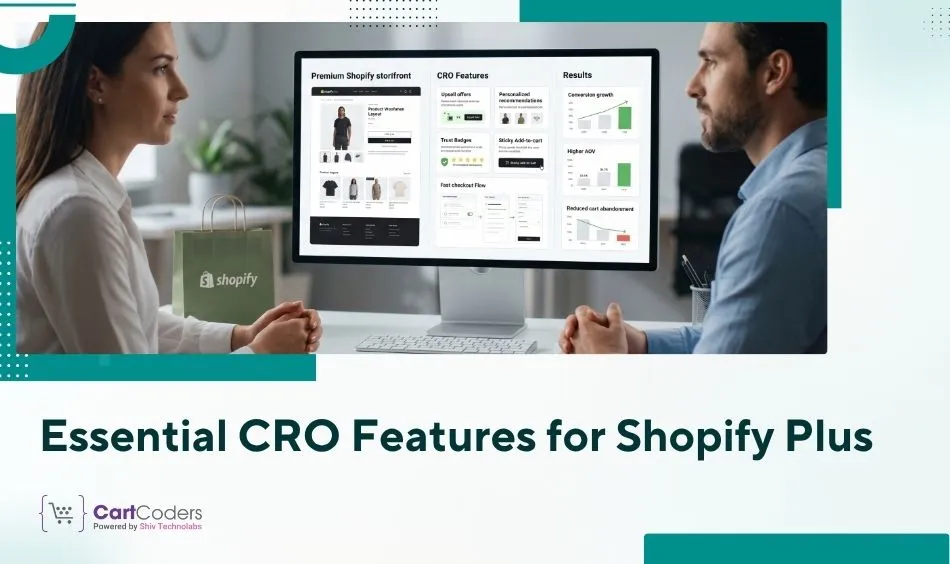
Personalization Engines
Showing different content to different customer segments boosts relevance and conversions. Product recommendations based on browsing history increase average order value. Dynamic content blocks display different messaging to new vs. returning customers. Geo-targeting customizes content, currency, and shipping by location.
A/B Testing Tools
Data-driven optimization requires testing what actually works. Compare headlines, layouts, images, calls-to-action, and checkout flows. Run tests long enough to achieve statistical significance and avoid testing multiple changes simultaneously.
Cart Recovery Automation
Abandoned carts are revenue waiting to be recovered. Automated emails remind customers about items left behind. Effective messages send within 1-2 hours, include direct cart links, and may offer time-limited discounts.
Upsell and Cross-Sell Mechanisms
Strategic product suggestions increase transaction value. Post-purchase upsells offer complementary items after checkout. Product page cross-sells suggest frequently purchased combinations. Cart recommendations show what other customers bought together.
Live Chat Integration
Real-time support reduces purchase hesitation. Position chat on product pages and checkout to capture customers at decision moments. AI chatbots handle common questions 24/7, escalating complex issues to human agents.
Choosing the Right Shopify Plus Development Company
The development partner dramatically impacts project success. Enterprise redesigns require expertise beyond basic web development.
Certifications & Experience
Look for verified Shopify Plus Partner status, not just general partner credentials. ISO certifications indicate quality commitment. Request portfolios with measurable results from similar projects.
Industry Expertise
eCommerce needs vary by industry. Fashion brands need lookbooks and size guides. B2B clients require custom pricing and wholesale portals. DTC brands need subscription and retention features. Choose agencies with relevant industry experience.
Technical Capabilities
Complex projects need specific skills. Custom development in Liquid, JavaScript, and API integration separates capable agencies from basic implementers. ERP and CRM integration experience ensures seamless data flow. Headless commerce expertise supports advanced architectures.
CRO Track Record
Effective agencies focus on conversion metrics, not just aesthetics. Review case studies showing before and after conversion rates, AOV improvements, and cart abandonment reductions. Client testimonials mentioning revenue impact validate claims.
Post-Launch Support
Launch isn’t the end. Maintenance packages cover bug fixes, security updates, and platform upgrades. Ongoing optimization through testing delivers compounding returns. Training enables internal teams to manage daily operations independently.
Talk To Experts About Shopify Plus Store Development
Discuss growth goals, architecture, and custom needs.


Complete Breakdown of Shopify Plus Redesign Costs in 2026
Budget planning requires understanding both platform fees and development investment. Shopify Plus projects involve multiple cost layers that add up quickly.
1. Platform Fees
Shopify Plus subscriptions start at $2,300/month (3-year contract) or $2,500/month (1-year term). High-volume stores pay 0.25-0.40% of GMV once monthly sales exceed ~$800,000.
| Fee Type | Cost | Notes |
| Base Platform Fee (3-year) | $2,300/month | Standard enterprise pricing |
| Base Platform Fee (1-year) | $2,500/month | Shorter commitment option |
| Variable Fee (High-Volume) | 0.25-0.40% of GMV | Applies above $800k monthly sales |
| Shopify Payments Processing | 2.15% + $0.30/transaction | No additional transaction fees |
| External Gateway Fee | +0.20% per transaction | Added to gateway’s own fees |
Transaction fees: Shopify Payments eliminates transaction fees but includes card processing rates. External gateways incur additional 0.20% fees on top of their processing rates.
2. Development & Design Investment
Project costs vary based on scope, complexity, and customization requirements. Choose the approach that matches business needs and budget.
| Project Type | Cost Range | Timeline | Best For |
| Theme-Based Redesign | $7,000 – $25,000 | 4-8 weeks | Quick launches, simpler needs, limited customization |
| Custom Theme Build | $24,000 – $72,000 | 8-16 weeks | Complex catalogs, unique requirements, brand differentiation |
| Enterprise Custom Build | $75,000 – $200,000+ | 4-9 months | Highly complex B2B, proprietary features, heavy integrations |
Theme-based redesigns: Start with premium Shopify themes and customize to match brand requirements. Delivers professional results quickly and cost-effectively.
Custom theme builds: Complete design freedom and optimized performance. Bespoke themes matching exact specifications for distinctive brand requirements.
Enterprise custom builds: Extensive API integrations, custom B2B functionality, advanced automation, and often headless architectures for maximum flexibility.
3. Additional Costs to Budget
Beyond platform and development fees, factor in these essential expenses that impact total cost of ownership.
| Cost Category | Price Range | Frequency |
| Apps & Integrations | $500 – $2,000/month | Monthly |
| Premium Themes | $180 – $350 | One-time |
| Content Migration | $2,000 – $10,000 | One-time |
| SEO Optimization | $3,000 – $15,000 | One-time |
| Photography & Content | $5,000 – $25,000 | One-time |
Apps & integrations: Email marketing (Klaviyo), reviews (Yotpo), subscriptions (Recharge), loyalty (Smile.io), and search (Algolia). Essential tools for functionality.
Content migration: Product descriptions, images, category structures, and metadata transfer for large catalogs. Critical for maintaining product information accuracy.
SEO optimization: Redirect mapping, metadata migration, schema markup implementation, and monitoring. Protects hard-won search rankings during redesign.
Photography & content: Professional product shots, lifestyle images, videos, and written content. Presents refreshed brand identity effectively.
4. Ongoing Costs
Post-launch expenses ensure continued operation, optimization, and growth.
| Cost Category | Price Range | What’s Included |
| Development Retainer | $2,000 – $10,000/month | Bug fixes, features, optimization, support |
| CRO Testing & Optimization | $1,500 – $5,000/month | A/B testing, analytics, conversion improvements |
| App Subscriptions | $500 – $2,000/month | Ongoing tool costs as store scales |
| Maintenance & Updates | $500 – $3,000/month | Platform updates, security, performance monitoring |
Development retainer: Covers bug fixes, feature additions, optimization work, and technical support. Ensures issues get resolved quickly without project delays.
CRO testing: Conversion optimization is continuous, not one-time. Testing platforms and specialist time deliver compounding returns through data-driven improvements.
Maintenance & updates: Platform updates, security patches, compatibility testing, and performance monitoring. Keeps store current, secure, and running smoothly.
The Shopify Plus Redesign Process
Successful enterprise redesigns follow structured processes that minimize risk and maximize results.
Phase 1: Discovery (2-4 weeks)
Discovery establishes project foundation through stakeholder interviews, analytics review, competitive analysis, user research, and technical audits. This phase identifies what works, what doesn’t, and opportunities for improvement.
Phase 2: Strategy & Planning (2-3 weeks)
Strategic planning translates insights into actionable roadmaps. Information architecture defines site structure and navigation. Wireframing creates layouts without visual distraction. Feature specifications document exact functionality. Project roadmaps establish timelines, milestones, and dependencies.
Phase 3: Design (4-6 weeks)
Visual design brings strategy to life through high-fidelity mockups for homepage, product pages, cart, and checkout. Design systems establish reusable components, color palettes, and typography. Responsive layouts demonstrate adaptation across desktop, tablet, and mobile devices.
Phase 4: Development (6-12 weeks)
Development builds functional stores using Liquid, HTML, CSS, and JavaScript. Custom functionality extends standard Shopify capabilities. Third-party integrations connect ERP, CRM, fulfillment, and analytics platforms. Data migration transfers products, customers, and orders safely.
Phase 5: Testing (2-3 weeks)
QA testing verifies functionality across browsers and devices. Performance testing measures load times and identifies bottlenecks. User acceptance testing catches usability issues before launch.
Phase 6: Launch & Optimization (Ongoing)
Staged rollout introduces changes gradually, minimizing customer impact. Post-launch monitoring tracks metrics in real-time. A/B testing and continuous improvements ensure the store keeps getting better.
SEO & Performance Optimization
Redesigns risk losing hard-won search rankings if SEO isn’t prioritized throughout the project.
301 Redirects Strategy
Every URL that changes requires a redirect mapping old URLs to new destinations.
Create redirect maps before launch listing every current URL and its new destination. Implement 301 redirects, not 302 temporary redirects, to transfer SEO value. Test thoroughly using crawling tools like Screaming Frog to identify any broken links post-launch.
URL Structure Preservation
When possible, keep URLs unchanged to avoid redirects altogether. If changes are necessary, maintain logical structure that search engines and users can understand.
Metadata Migration
Title tags, meta descriptions, header tags, and image alt text require careful migration and optimization. Review and improve metadata during redesign rather than blindly transferring old content.
Schema Markup Implementation
Structured data helps search engines understand content better and can earn rich snippets in search results. Common schema types for eCommerce include Product, Offer, Review, BreadcrumbList, and Organization.
Site Speed Optimization
Page speed is a ranking factor, especially for mobile search. Fast sites also convert better, making speed optimization important.
Technical SEO Checklist
Mobile-First Indexing
Google predominantly uses mobile versions of content for indexing and ranking. Ensure mobile versions contain all important content, structured data, and metadata.
Core Web Vitals
Optimize for Google’s Core Web Vitals measuring loading performance (LCP), interactivity (FID), and visual stability (CLS).
Structured Data
Implement appropriate schema markup for products, reviews, breadcrumbs, and organizational information.
XML Sitemap
Generate and submit updated sitemaps to Google Search Console and Bing Webmaster Tools post-launch.
Image Optimization
Compress images without quality loss, use next-gen formats like WebP, implement lazy loading for below-fold images, and ensure all images have descriptive alt text.
Future-Proofing Your Shopify Plus Store
Technology and consumer expectations evolve constantly. Smart redesigns anticipate future needs rather than just addressing current problems.
AI Personalization
Artificial intelligence enables hyper-personalized experiences at scale. AI-powered product recommendations, dynamic content, predictive search, and chatbots are becoming baseline expectations rather than competitive advantages.
Voice Commerce
Smart speakers and voice assistants change how customers discover and purchase products. Voice-optimized product information and purchase flows will grow in importance.
Sustainability Features
Consumers increasingly factor environmental impact into purchase decisions. Carbon footprint calculators, sustainability certifications, packaging information, and offset programs differentiate conscious brands.
Web3 and NFT Integration
While still emerging, blockchain technology, cryptocurrency payments, NFT loyalty programs, and digital collectibles represent potential future channels.
Social Commerce Expansion
Social platforms are becoming shopping destinations. Instagram Shopping, TikTok Shop, and Pinterest Catalogs require seamless product synchronization and expanded channel presence.
Augmented Reality
AR try-on, product visualization, and virtual showrooms help customers make confident purchase decisions, particularly for fashion, beauty, and home goods.
Transform Your Shopify Plus Store Into a Conversion Machine
Enterprise eCommerce success requires more than great products and marketing. The store itself must be a finely-tuned conversion engine guiding visitors seamlessly from discovery to purchase.
Strategic Shopify Plus redesigns combine conversion-focused development, technical excellence, and industry expertise to deliver measurable business results. Whether addressing declining conversions, slow performance, or preparing for next growth stage, the right redesign partner makes the difference between wasted investment and transformative returns.
CartCoders specializes in conversion-driven Shopify Plus development for enterprise brands ready to maximize their eCommerce potential. As an ISO-certified company and official Shopify Partner with 7+ years of experience and 250+ successful projects, the team brings proven expertise across industries from fashion and beauty to B2B and beyond. The approach combines technical mastery with strategic CRO thinking, delivering stores that don’t just look exceptional but drive measurable revenue growth. Certified Shopify experts follow streamlined development processes ensuring on-time, on-budget delivery while maintaining the flexibility to adapt as project needs evolve.
Frequently Asked Questions
Timeline depends on project scope. Simple theme-based redesigns complete in 4-8 weeks. Custom theme builds require 8-16 weeks. Complex enterprise projects with extensive integrations and custom features take 4-9 months. Factors affecting timeline include design complexity, required integrations, data migration volume, custom feature development, and stakeholder approval processes.
Costs range from $7,000 for basic theme refreshes to $200,000+ for enterprise custom builds. Most mid-market brands invest $24,000-$72,000 for comprehensive custom theme redesigns. Ongoing costs including platform fees, apps, and maintenance add $3,000-$10,000+ monthly depending on store complexity.
Properly managed redesigns maintain or improve SEO performance. Critical elements include comprehensive 301 redirect mapping, metadata migration and optimization, URL structure preservation when possible, structured data implementation, and post-launch monitoring and fixes. Working with agencies experienced in Shopify SEO services ensures rankings are protected.
Yes. Development occurs in staging environments separate from live stores. Staged deployment strategies test new designs with small traffic percentages before full rollout. Preview themes let stakeholders review work without affecting customers. When launched properly, customers experience seamless transition with zero downtime.
Shopify Plus offers exclusive features critical for enterprise stores including checkout customization, Scripts for custom discounts and logic, Flow automation, Launchpad for scheduled events, dedicated wholesale channel, API rate limits 10x higher than standard plans, and expansion stores for international markets. Plus also provides dedicated account management and priority support.
Track key performance indicators before and after launch including conversion rate, average order value, customer lifetime value, cart abandonment rate, bounce rate, page speed scores, organic traffic, and revenue per visitor. Establish baseline metrics during discovery phase and monitor continuously post-launch.
Consider Shopify Plus when current platform limits growth through poor performance under traffic, lack of customization options, expensive maintenance and development costs, poor mobile experience, or integration limitations. Platforms like Magento, WooCommerce, and BigCommerce often become bottlenecks as businesses scale.
Core app categories include email marketing (Klaviyo, Mailchimp), reviews management (Yotpo, Judge.me), SEO optimization (Plug in SEO, SEO Manager), analytics (Google Analytics, Hotjar), and customer support (Gorgias, Zendesk). Specific needs vary by industry and business model. Avoid app bloat by selecting only essential tools.
Ready to transform an underperforming Shopify Plus store into a revenue-generating powerhouse? Contact CartCoders to discuss specific redesign needs and discover how conversion-focused development can accelerate eCommerce growth.


